


 4020
4020 2
2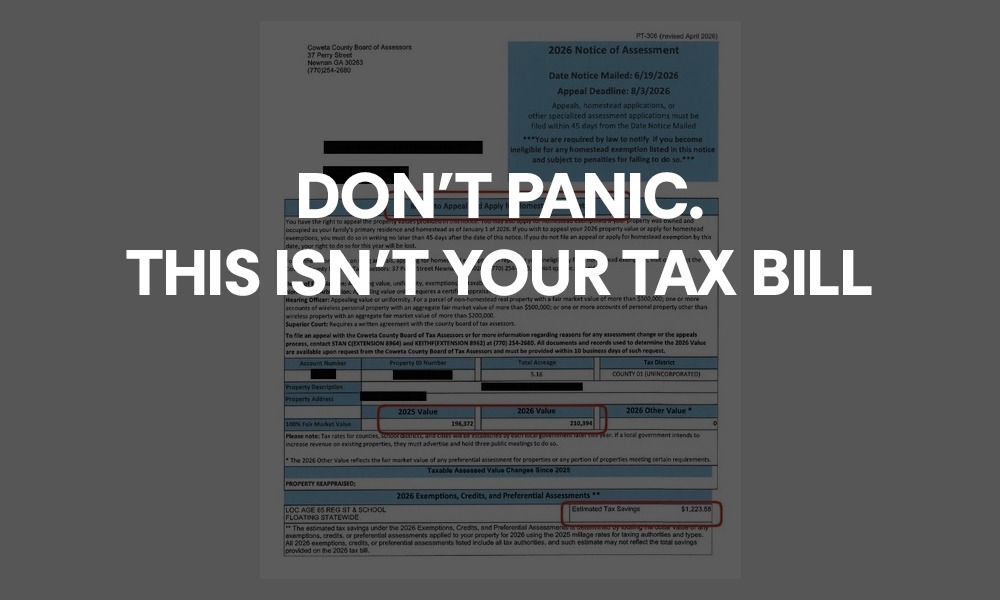
If a property assessment notice arriving in your mailbox has you wondering whether your property taxes are about to skyrocket, county officials in both Coweta and Fayette say: don’t panic. The document now arriving in mailboxes across Georgia is not a tax bill, and several recent changes in state law have made the new forms more confusing than in years past.
“It’s not a tax assessment,” Coweta County Communications Manager Cathy Wickey said. “It’s an assessment on value, so it has nothing to do with taxes this time.”
For homeowners in both Fayette and Coweta counties, here’s what you actually need to know.
First: This is not your tax bill
The notice simply tells you what your county believes your property is worth at fair market value. Your actual property tax bill won’t be mailed until October, after local governments complete their budget processes and set millage rates.
The confusion stems from changes passed by the Georgia General Assembly over the past two years. House Bill 581, known as the “Save Our Homes Act,” created a statewide floating homestead exemption designed to protect homeowners from sharp increases in taxable property values. Voters approved the constitutional amendment in late 2024, and it took effect for the 2025 tax year.
Fayette County Manager Steve Rapson said one distinction is critical.
“The legislation doesn’t limit the increase in the value of the property,” Rapson explained. “It provides for a floating homestead that effectively limits the taxable value. State law still says we have to value property at fair market value.”
In other words, your home’s market value can still rise based on what comparable homes are selling for. The protection applies to the value used to calculate property taxes for homeowners who qualify for the statewide homestead exemption.
One more reason not to panic
The new law also limits how much of your home’s increased value can be used to calculate your property taxes each year.
For 2026, the state has set that increase at 2.7%, based on the Consumer Price Index, a measure of inflation. That means homeowners with a qualifying homestead exemption shouldn’t see the kind of dramatic jumps in the value used to calculate their property taxes that frustrated many property owners in past years.
“There is a cap,” Fouts explained. “They’re saying your property will not go up more than 2.7%.”
In other words, your home may continue to increase in value, but the new law is designed to prevent homeowners from seeing huge year-to-year increases that immediately translate into higher property taxes.
What homeowners should check
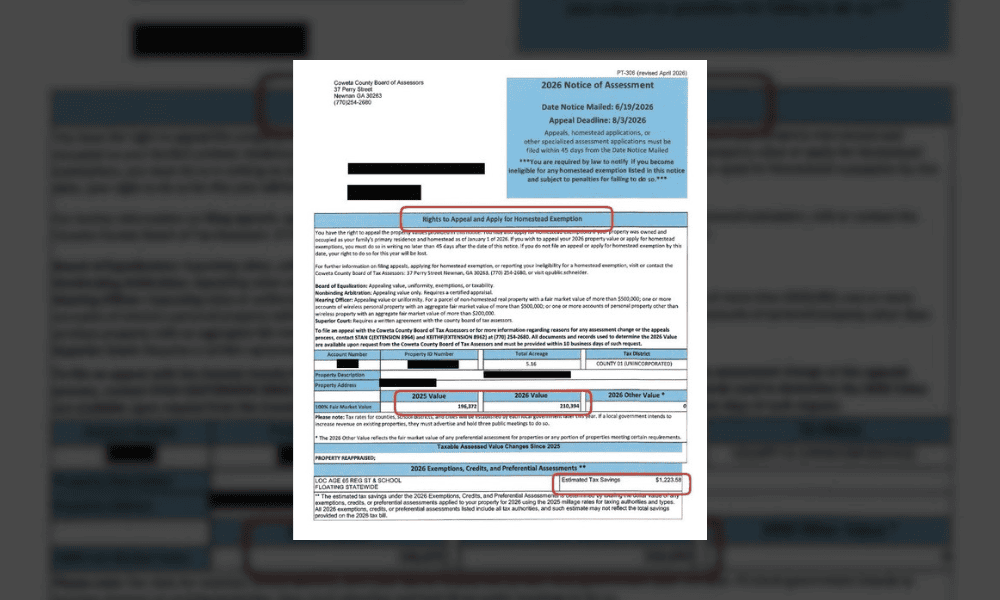
Rather than focusing on what you might owe in October, officials say homeowners should carefully review four items on the notice.
First, verify that the county’s assessment appears reasonable.
Second, make sure any exemptions you qualify for are listed. Homeowners with a primary residence should see the statewide floating homestead exemption, while eligible seniors may see additional exemptions.
Third, if you believe your home’s value is incorrect, remember that you are appealing only the property’s assessed value—not your future tax bill.
Finally, pay attention to the appeal deadline. In Coweta County, property owners have 45 days from the mailing date to appeal the value or apply for homestead exemptions they may have missed. This year’s Coweta deadline is August 3.
Fayette County gets a few more days for appeals. The Fayette County appeals deadline is August 7.
If you have questions in Fayette or Coweta, contact the County Tax Assessors Office at the information located on your form.
One change county officials welcome is that homeowners who failed to apply for a homestead exemption earlier in the year can now do so during that 45-day appeal window.
Why the new form is confusing
Michael Fouts, Coweta County administrator, acknowledged that the state-required form has left many homeowners scratching their heads.
“I think the state legislature has gone and made it even more complicated for the average citizen to understand,” Fouts said. “That’s what gets a lot of people frustrated and anxious when they change things.”
One of the biggest sources of confusion is the box labeled “Estimated Tax Savings.” Homeowners will see a dollar amount showing what they could save through exemptions, but they won’t see any estimate of what they’ll actually owe in property taxes.
“People don’t have a clue yet,” Fouts said. “That’s really based on their exemptions.”
In other words, the notice tells homeowners how much they may save through exemptions, but it can’t tell them what their final property tax bill will be because local governments have not yet adopted this year’s millage rates. Property tax bills will be mailed in October after those decisions are made.
How sales taxes fit into the picture
Another recent state law change adds another layer of confusion.
Coweta voters approved a new 1% Floating Local Option Sales Tax, or FLOST, last November. The sales tax took effect January 1 and was specifically created to help offset property taxes rather than fund new buildings or capital projects.
Fouts said county leaders originally expected to use a full year’s worth of FLOST revenue to reduce this year’s property taxes. Instead, Senate Bill 33 changed the implementation, allowing only part of that first year’s collections to be used immediately.
As a result, homeowners should still see tax relief from the new sales tax, but likely not as much during the first year as county officials had anticipated.
The law also creates an unusual situation in which some local governments could be required to advertise what appears to be a tax increase, even if the actual millage rate is lower than the previous year’s because of the way the state now requires calculations to be presented.
What happens next
For now, county officials say homeowners should focus on reviewing the assessment notice itself—not trying to estimate their October tax bill.
Check that your home’s value appears reasonable, verify that your exemptions are listed correctly, and remember that the appeal period is your opportunity to correct errors before tax bills are mailed.
“The biggest thing I would tell them is, this is a state promulgated form,” Fouts said. “If we did it, it’d look a lot different.”
Budget hearings and millage rate discussions will take place later this summer in both Coweta and Fayette counties before property tax bills are mailed in October.
Until then, officials encourage homeowners to review their assessments carefully and contact their county tax assessor’s office if something doesn’t look right. Those questions are far easier to resolve now than after tax bills arrive this fall.






Leave a Comment
You must be logged in to post a comment.