

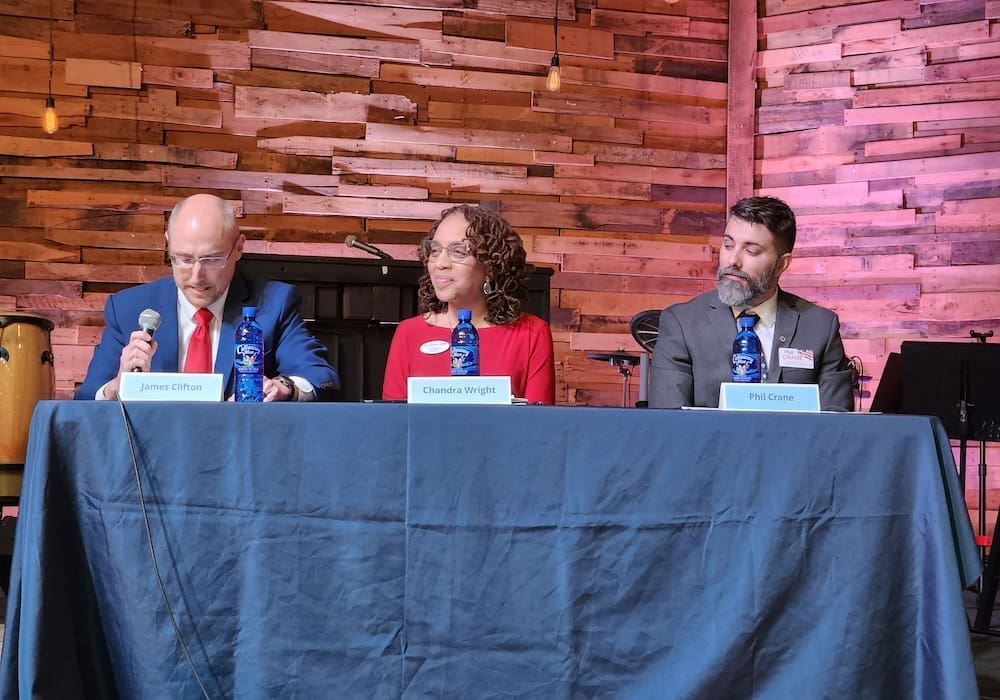
This is the second of two columns covering the May 5 candidate forum at Peachtree City Christian Church, jointly hosted by the Fayette Chamber of Commerce, the Peachtree City Rotary Club, and the Fayetteville Rotary Club. The first column focused on the State Court Judge race. This one focuses on the District 3 seat on the Fayette County Board of Commissioners.
The District 3 seat is open because Commissioner Edward “Edge” Gibbons is not seeking reelection. The seat carries real responsibilities. The Board of Commissioners sets the county budget, funds public safety, maintains roads and infrastructure, oversees zoning in the unincorporated portions of the county, and decides how taxpayer dollars are spent.
Three candidates filed for the seat: Republicans James Clifton and Phil Crane, and Democrat Chandra Wright. May 19 is the Republican primary, which means Crane and Clifton are competing for the Republican nomination on that day. Wright is unopposed on the Democratic side and advances to the general election in November.
The three candidates met on the Chamber stage and answered eight questions in front of a full room. The forum revealed that one candidate has been preparing for this seat for years, one would be ready for the role from day one, and one is running on slogans that have very little to do with what the office actually does.
But before we go into the details, let’s meet the candidates.
The Candidates
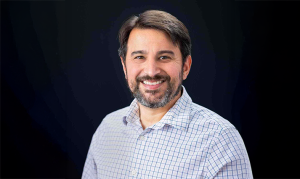
Phil Crane was born in Peachtree City in 1990. He graduated from McIntosh High School in 2008 and earned his Doctorate in Chiropractic from Sherman College in 2016. He and his wife Gillian own a chiropractic practice in Peachtree City, where they welcomed their son Philip in November 2025. Crane ran for Peachtree City Council in 2021 and 2022 but lost each race. Rather than walk away after those losses, he stayed engaged. He served on Peachtree City’s SPLOST Advisory Group reviewing capital projects, and he currently serves on the Fayette County Board of Health. He has been a regular presence at County Commission meetings for years and has been endorsed by Edge Gibbons, the retiring commissioner whose seat he is seeking.
Chandra Wright brings a less common combination of experience to this race. She earned a Bachelor of Science in Computer Science from Southern University and A&M College and began her career at AT&T Bell Laboratories in the Chicago area, where she led software development initiatives and managed global projects. After moving into community development work, she relocated to Peachtree City in 2016 and joined the city’s Planning and Development Department, where she gained direct experience in zoning, growth management, and the policies that shape how communities develop. She earned a Master’s degree in Public Policy from Georgia State University. She currently serves on the Fayette County Democratic Committee and on the Executive Board of the Georgia Federation of Democratic Women. Running as an unopposed Democrat, she advances to the November general election regardless of the May 19 outcome on the Republican side.
James Clifton is an attorney who founded The Clifton Law Firm and operates law and real estate businesses in Fayetteville and Newnan. He was born in Fayette County and holds law licenses in Georgia, Florida, California, Texas, and the District of Columbia. Clifton has run for office four times in the past twelve years. He ran for Georgia Senate in 2014 and Georgia House in 2016, finishing sixth and last in those primaries respectively. He ran for Peachtree City Council as former mayor Steve Brown’s running mate in November 2025 and lost to Michael Polacek. The county commission race is his fourth attempt at elected office.
The Elephant in the Room
If you’ve read my previous columns, you know I have been very critical of James Clifton, and for good reason. Since losing his Peachtree City Council race last November, Clifton has been promoting a conspiracy theory that Peachtree City and the Fayette County Development Authority are quietly working together to annex Coweta County land for a data center. The mayor of Peachtree City, the council member who proposed the annexation study at issue, and the president of the Fayette County Development Authority have all denied the claim in writing. Clifton himself acknowledged to The Citizen that his evidence is, in his own words, “circumstantial,” yet he continues to push the claims to others as fact.
He has also straight up lied to support his conspiracy. At one point, after obtaining recordings from a January city council retreat, Clifton posted a video to Facebook titled “The Peachtree City data center conversation that supposedly never happened.” The audio he used was of FCDA President Niki Vanderslice discussing a data center project in Fayetteville that had been reviewed by the Fayetteville Planning and Zoning Commission two days before the retreat. Vanderslice was not discussing Peachtree City. Clifton stripped the context, applied a Peachtree City label, and told his followers the recording was proof that city officials had been planning a data center behind their backs. He has never corrected the video or acknowledged that the audio was about Fayetteville (I documented the full details with screenshots and the video here). When confronted with facts like these, Clifton does not address them. He tells his followers the coverage is a political attack, frames himself as the target of a campaign to silence him, and moves on to his next post without engaging with what was actually documented.
What Clifton is ultimately doing is using a manufactured threat to build a base of supporters for his county commission campaign. That is something voters should seriously consider, but for the purposes of this article, I will assess Clifton’s forum appearance on its own terms.
How the Forum Was Conducted
The Chamber’s rules called for a 90-second opening statement from each candidate, 60 seconds to answer each of eight questions, and up to two minutes for a closing. Sixty seconds is enough to make a focused point but not enough to ramble, which is part of the value of a format like this one. What it reveals over the course of an evening is whether a candidate understands the actual scope of the office they are seeking, whether they can speak with specificity about how the County Commission operates, and whether they have done the preparation that produces concrete examples rather than slogans. That is the lens I will use through the question-by-question analysis below.
Question 1: Economic Development Priority
Edward Smith, Director of Institutional Client Services with the JTC Group, opened the questioning with a 2025 cost-of-community-services study showing that residential properties in Fayette County cost $1.05 in services for every dollar of property tax they generate, while industrial properties cost only $0.55. Given that gap, what would each candidate’s main economic development priority be?
Crane named sports medicine as a target sector and tied it to the new US Soccer presence in our area and the broader sports activity in the community, including pickleball, soccer, and baseball. He noted that a $550,000 home is roughly net zero for tax revenue versus services consumed, which framed his priority around closing that gap with the right kind of commercial growth.
Wright drew on her time inside the Peachtree City planning department to describe the residential-to-commercial tax balance as something planners actively manage rather than treat as a fixed condition. She framed economic development as a partnership in which the development authority does the recruiting and elected officials set the guardrails, with the responsibility to negotiate agreements that put residents first.
Clifton offered a critique rather than a priority. “Growth just for the sake of growth is not progress,” he said, with his memorable line about paving over a strawberry farm to build a parking lot. He did not name a sector, an industry, or any specific approach to economic development.
The clear winner of this question is Crane. He answered the question that was actually asked, named a target with a real connection to assets the community already has, and framed the response around the math that the question opened with. Wright was a close second because her framing demonstrated direct familiarity with the underlying mechanics of how planners and economic development professionals actually balance the residential-commercial mix. Clifton was third because the question asked for a priority and he offered a position.
Question 2: Comprehensive Transportation Plan
Maurice Ungaro, Town Manager for the Town of Brooks, asked about the county’s five-year update to the Comprehensive Transportation Plan and the regional trail and multi-use path plan being developed alongside it.
Clifton said he had filled out the survey, planned to attend a meeting on May 12, and supported many of the initiatives being discussed. He then pivoted to declare his opposition to the TDK extension.
This pivot is worth pausing on. The TDK extension is a Peachtree City Council matter, not a county matter. The county does not own the road, does not control its zoning, and does not have a vote on whether it gets extended. Edge Gibbons made this exact point in his April 29 endorsement letter for Crane: “The TDK Boulevard extension is also under the jurisdiction of the Peachtree City Council, not the county.” Clifton choosing to promote this position when asked about a county-level transportation plan suggests he is still campaigning on city-level issues from a county-level seat.
Wright did not draw hard policy lines on transportation specifically and instead focused on the importance of coordination with the Atlanta Regional Commission and the individual municipalities. Her three-part framework for traffic relief, which involves increasing flow, getting cars off the road, and considering bypass options, was structurally sound but did not get to specific policy positions.
Crane named the actual cast of stakeholders required to address Highway 54/74. He listed Peachtree City, Fayette County, Coweta County, Fayetteville, Tyrone, Sharpsburg, the Atlanta Regional Commission, and the Georgia Department of Transportation, and he framed the path system as a real lever for traffic reduction by getting more people on golf carts and fewer on the roads. He pointed toward future grade-separated crossings as a planning priority that the county should be thinking about now rather than later.
Crane wins this question. He demonstrated familiarity with which entities actually have authority over which segments of road, which is exactly the kind of jurisdictional literacy this question was probing for. Clifton’s answer showed the opposite, since he raised a city-level issue when asked about a county-level plan. Wright was solid in her answer but did not match the specificity Crane offered.
Question 3: Housing Affordability
Letrissa Frieson, Chair of the Fayette Board of Realtors, asked what specific strategies each candidate would support to balance growth with housing affordability for working families, teachers, first responders, and young professionals.
Crane was honest about where he draws the line philosophically. He does not believe it is government’s job to provide affordable or attainable housing directly, but he correctly identified the lever a commissioner does have, which is negotiation during rezoning requests. He gave the example of negotiating tree retention requirements as a way to influence what gets built and at what scale.
Wright made the most policy-substantive case of the three. She cited the roughly 345,000-unit gap statewide identified by the Georgia Department of Community Affairs and made an explicit case for workforce housing that allows teachers, police officers, fire personnel, and seniors to live in the community they serve. Her answer reflected a familiarity with how other counties across Georgia have actually solved the problem through grants, partnerships, and innovative housing programs.
Clifton used his sixty seconds to argue against multifamily housing, high-density housing, and apartments. He proposed competitive wages for public employees as the affordability solution.
This is the second place where the jurisdictional issue matters, and it matters more here than in any other answer Clifton gave all night. Clifton’s promise to oppose high-density housing in Fayette County runs into a basic infrastructure reality. The unincorporated parts of Fayette County, the only parts the County Commission has zoning authority over, do not have a countywide sewer system. Everything is on septic, and septic systems do not support apartment-density development. The county’s own Comprehensive Plan states this clearly. Within the cities, where sewer does exist, zoning decisions are made by city councils rather than the county commission. As Edge Gibbons wrote in his endorsement letter, “Apartments require sewer and cannot be approved in the unincorporated county.” Clifton is promising to enforce a constraint that physical infrastructure already enforces, on land where the County Commission cannot act in the first place, which makes his answer a slogan rather than a policy position.
Wright is the winner of this question. She answered the question with the most depth, the clearest grasp of what workforce housing means, and the most awareness of how it actually gets built. Crane was a strong second for being honest about the role of government and identifying a real mechanism a commissioner can use. Clifton was third because his central promise, stopping apartments in unincorporated Fayette County, addresses something that the infrastructure already prevents and the office he is seeking does not control within the cities.
Question 4: Airport Partnership
Ken Fleming, Chair of the Atlanta Regional Airport at Falcon Field, asked whether the candidates view the county’s relationship with the airport as mutually beneficial, and how that partnership should be strengthened.
Clifton called it a great partnership and noted that Falcon Field is the third busiest airport in the state. He praised its self-sufficiency through jet fuel sales and hangar rentals and said he would work with the authority to increase business growth around the airport. He added a note of caution about not making the airport so busy that residents become uncomfortable with the number and size of flights, which is an understandable concern for a district representative but an unusual emphasis in a question about strengthening the relationship.
Wright spoke to the airport’s role for executives and the broader business community and described what a commissioner’s actual work on this partnership would look like: supporting land management decisions, helping with budgeting, and coordinating with the development authority when opportunities for expansion arise. Her answer treated the airport as a partner that deserves cooperative governance, and it was the most grounded in what the office would actually do on a day-to-day basis.
Crane described the airport as essential to the county’s economic profile and was the only candidate to raise a specific operational concern: the airport has grown busy enough that a control tower is becoming a safety question, and he proposed exploring T-SPLOST funding as a way the county could help. He acknowledged that the county does not fund the airport directly, which makes the proposal more of a constructive idea than a commitment the office can deliver on its own.
Crane wins this exchange, but narrowly. He brought the most specific issue to the table and showed he has thought about how the county could play a supporting role even where it does not have direct authority. Wright was close behind with the most practical answer about what the day-to-day work of this partnership actually looks like. Clifton was third because his answer, while supportive, did not engage with any specific way to strengthen the relationship.
Question 5: Tax Abatement and Small Business
Edward Smith returned with a question about how to support local small businesses, who pay the full tax burden, while large incoming corporations sometimes receive aggressive abatements that make the playing field uneven.
Crane proposed expedited permitting for new businesses, a possible first-year property tax relief mechanism for new local businesses, and a serious investment in vocational and technical education. He was the only candidate to draw the explicit connection between workforce development and small business retention, which is consistent with the vocational and technical school he has been advocating for throughout his campaign. He also brought the personal context of a household in which he, his wife, his father, his brother, and his sister-in-law are all small business owners in town.
Wright made the case that large corporations should be taxed at a level that funds grants and technical assistance for the small businesses that actually anchor the local economy. She acknowledged the high failure rate of small businesses in their first five years and argued that early-stage support, training, and resources are where the public dollar makes the most difference. Her framing treated small business retention as a system that requires both revenue strategy and direct services, which is more sophisticated than most answers a forum like this produces.
Clifton declined the premise of tax abatements philosophically. He argued that abatements pick winners and losers and that boom-and-bust cycles result when ten-year abatements expire and companies leave. His positive prescription was to maintain low millage rates, fiscal discipline, and the existing per-employee occupational tax structure rather than a gross revenue model.
Crane is the winner here. Both he and Wright proposed early-stage tax relief for new small businesses, but Crane went further by connecting that relief to a longer-term workforce development strategy through vocational and technical education, which closes the loop on retention in a way no other answer did. Wright’s broader framing of using corporate revenue to fund small business grants and training was substantive and sophisticated. Clifton’s answer was a coherent philosophy on abatements, but the question asked what he would champion to support and retain small businesses, and his response did not offer a specific tool the office controls.
Question 6: Comprehensive Plan and Rezoning
Maurice Ungaro returned with a question about the role of the Board of Commissioners in rezoning decisions and how those decisions should be weighed against the future land use map and the broader comprehensive plan.
Clifton said variances and rezoning requests should be the exception rather than the rule, and that his long-term vision is to keep Fayette County low-density and suburban.
Wright described comprehensive plans as living documents that need to be revisited as community needs shift, while making clear that zoning requests inconsistent with the plan create real governance problems. Her answer reflected the way someone who has worked inside a planning department thinks about the relationship between long-range vision documents and the specific applications that come before a board.
Crane brought a specific recent example. Over the last several months of County Commission meetings, the rezonings have actually been moving in the direction of lower density, with one and two-acre lots being rezoned to five-acre lots, which decreases rather than increases pressure on infrastructure. He framed the role of the commission as following the citizen-led land use plan and being accountable to the residents who shaped it.
Crane wins this question as well. He demonstrated that he has been watching the actual meetings, and the example he cited is the kind of evidence that signals a candidate has done the work to understand what the office is doing. Wright was a strong second for the most accurate description of how comprehensive plans should function in relation to rezoning. Clifton’s answer was acceptable but generic, and a preference for low density is not by itself a rezoning framework.
Question 7: Housing Diversity
Letrissa Frieson returned with a question about the importance of housing diversity given the difficulty employers report in recruiting workers because of limited housing options at varying price points.
Crane spoke to the lifecycle reality of housing. His first house in Peachtree City was $180,000, and his current home is more expensive. Empty nesters with two people in a 4,000 square foot house may want to downsize, which opens that home for a younger family, which in turn allows a starter home to come back on the market. He acknowledged that the question of how government should facilitate this lifecycle movement is genuinely hard, and that honesty was more useful than a slogan would have been.
Wright made the case that life changes drive housing needs. People change careers, take pay cuts, age into different needs, or face new tax realities, and a community that wants to keep its first responders, teachers, and longtime residents needs housing options across price points. Her example of a safety officer being able to live in the community he or she serves landed because it captured something real about why housing diversity is not a luxury but a function of public safety and community health.
Clifton returned to his anti-high-density theme and argued that the issue is low housing supply, with builders preferring to build large homes on five-acre lots.
Crane and Wright share the win on this one. Both engaged the actual question with humanity and specificity. Crane brought the lifecycle frame and Wright brought the career-and-life-change frame, and they complemented each other well. Clifton used the question as another platform for his core position rather than engaging diversity as the topic, and he continued his pattern of returning to the same handful of slogans regardless of what is being asked.
Question 8: Intergovernmental Collaboration
Ken Fleming closed out the questions with a broad one. What steps would each candidate take to strengthen intergovernmental collaboration in support of economic development and long-term planning?
Clifton said his attorney skills make him good at finding middle ground and listed the surrounding counties he would reach out to, including Coweta, Spalding, Clayton, Henry, and Fulton.
Wright gave what was arguably her strongest answer of the evening. She spoke about relationships, curiosity, and her time inside the Peachtree City Planning Department as the place where she developed her understanding of the intersection of people, policy, and politics. She argued that no single agency can solve the county’s problems alone, which framed cross-agency relationships as an operational necessity rather than a soft skill. Her career path from corporate technology into public planning is itself an act of the kind of cross-sector bridge-building this question was asking about, and she connected that history to the question naturally rather than as a rehearsed talking point.
Crane pointed to a track record. Since his council races, he has spent years building working relationships with local officials and community leaders, including his service on Peachtree City’s SPLOST Citizens Advisory Group and the Fayette County Board of Health. He also raised the structure of the airport authority as worth examining, since the county currently sends ad valorem revenue to the airport without representation on the authority itself.
Wright and Crane share the win on this question. Both candidates demonstrated real foundations for collaborative work rather than simply claiming they could do it. Wright connected her career directly to the cross-agency coordination the question was asking about. Crane pointed to specific bodies he has already served on and a concrete governance question he is already asking. Clifton listed counties he would call, which is a statement of intention rather than evidence of preparation.
What the Closings Revealed
Wright closed first and used her two minutes to emphasize her commitment to serving full-time, attending HOA and community meetings, and remaining in active conversation with constituents between board votes. Her closing was consistent with the rest of her answers. It described what the job requires and how she would approach it, and it kept the focus on the people she would represent.
Clifton closed second and used his two minutes to recap his platform: low-density zoning, fiscal discipline, smart traffic, support for law enforcement and schools, and full transparency. He framed the race as a choice between resident-first leadership and unchecked growth, and he told the audience he is “already delivering results,” a questionable claim for someone who does not currently hold office or a municipal or county volunteer position. The closing was important because it confirmed something the eight questions had already suggested. Even when given the chance to demonstrate engagement with the specifics of county governance, his answer continued to be the campaign brochure. Voters listening for evidence that he understood the office got, instead, a final repetition of the slogans.
Crane closed last and used his time to walk through what he has done since his 2021 race. He named the SPLOST Advisory Group and the Fayette County Board of Health, made the point about working with elected leaders across municipalities and neighboring jurisdictions, and stated plainly that he stands on his own two feet and is accountable to voters rather than to a small group operating behind the scenes. That line was probably the sharpest moment of the evening, and it landed because there is a real difference between a candidate building a platform around demonstrated work and one building a platform around grievance.
Listen for Yourself
While I’ve gone into detail on what happened at the forum, you do not have to take my word on any of this. I recorded the forum and have made the audio available so anyone interested can listen, judge for themselves, and verify what I have written. The forum is part of the public record, and you should feel free to evaluate it directly.
Click here to listen to the candidate forum.
The Verdict: The Case for Crane Is Clear
Wright is a strong candidate. Her policy and planning background is real, her answers consistently demonstrated the most theoretically sophisticated grasp of how local government operates, and she made a credible case for being able to do the job from day one. The November general election will be a substantive race, and I plan to write about it in more detail when we get there.
The race in front of voters on May 19, however, is the Republican primary between Crane and Clifton, and the gap between them across eight questions and a closing statement was significant. Crane named specific stakeholders, surfaced specific operational issues, pointed to specific recent decisions, and demonstrated specific service on specific bodies. Clifton repeated his slogans, returned to his core platform regardless of what was being asked, and used a forum about county-level governance to campaign on issues like the TDK extension that the office he is seeking does not control.
That last point is the heart of the case against Clifton. His website lists three banner positions: no data centers, no apartments, and no MARTA. Each one of those positions has a problem, and the problems are not small ones.
On data centers, the County Commission does not approve data centers within municipalities, which is where the data centers in Fayette County have actually been approved. Those decisions belong to the city councils where they are proposed. The conspiracy theory Clifton has built his campaign around concerns Peachtree City annexing Coweta County land, which would also be a Peachtree City Council matter. The County Commission does have zoning authority over unincorporated Fayette County, but no data center has been proposed there, and Clifton is not running on opposing one that has.
On apartments, the unincorporated county does not have a countywide sewer system, and septic does not support apartment-density development. The Comprehensive Plan makes that point directly, and any serious candidate should know that. “Stop apartments” as a county commission slogan is a promise to enforce a restriction that the physical landscape already enforces. Within the cities, where apartments could theoretically be built, zoning is a city council decision.
On MARTA, no one is seriously proposing to bring MARTA into Fayette County. There is no active proposal on any agenda anyone is setting. “No MARTA” as a campaign position is an answer to a question nobody is asking. It is on the list because it sounds popular, not because it is on the table.
Two of Clifton’s three banner positions are about outcomes the office cannot deliver, and the third is an answer to a question that does not exist. Slogans like these are designed to sound popular without informing anyone of anything. They depend on voters not knowing how the office works. That is the deeper problem with Clifton’s candidacy. It is not just that his platform is mismatched to the office. It is that the mismatch appears to be the strategy. Tell voters you will stop something that is not happening or that you cannot stop, let the slogan do the work, and never get into the substance of what the seat actually decides.
Crane’s platform stands in clear contrast. Vocational and technical education, a county-wide aquatics facility, infrastructure investment in the county water system, and fiscal discipline are all things a county commissioner has a vote on. He has spent the past five years doing the work it takes to be ready to make those votes, on the SPLOST Advisory Group, on the Fayette County Board of Health, and at County Commission meetings he attends as a citizen rather than as a candidate. He is not a flawless candidate. Wright matched or exceeded his policy depth on housing and intergovernmental collaboration, and his airport tower proposal was a constructive idea that he himself acknowledged sits outside the county’s direct authority. But the difference between Crane and Clifton is not about polish. It is about whether a candidate has bothered to learn what the office does before asking voters to put him in it.
Edge Gibbons, the retiring commissioner whose seat is being filled, made the same case in his April 29 endorsement letter. Gibbons wrote that he has personally seen Crane at countless County Commission meetings, and he stated directly that he has not seen Clifton at any of them.
The case for Crane is clear. He is the better-prepared candidate by a wide margin, his platform is built around things the office actually decides, and his record of engagement is something he can point to rather than something he claims.
He is the right choice for District 3.
Where and When to Vote
Election Day is Tuesday, May 19, with polls open from 7:00 a.m. to 7:00 p.m. Any voter in line before 7:00 p.m. will be allowed to vote.
Early voting continues across Fayette County through the end of this week:
- Monday, May 11 through Friday, May 15
Early voting locations and hours:
- Fayette County Elections Office at 175 Johnson Avenue, Fayetteville, GA 30214: Monday through Friday 9:00 a.m. to 5:00 p.m.
- Peachtree City Library at 201 Willow Bend Road, Peachtree City, GA 30269: Monday through Friday 9:00 a.m. to 5:00 p.m.
- Tyrone Town Hall at 950 Senoia Road, Tyrone, GA 30290: Monday through Friday 9:00 a.m. to 5:00 p.m.
- Fayetteville Library at 1821 Heritage Parkway, Fayetteville, GA 30214: Monday through Friday 9:00 a.m. to 5:00 p.m.
Transcript
Candidate Forum on Community Issues
Tue, May 05, 2026 6:36PM 42:41
SUMMARY KEYWORDS
Economic development, housing affordability, transportation plan, comprehensive plan,
fiscal responsibility, public safety, workforce housing, community engagement,
intergovernmental collaboration, tax abatement, infrastructure improvements, quality of life,
competitive wages, rezoning requests, smart growth.
SPEAKERS
Speaker 5
Speaker 10, Speaker 3, Speaker 9, Speaker 2, Speaker 4, Speaker 8, Speaker 7, Speaker 6, Speaker 1,
S
Speaker 1 00:00
And so first I’m going to ask our moderators to come forward, and so this portion will be
moderated by the following community leaders. First, we have Maurice ngaro, who is the town
manager for the town books. Next, we have Dr Edward Smith, who is the Director of
Institutional client services with the JTC group and Peachtree City resident. And then next we
have latrica fryson, who’s the Chair of the Fayette County Board of Realtors and a broker for
LEA group of Keller Williams. And then last, Ken Fleming, who’s the Chair of the phtc Airport
Authority Atlanta Regional Airport faculty and so each of our moderators will ask questions that
will pertain to various subjects related to transportation, infrastructure, sustainability, Economic
Development, housing and community development and the like, and so with that, I’m now
going to introduce the candidates and ask them to come Forward, starting with first Shonda
right next is James Clinton. And last but certainly not least, is Bill Frank. So the candidates will
begin each one with about with a one and a half minute opening statement. Following their
opening statements, they will, then we’ll have a series of questions from our moderators here.
And so with that, we will actually, we’ll just go in the order as they are at the table, starting
with we’ll start with you, James, since you’re closest to me, and then go down from there.S
S
Speaker 2 02:41
Sounds good. Thank you to PTC three, the chamber and Rotary Clubs, for hosting this forum.
I’m James Clifton. I’m a lifelong resident of Fayette County, a small business owner, and I’m
running for Fayette County Board of Commissioners to give back to the county that has given
me everything for decades. Fayette County, suburban charm taxes, strong schools and high
quality of life have made it a magnet for families and businesses alike. That is exactly what I
am fighting to protect my commitments are clear. We need measured growth that doesn’t over
develop our county and take away our green space, we need to restrict high density housing
that overloads our schools and roads, and we need to ensure that we don’t import problems
that accompany things like public transportation instead own champion low density housing
fiscal responsibility to cut wasteful spending and reduce property taxes, smart Traffic Solutions,
support for law enforcement in our top ranked schools, and most importantly, full government
transparency with no more backroom deals. By focusing on Smart Growth infrastructure
improvements and quality of life initiatives, we can deliver responsible economic development
that benefits businesses and preserves very big things that make Fayette County special. I’m
running to keep Fayette County prosperous, family friendly and fiscally sound for generations
to come.
Speaker 3 04:17
Good evening. My name is Chandra, right, and I’m running for Fayette County Board of
Commissioners representing District Three. I want to thank the Chamber of Commerce and the
Rotary Club for hosting tonight, because an informed community makes better decisions, and
better decisions make a better Fayette County. I’m running because governing requires more
than good intentions. It requires knowing the parameters of this position and what a
commissioner can and cannot do. It requires understanding of how local government actually
operates, the budget process last cycle, zoning law and intergovernmental relationships that
make things happen. It requires knowledge, knowledge of policy, the ability to evaluate
proposals rigorously before committing public resources, and it requires building genuine
relationships across governments, agencies and the business community, because a
commissioner who cannot work across those lines cannot deliver results. I bring graduate
training in public policy and technology. I bring direct experience inside East Street cities
Planning and Development Department, and I bring a commitment to staying in ongoing
conversation with constituents, because good governance isn’t just what happens in the
boardroom, it’s about what happens between those meetings. The community deserves
someone ready to do this job from day one, and I am ready. I’m asking for your support, and
I’m looking forward to the conversation tonight.S
S
S
S
Speaker 4 06:12
Good evening. About to make everybody in this room a little angry at me. I have the world’s
easiest baby. He comes to meetings with me, he hands out times with me, and overall, he’s
pretty awesome. He’s a big reason why I’m running. I want him to grow up in the same
community I did with the same opportunities. I’m Phil crane, and I’m not just raised in BC I was
born here. I’m running for the commission because I want to make smart, responsible decisions
of the future, not just two years, not just four years, not finishing out the term 1020, years
down the road, that way our children, our next generation, knows why they want to move back
here, and that starts lowering the tax burden in Fayette County, costs are up across the board,
and government should be looking for ways to provide relief, not add The pressure. It also
means planning for the long term. Like recreation, it’s a big part of what makes Dade County
special. Families rely on our parks, our facilities, and as we grow, we need to make sure we’re
planning ahead and funding these assets the right way, with shared responsibility and long
term sustainability. Public safety remains a top priority. Supporting our Sheriff’s Office, martial
office martial office of first responders is essential to keeping Fayette County one of the safest
places in Georgia. I’m a conservative who believes in state leadership, open communication
and making decisions based on what’s best for Fayette County, not politics. I’m ready to get to
work day one, and by the end of the night, I hope to earn your support. Thank you.
Speaker 5 07:40
Good
Speaker 6 07:48
afternoon. Thank you candidates for showing up to this event. My name is Ken Smith. I’ve been
in economic development for 20 some odd years, and I consider it an honor to be able to ask
you questions tonight. So to start off, I’d just like to say 2025 cost of Community Services
analysis conducted by the Fayette County Development Authority in Georgia Tech revealed a
stark fiscal reality. The data shows that residential properties cost the county $1.05 in services
for every dollar generated in property taxes, while industrial properties only cost 55 because
commercial growth is required to subsidize residential services and keep homeowners taxes
from skyrocketing, what will be your approach to economic development? Or rather, as county
commissioner, what will your main economic development priority seat? Thank
Speaker 5 08:42
you.S
S
S
S
S
Speaker 7 08:42
Started. Thank you for
Speaker 4 08:49
the question plays right into planning for the future. In Peachtree City, I don’t remember the
county numbers, but in Petri city, if your home is worth $550,000 you are net zero, you do not
raise any money. Services consume all of that. In order to lower the tax burden, we have to
look at economic development, but we need development that fits our community. And if it’s
not right, it’s not for us. With the addition to us, soccer here, we have opened up the ability for
sports medicine. It is a new set before us. Growing sectors, and there’s one that I’m passionate
about as a chiropractor. We have a very active community, pickleball, soccer, baseball, all of it
sports medicine. Here would be a great addition and a great economic driver. Thank you.
Speaker 5 09:40
Hey.
Speaker 3 09:45
So when I worked in Peachtree City, one of the things that we talked about in the planning
department was the fact that we wanted to make sure that the balance was right in terms of
tax base from residents and residential and what we were getting from businesses. Economic
development is absolutely crucial to ensuring that we will get the revenue that we need for the
services and the resources that are required to keep our quality of life. So I believe that the
economic development agency is critical their job, their absolute job is to make sure that they
are attracting and bringing businesses into our county that are going to help us with getting the
revenue that we need. But then our elected officials are the people who are going to make sure
that those businesses are right, that they are doing things the right way. Those agreements are
are negotiated in a way that keeps people first and that we get those resources and that
revenue that we are looking to get to support our quality of life.
Speaker 2 10:55
Economic Development is critical for our county, and it needs to be done in a responsible way
growth, just for the sake of growth, is not progress. Paving over a strawberry farm and turning
it into a parking lot is not progress. So when we talk about economic development, we need to
talk about bringing in businesses that produce high paying jobs, that will lift up our community,
lift up the tax base and employ the workers that we have in our community so that they can
continue with the quality of life that they’ve come To expect here in Fayette County.S
S
S
Speaker 8 11:40
Good evening candidates. Fayette County is currently engaged in a five year update to the
comprehensive transportation plan for the CTP. The CTP is a local planning initiative to
determine community needs in relation to the broader general regional planning initiative
through the regional transportation plan. At the same time, fade forward, working in
conjunction with Fayette County and all municipalities, is developing a countywide trail and
multi use path plan. As Commissioner, what will your commitment be to upholding approved
transportation and circulation plans?
Speaker 2 12:22
Yeah, so the I’ve been following the comprehensive transportation plan something, I filled out
the survey already, and I am looking forward to what the look for the meeting on the 12th of
May. I’ll be there. And I think there are a lot of good initiatives that we can accomplish through
that in order to reduce traffic, especially at intersections like highway 54 and 74 in Peachtree
City, and also to improve our interconnected PATH system. I think those are important aspects
of Fayette County. I want to make sure that when we do it though, we do it responsibly, and
that we do it in a way that doesn’t distract or to destroy other parts of our community, and for
instance, the TDK extension. I do not support the TDK extension as it would make Peachtree
City a worse place through the corridor where it exists on the cross sound evaneser And TDK.
Speaker 3 13:21
So this issue of transportation is so important, I don’t have hard and fast lines as it relates to
policy on that and why? Because we really do have to make sure that we look at, as far as I’m
concerned, there are three things that will alleviate traffic, increasing the flow, making sure you
get cars off of the street, and a bypass. That is what that those are the things that actually
address traffic. So when we are talking about doing things like putting together a
comprehensive plan. We must work with the arc the Atlanta Regional Commission. We must
make sure that we understand the needs of each and every municipality and the county as it
relates to an overall, comprehensive plan. And we must make sure that we are working with
the people who are most innovative, who have the best ideas, and pull all of that together and
put together a comprehensive plan that accomplishes what each of the municipal
municipalities need to accomplish. Thank you.S
S
S
Speaker 4 14:34
I’m gonna dress the elephant in the room. 5474 is bad. It’s not getting better as more cars
improved. It gets worse. So we need leaders who are able to work with multiple jurisdictions.
Peachtree City, Fayette County, Coweta County, city of Fayetteville, Tyrone, Sharpsburg, arc,
Georgia, Department of Transportation. No single person is going to fix 5474 but a
collaborative, not combative working relationship is how we’re going to get real results. As far
as the past system, you get more people on carpet as you get less people on the road. That’ll
fix traffic by itself. As technology advances, we’re going to see golf carts being able to go from
southeastern city all the way up to trills. It’ll be a little while, but we’ll get there eventually. If
we start planning for it now, then we can have more grade separated crossings that are safer
now, rather than trying to figure out what trees we have to cut down, whose front yard we have
to go through in the future. Thank you.
Speaker 9 15:40
Good evening, candidates, which is the president, licensed tools like broker for the past six
years, serving the community so have been keeping fed moving. My question would be, as
Fayette County continues to experience growth, while many working families, teachers, first
responders and young professionals struggle to find attainable housing. What specific
strategies would you support to help balance growth with housing affordability while preserving
the character of our communities so
Speaker 4 16:16
it’s conservative? One of the first things I ask is that importance job and affordable, attainable
housing, I don’t think is the difference job. Now, what can you do with that? You can guide it a
little bit. When rezonings come forward, you as the government, as the Commissioner, have
the negotiating power, and that negotiating power is where this comes in. We do not need
more million dollar homes going on half acres in every single available piece of land we can
negotiate to say, hey, you have to maintain maybe 10 mature trees on this property. Don’t
plant one gallon in trees. And if you maintain the trees, you’re going to have smaller homes.
You will probably get cheaper homes. But at the end of the day, I don’t believe it’s
government’s job to provide affordable or attainable housing, because it’s very difficult to
define that. Thank you.S
S
S
S
Speaker 3 17:06
So this is an area that I am actually pretty passionate about. I believe that it is the right of
people to have a roof over their head. The Department of Community Georgia, Department of
Community Affairs is looking at this problem intensely, and we have found a approximately
345,000 gap between people who need housing and those who don’t. It is important to me that
workforce housing is something and by workforce housing I mean that we have housing in our
county, that public that teachers can afford, that police officers and fire personnel can afford.
We that seniors can afford, and there are ways that we can do it. The problem is not about the
how you know the cost of the housing. The issue, the issue is about making sure that we use
innovation and we use programs and grants to build the housing that people can afford, and it’s
possible it is something that the government can be a partner in. It’s been proven time and
time again across many, many counties that we can provide housing for the people who live in
this county. They deserve it, and it can be beautiful housing, innovative housing, and fit the
beauty and the quality of life that we offer here in May
Speaker 2 18:26
County, first, I’d like to start off with what I don’t think is a solution. I don’t think multi family
housing, high density housing and apartments, is a solution to that problem. It imports crime, it
increases overcrowding, puts more traffic on our streets. What we can do is we can make sure
that our teachers, our employees, our public employees, are paying competitive wages. Our
first responders, they get competitive wages. When they get competitive wages, they can
afford houses our community. I know that’s possible because I have friends who are first
responders. I have friends who are teachers, and they are able to afford houses in this
community because we pay them competitive wages. As a commissioner, we control that. It’s
something that is in our direct control. That’s something I’ll make sure they do. The housing
affordability crisis really is a top down problem. Starts with the federal government. They spend
way too much money, causes inflation. When inflation goes up the Federal Reserve, they
increase the interest rates when inflation and interest rates are up, people can’t afford houses.
But what we can do here in Fayette County is make sure that we’re paying competitive wages
to our first responders and our public employees, and we can also attract businesses that have
high wages so that people can afford to live here Fayette County,
Speaker 5 19:39
yeah,
Speaker 10 19:46
thank you, candidates from the airport. So do you view the county’s relationship with Atlanta
Regional Airport Falcon field as mutually beneficial andS
S
S
S
Speaker 2 19:59
how? Yeah, I think it’s a great relationship. Falcon field is third busiest airport in the state. It is
self sufficient. It provides its own funding through jet fuel sales and through the rental of
obtainers. And I think that is a great partnership to have. As a county commissioner, I’ll work
with you guys to make sure you have all the resources necessary to increase business growth
around the airport and but the one thing that I want to make sure we do is not make our airport
so busy that starts to make our residents feel uncomfortable because the number of flights
from the size of jets so but yes, I think it’s a great partnership, and you guys are doing a great
job continue the good work With your self sufficiency. That’s 40 100%
Speaker 3 20:45
the fact that we have Dr Phil right here in District Three is a beautiful thing. We know that it is
primarily a place where we have a lot of executives and corporate folks who fly in the business
community uses it is a great way to make sure that people invest in this area in our county,
because they know that they have adequate transportation and flight the possibility of getting
here with ease and being able to bypass the larger airport. I believe that the county
commission, of course, is a self sufficient airport, but the county commissioners need to make
sure that, as this airport sustains itself, and it needs to do things that maybe deal with land
management, acquisition, you know, making sure that that whatever you need to do we’re
able. We’re there to help with the budgeting, the funding, working with at the economic
development agency when they are trying to do things to help expand we need to be in
partnership with you, that’s the point of it. And yes, I think we are in a good relationship, and
we’ll continue to be that way when I win.
Speaker 4 22:01
The airport’s not just important. It’s essential. We have grown the way that we have, partially
because that it’s an economic driver, and we need to not only preserve it, but promote it. And
that comes down to the tower. That airport is getting so busy now that there needs to be a
tower there for safety. We don’t need accidents. That’s that’s not a good idea. But the county
doesn’t fund the airport, but we can help. So I think that in the next couple years, we need to
start looking at the T slopes to help fund that tower and make sure that that airport not only
continues to be an economic driver, but continues to be a safe economic driver. Thank
Speaker 5 22:42
you.S
S
S
Speaker 6 22:42
Thanks for your answers. Thus far another economic development question. So as an economic
development professional, I see counties across the country, including our own frequently used
tax abatement and sometimes aggressive tax abatement. So we’re due out of county, out of
state corporations. However, local economies are anchored by our existing small business
owners who pay the full tax burden, and they pay this burden every day. So as commissioner,
what specific policies will you champion to support the Retention and Expansion of our existing
local businesses, and how will you ensure that they receive the same level of focus as major as
mega projects recruited by the development. Thanks.
Speaker 4 23:32
That’s a great question. Small business owner myself, my wife’s a small business owner. My
dad, my brother, my sister in law, also must be small business owners in town. Couple different
ways to do that. I want to champion something where you open a new business. We I don’t
want to say, get rid of red tape, because regulation is important, but let’s expedite it.
Something shouldn’t sit on the table for too long, and for your first year, maybe you don’t pay
taxes, maybe even your first year, your second year, these 10 year sunset tax statements are
crazy on the property. Furthermore, workforce development, if we can expand our vocational
and technical opportunities in town, then we’re not only going to get people working in town
that have pride, but they’ve been trained here. So the money isn’t going back to Atlanta when
a giant business is sending their employees down here, we are homegrown workforce, and
that’s one of the ways I think that we can protect our local businesses.
Speaker 3 24:31
We know that large corporations are beholden to shareholders and that small businesses tend
to and they don’t typically pour back into the community. Small businesses are the backbone of
communities. They are the people in the community. They employ people in the community.
It’s so important that they are successful. So when we bring these large corporations into our
communities, we need to make sure that we are getting as much capital out of them, as much
revenue as possible out of them when they’re here, and we can take those dollars and provide
grant dollars to to those who need them in particular, we can use that to help small businesses.
We also need to make sure that we give small businesses tax breaks, and especially in that
early part of their development, because we know that a lot of small businesses do fail within
those first five years, so we need to prop them up as much as possible, and we also need to
make sure that they have the resources and the training that they need in order to sustain
themselves and to stay active and to turn that profit as quickly as possible, and We can provide
those services with the revenue that we get from these larger businesses. Thank you.S
S
S
Speaker 2 25:47
Regarding tax abatements, it’s a bit of an interesting question. I don’t really like the idea of
government picking and choosing winners and losers, and when you start to pick and choose
which businesses or which industries are going to be your winners and losers, you create boom
and bust economies. As your 10 year tax abatement expires, it incentivizes that company to
find somewhere else to go and take their jobs and take their revenue that they’re producing for
the community. So every cycle you’re having to look for new businesses for our local small
businesses. We need to maintain a business friendly Fayette County that starts with low millage
rates for property taxes. It has fiscal responsibility cutting wasteful spending. We need to make
sure that we maintain a low occupational tax. We currently have a per employee occupational
tax that is very business friendly. I will not, as a county commissioner, change that to a gross
revenue occupational tax. And we also need to make sure that we keep our sales taxes low. So
we need to make sure that when we approve any kind of loss that we’re doing so reasonably so
that doesn’t negatively impact on business small business,
Speaker 8 27:09
another planning question for you. County wide, all jurisdictions are updating their confidence
plans for Community Affairs schedules. Part of any comp plan is a future land use map which is
used in guiding growth and development zoning change requests or rezoning should be
weighed and measured against the future land use map, as well as against impacts on the
surrounding area and transportation. What is the board Commission’s role ensuring that the
appropriate decision is made any rezoning request
Speaker 2 27:42
for rezoning requests, variances and other things where an individual or company asked to
have a different zoning applied to them, I think those should be the exception and not the rule.
The whole purpose of the comprehensive plan is to ensure that the county or municipality has a
long term vision, and in Fayette County, my long term vision is to ensure that we continue
down a path of suburban life, that we have low density housing, that we don’t over develop,
and that will be part of my decision making process when individuals or companies come to the
board and ask for variances or result.S
S
S
S
Speaker 3 28:26
The comprehensive planning process is is essential for making sure that communities develop
in such a way that the people, the people are on board with how we are. We are progressing
however they are living documents. And so it’s important that while we set these
comprehensive plans, that we do look at them regularly, because as we, as people, come to us
and they request these zoning differences, and they are not in compliance with the
comprehensive plan. That makes for a lot of problems. The Comprehensive Plan dictates the
future. The vision of how we want to grow, it is pretty much how we govern that growth. And
when we have zoning that is not lining up with that, we can step back and make sure that we
talk to our constituents and our public to understand we’re impacting that growth in a way that
they’re comfortable with and that aligns with the change that is taking place in the in the
comprehensive plan itself.
Speaker 4 29:32
Comprehensive Plan is one of the citizen led plans that happens. It takes stakeholders. You
meet everybody in this room and ask them what they want. So as a commissioner, we owe it to
the community to follow the land use plan. Recently, the last five or six county commission
meetings, there was a lot of rezonings that happened, but they weren’t too typical rezoning
normally. You see, I want this 25 acres turned into one acre lots. Well, we sold the opposite.
There was a lot of one and two acre lots that were being asked to be rezoned to five acre lots,
and that’s almost a no brainer. When you have that you’re following the land use plan, you’re
not burdening infrastructure. In fact, you’re decreasing the burden on infrastructure. So the
Board of Commissioners rolling back to your question is to follow the land use plan and be
accountable to the citizens. Thank you. All right,
Speaker 9 30:28
so how’s the inventory of economic development? So many local employers have shared
concerns about workforce recruitment due to limited housing options at varying price points.
How important do you believe housing diversity is to the long term economic stability and
sustainability of Fayette County?
Speaker 4 30:56
It’s very important. My first house in peach city was $180,000 my current house is more than
that, and having a diverse housing option is not just for getting here, but it’s for empty nesters.
So two people sitting in a 400 or 4000 square foot house is a lot. You don’t want to clean it.
Your kids are off to college. You want them to move back, having options for seniors to move
into, opens up other homes for workforce to move into. Now, how does government do that?
That’s the question, but I do believe that it is important as an economic driver. ThankS
S
S
Speaker 3 31:39
you. Housing Diversity is absolutely critical. Look, we change our lives. Change we make
different decisions. One day we want the, you know, the 4000 square foot house, you know,
two levels, and the next one, we’re like, we can’t make it up those stairs. We need to decrease
it. People’s lives change. People make, I’ve made a career change decision. I went from a high
paying, you know, career to one where there’s very little money, yes, and so you have to make
decisions about that tax situations change. One day the taxes you’re, you know, your house is
worth this much. The next day, you know, the next time houses are going up and all of a
sudden you have a tax bill that it’s a little uncomfortable for you, and we have to remember,
we have to remember that it’s really we want those salaries to go up. We want to have high
paying jobs, but we want to make sure that the people who are serving our community with the
salaries that they have, that they are able to be in our communities. There is nothing better
than having your safety officer live in the community with you and be in relationship with you.
So yes, housing diversity is critical to a community, being able to grow and change and having
a variety of different people to live in that community. Thank you.
Speaker 2 33:01
One of the factors that is causing house prices to remain high is a low supply. As long as
builders want to build in a low density manner, 123, in our AR zoning five acre lots, I have no
problem with them developing in that manner. That is their right as property owners to do that.
And I think that if we increase the supply, some that will also provide more economically
feasible options for those workers, where I won’t compromise, I’m reiterating this is high
density housing. I will not, under any circumstances, allow high density housing by county
commissioner. It is, is not good for our county. It will cause overcrowding, increased crime
rates, and is something that I will not compromise.
Speaker 10 33:52
Last question for the airport, what steps would you take to strengthen intergovernmental
collaboration in a way that supports economic development, long term planning and mutual
success. SoS
S
S
S
Speaker 2 34:07
working with other governmental leaders is critical to success. You have to be able to
negotiate, you have to be able to reach out, you have to be able to find middle ground. And
that is all within my skill set. As an attorney, I work every day to help find middle ground
between various parties who think that they would never in a million years have things in
common. And I do that every day, day in and day out. And as a county commissioner, I’ll do the
same thing. I’ll reach out to our neighbors in Calhoun County, in Spalding County, Clayton
County, Henry County, Fulton County, I’ll reach out to our municipalities, and I’ll make sure that
we have intergovernmental agreements that are fair for Fayette County and that prioritize
Fayette County citizens, and in that way, we’ll make sure that Fayette County remains
prosperous and that it is the place that families continue to want to live in.
Speaker 5 35:02
You
Speaker 3 35:02
so this job is about relationships, period. Look, I’m curious. I love learning. I love talking to
people. As some of you probably already know, I joined the Peachtree City Planning
Department because I wanted to understand the intersection between people and policy and
politics. It’s important because they all work together. It is so important that for the folks who
are in these positions of leadership that they want to work across agencies, because there is
not one agency that can do this alone. There is not one politician that can do this alone, and we
must be in relationship and understand the differences between the needs of each of those
things in order to work together to come up with innovative ideas that work for the people,
Speaker 4 36:01
I have built relationships on trust and mutual respect for the last five years. When I ran for city
council five years ago and just barely didn’t get it, I didn’t step down. I stepped up. I continued
to work. I continued to work with local officials, with community leaders, and build those
relationships. So that’s not just in my skill set. I’ve already done it, and when it comes time to
work together for the greater good of Fayette County, I’ll accomplish it. As far as the airport
goes, I would very much like to see some County, I don’t want to say influence, but more of a
relationship there currently ad valorem tax from the airport comes to the county, and there’s
no representation candidates that do anything, whether that’s expanding the authority, which I
think the key street city officials are looking at me for that, or finding other ways to strengthen
that relationship, I would very much like to start that conversation. Thank you soS
S
S
Speaker 5 37:00
so
Speaker 1 37:02
as we now prepare to wrap things up, and you get ready for your last closing statement here,
I’m going to ask this question. And actually, what I want to do, since we’ve gone from kind of
the end to the end to the end, we’ll start and go about actually the pictures on the screen. And
so we’re going to start with Kendra. I got it right this time, did that, and then followed by James,
and then followed by Phil. And so, minute and a half just ultimately share with us. Perhaps
there’s if there’s something you haven’t been asked, but that’s important that you feel needs to
be conveyed this evening, minute and a half. What would you like to share that you would not
ask?
Speaker 3 37:51
This has been such a journey for me. I started out my career in corporate, in the technical, in a
technological field. And my journey has been one of discovering how important it is for people
to be civically engaged, how important it is for the people to truly be engaged in their
government, to truly be plugged in, to truly talk to their representatives, to truly hold their
representatives accountable. I had to learn that the hard way, and so I will do this job full time.
I will be your Commissioner full time. I will come to your HOAs. I will come to your meetings. I
will tell you what’s going on. I will absolutely make sure that I understand the things that
concern you, and you will have a voice at the table because people centered government
means everything to me, and I’m going to make sure, very sure, that it means everything to
you. Is thisS
S
S
S
Speaker 2 39:15
our closing station? Thank you again. To the chamber, Rotary Clubs and BTC three our
moderators and everyone here tonight, Fayette County stands at a crossroads. We can
continue down the path of responsible resident first leadership that has made us one of
Georgia’s most desirable counties, or we can allow unchecked growth to change the character
of this county forever. My platform is straightforward. I will deliver low density zoning to protect
our green spaces, fiscal discipline to cut taxes and waste, smart traffic solutions that actually
work, unwavering support for our law enforcement in schools and full transparency so citizens
are never left in the dark. These positions are not anti growth. They are pro fed. As your next
County Commissioner, I will be the consistent voice on the board who put citizens first and their
businesses. I will work collaboratively with elected leaders, both locally and on the state level,
to keep Fayette prosperous, safe and true to the suburban dream we all cherish together, we
will build fan’s future the right way. I’m not here tonight just to make promises through hard
work and community engagement, I am already delivering results. I humbly ask for your vote
on May 19. Thank you. I’d like to give my actual closing
Speaker 3 40:58
proper language.
Speaker 4 41:10
Thank you to the fan chamber, the peach city and faithful Rotary Club. PTC three, all of the
candidates down there as well moderators and the kids who have done a great job tonight, as
well as everybody else out there, you’ve taken time out of your day to be part of what makes
this country so great. Be involved. After my last race, I got more involved. I served on the Sloss
advisory group, working through real projects, real numbers and real decisions that impact the
community. I currently serve on the Fay County Board of Health, working alongside local
healthcare leaders. And just as important, I build relationships with local leaders across
municipalities and neighboring jurisdictions, because at the end of the day, one person doesn’t
fix problems alone. Real Solutions like addressing traffic happen when everybody in the room
has a common goal. That’s what I bring on day one. I’m accountable to you, the voters, not a
small group, not a handful of people. Behind the scenes, I stand on my own two feet, and every
decision I make is based on what’s best for Fayette County. This race is more than just about
ideas. It’s about trust. It’s about who’s prepared to lead, who understands the issues, and who
can actually deliver results. I put in the time, I’ve done the work and I’m ready to serve if you
want steady leadership, real solutions, and someone who will put the Fayette County first every
time, I would be honored to earn your vote on May 19. Thank
Speaker 5 42:40
you.
Websites
James Clifton – https://voteforclifton.com
Phil Crane – https://www.vote4crane.com
Chandra Wright – https://www.vote4chandra.com


Leave a Comment
You must be logged in to post a comment.