


 5303
5303 0
0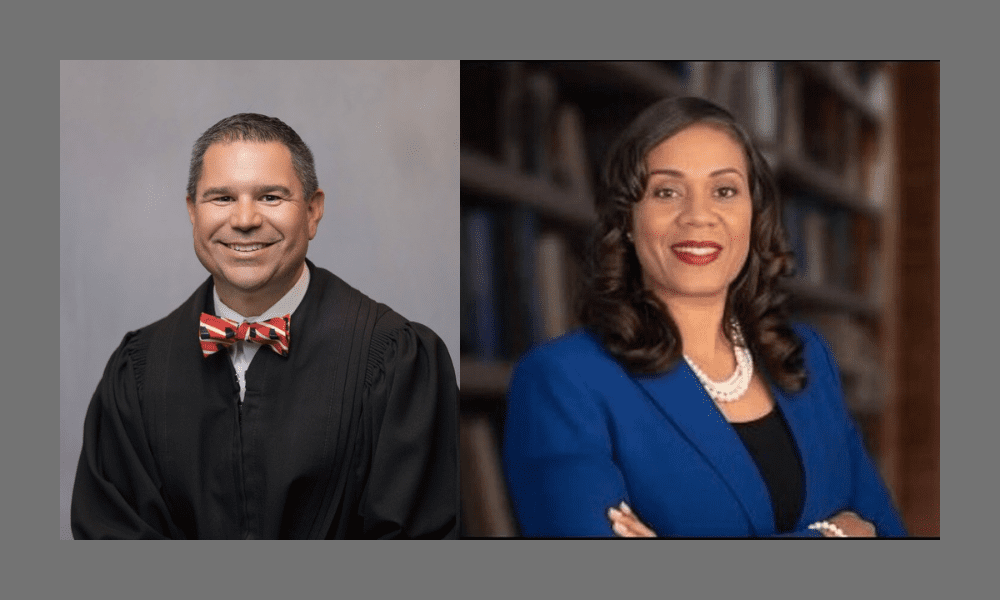
On the evening of May 5, the Fayette County Chamber of Commerce partnered with the Peachtree City and Fayetteville Rotary Clubs to host a candidate forum at Peachtree City Christian Church. Two Fayette County races were on the agenda: the State Court Judge seat and the Board of Commissioners District 3 contest.
This is the first of two articles I’m writing about the forum, and this one focuses on the judges.
The state court race put two people with serious legal careers on the same stage: incumbent Judge Jason B. Thompson and challenger Judge Nailah Grant McFarlane. The forum revealed that while both belong in a courtroom, only one made a convincing case for this particular seat.
The Candidates
Judge Jason B. Thompson has been Fayette County’s State Court Judge since May 2013, appointed by Governor Nathan Deal after years of service as a prosecutor, Municipal Court Judge, and Magistrate Court Judge. On the bench, he built the Griffin Judicial Circuit’s first DUI/Drug Court in 2016 and the Veterans Treatment Court in 2020. He serves on the executive committees for both the Council of Accountability Court Judges and the Council of State Court Judges, represents state court judges on the statewide Access to Justice Committee, and received the 2022 Dreambuilder Award from the Fayette County Chamber of Commerce and the 2025 Award of Excellence from the Fayette County Bar Association. He and his wife live in Fayetteville with their three kids, and if you have driven anywhere in this county lately you already know his name. The man seems to have more yard signs throughout the county than there are roads.
Judge Nailah Grant McFarlane is a graduate of Morris Brown College and John Marshall Law School and is a 29-year member of Delta Sigma Theta Sorority. She spent 19 years as a trial attorney across prosecution, defense, and civil litigation before becoming a judge in 2014. She has also served in municipal, magistrate, state, juvenile, and Superior Court by designation, a range she calls a “360-degree experience.” She has been on the campaign trail for over a year running on a platform of reducing case backlogs, expanding access to accountability courts, and bringing what she calls a “Smart Justice” approach to the bench.
What Judge McFarlane Said
The forum gave each candidate six minutes for an opening statement, followed by a two-minute closing. Judge McFarlane went first.
She opened with a story about a childhood friend named Omar, someone full of life who dreamed of traveling the world and serving in the military, who was wrongfully convicted because he lacked proper representation and meaningful judicial protection. She said that witnessing that injustice shaped her commitment to fairness, respect, and dignity for every person who walks through a courtroom door.
From there she made a data-driven argument against Judge Thompson. Between 2020 and 2024, she said the probation rate in Fayette County increased by 153%, and fines and fees collected by the court went from $433,430 to $827,814. Her conclusion was that the court has grown more punitive rather than more rehabilitative.
She also challenged the accessibility of the accountability courts Judge Thompson has built. She did not dispute that the programs work but argued they are not available to everyone who should qualify. At $430 per month, the cost of participating prices out the very people most likely to need the help, and the scale concerns her as well: with 100,000 cases over 13 years and less than one percent moving through his accountability courts, the math works out to roughly nine people per year. The argument was not that the programs are bad but that they are too small and too costly to access to have a countywide impact.
She also argued that the court should be doing more to move people off extended probation. She said that cases eligible for review after six months or a year are not being acted on consistently, and that getting those cases on the docket would be her priority on day one.
What Judge Thompson Said
Judge Thompson took the bench in 2013 with one tool available for defendants struggling with substance use disorders, mental health challenges, or PTSD, and that tool was incarceration. He described one of his first trials, in which a defendant with a substance use disorder was found guilty and sent to jail. The man had supervised 20 employees for 15 years at the same company. His employer ended the job. His two middle-school daughters said goodbye to their father in the courtroom. His wife entered the workforce. And the county spent $98 a day to hold someone who would receive no treatment, learn no trade, and emerge no better than he went in. “I keep looking for his name on either the obituary or the jail roster,” Judge Thompson said.
After that case, he brought preachers, prosecutors, defense attorneys, probation officers, and community leaders into the same room and asked whether they wanted to do better. What came out was the DUI/Drug Court, launched in 2016 after years of grant-seeking and community building. Rather than incarceration, participants spend two years in structured accountability with treatment, testing, and curfews. Recidivism drops from 70% to under 20%, participants keep their jobs and their families, and the county has saved $1.5 million in jail costs.
The veterans came next. Four years into the drug court, Judge Thompson said he kept being asked what he was doing for veterans and did not have a good answer. His father is a Purple Heart recipient, and his grandmother served in the Women’s Army Corps in World War II, so it landed personally. He went back to the same table, added the veteran community, and built the Veterans Treatment Court, now six years running. Each participant is paired with a retired service member as a battle buddy, graduations are held at American Legion posts, and Judge Thompson described a father who finally attended his son’s high school football game after going through the program. “My dad got to watch me play for the first time,” the son told him, “and we had the best Father’s Day ever.”
On Judge McFarlane’s probation numbers, he pushed back with context. In 2020 and 2021, the Supreme Court of Georgia declared a judicial state of emergency that suspended jury trials for 18 months. He normally runs about 25 jury trial weeks per year; during those two years he had three. When the emergency lifted, he chose to work twice as hard rather than let cases pile up, which meant roughly seven times as many cases, pleas, and sentences flowing through the court in a compressed window. The probation increase Judge McFarlane cited, he argued, was a predictable consequence of clearing that backlog, not evidence of a court growing more punitive. On access to his accountability courts, he said finances have never been a barrier. The program offers scholarships, and no one who qualifies has been turned away for lack of funds.
The Closings
Judge McFarlane returned in her closing the same way she had opened, with the numbers: probation rates up 153%, fines and fees nearly doubled, and accountability courts that remain out of reach for too many people at $430 a month. She pledged to find resources and bring that cost down, and she walked through her credentials one more time, noting she handled 5,255 traffic matters and 938 criminal matters in 2024 alone. She has done the work and she knows the system, she said, and she is ready for this seat.
Judge Thompson closed with his grandmother, who served in the Women’s Army Corps in World War II and gave him the only instruction a judge needs: go into your courtroom every day, treat everybody respectfully, treat everybody equally, and follow the law. “That’s what I’ve done for 13 years,” he said, “and I’ll continue to do that.”
The Verdict: Consistency Trumps Critique
Forums are not elections, but they do something useful. They put two people side-by-side and show whether the case they are making holds together when someone is ready to push back.
With that in mind, let’s take a deeper look at Judge McFarlane. She is very impressive. Nineteen years of trial work across prosecution, defense, and civil litigation is not something most attorneys can claim, and the breadth of courts she has served gives her a perspective that many judges never develop. Her emphasis on fairness and human dignity is exactly right for this seat, and her statistical critique of probation rates and court fees came across as persuasive, as did her accessibility argument around the accountability courts.
The problem is that Judge Thompson had a convincing, specific answer for every point she raised. His COVID explanation for the probation numbers was logical and held up, and his response on program access was direct: no one has ever been turned away for lack of funds.
This solid defense creates an issue for Judge McFarlane. When you spend most of your time criticizing your opponent and your opponent has a grounded answer for each of those criticisms, you are left with very little else. Voters are then left not knowing why she would be better than the person who has been doing this job for 13 years.
Judge Thompson is not entirely off the hook, though. I walked out of the forum not fully understanding what his next term would look like, and that is a real gap. But when a challenger’s critique runs up against an incumbent’s record, the burden falls on the challenger to show that change produces better outcomes than continuity. She did not make that case.
Judge McFarlane is a compelling candidate, and I would not be surprised to see her in a seat like this one day. But for this election, at this moment, the record in front of voters is hard to argue against.
My recommendation is to give Judge Thompson another term. He has earned it.
Where and When to Vote
Election Day is Tuesday, May 19, with polls open from 7:00 a.m. to 7:00 p.m. Any voter in line before 7:00 p.m. will be allowed to vote. However, early voting is still underway across Fayette County, and you have several options depending on where you live and what day works for you.
Remaining early voting dates:
- Wednesday, May 6 through Saturday, May 9
- Monday, May 11 through Friday, May 15
Early voting locations and hours:
- Fayette County Elections Office at 175 Johnson Avenue, Fayetteville, GA 30214: Monday through Friday 9:00 a.m. to 5:00 p.m., Saturday 9:00 a.m. to 5:00 p.m.
- Peachtree City Library at 201 Willow Bend Road, Peachtree City, GA 30269: Monday through Friday 9:00 a.m. to 5:00 p.m., Saturday 9:00 a.m. to 5:00 p.m.
- Tyrone Town Hall at 950 Senoia Road, Tyrone, GA 30290: Monday through Friday 9:00 a.m. to 5:00 p.m., Saturday 9:00 a.m. to 5:00 p.m.
- Fayetteville Library at 1821 Heritage Parkway, Fayetteville, GA 30214: Monday through Friday 9:00 a.m. to 5:00 p.m., Saturday 9:00 a.m. to 5:00 p.m.







Leave a Comment
You must be logged in to post a comment.