


 2652
2652 2
2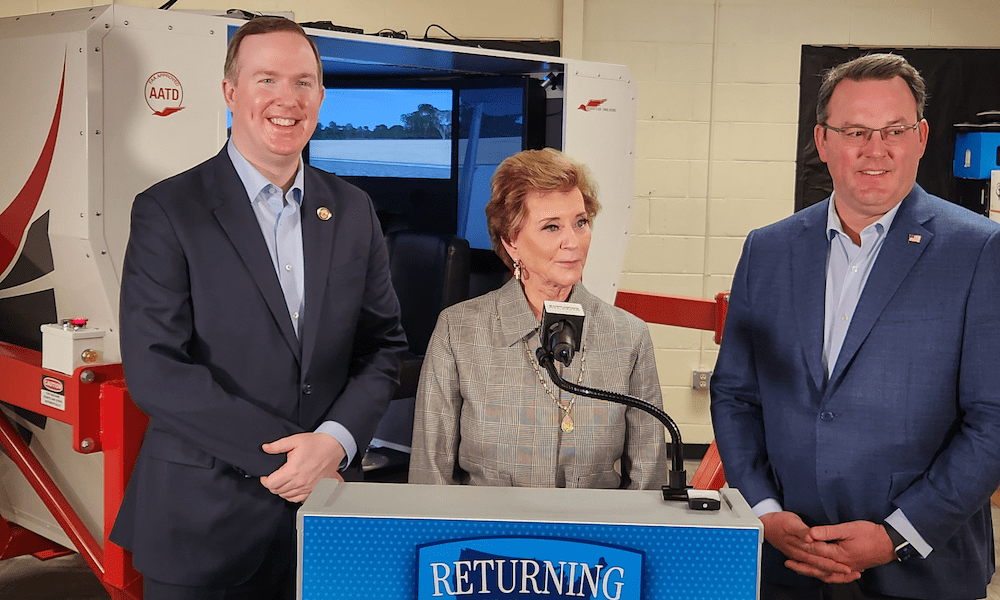
U.S. Secretary of Education Linda McMahon answered pointed questions Friday about the future of federal education policy during a press gaggle following her visit to the Central Educational Center in Coweta County.
McMahon addressed concerns ranging from Title I funding and civil rights enforcement to student loan repayment, as the Trump administration moves forward with plans to dismantle the U.S. Department of Education and return its functions to other federal agencies and the states. Georgia marked the 27th stop on McMahon’s tour of all 50 states.
Title I funding
Asked what would happen to Title I funding if education authority is shifted away from the department, McMahon said schools should not expect changes to how the money is distributed.
“It’ll look the same, the same,” she said. “Before there was a Department of Education, Title I funding flowed. They came exactly where it was supposed to go.”
McMahon said restructuring federal agencies would not change congressional appropriations.
“That money will flow the very same way,” she said. “It’ll just go through a different agency.”
Civil rights enforcement
McMahon was also asked how civil rights protections would be enforced if the Department of Education is dismantled, particularly in cases involving discrimination.
“The service within the Department of Education is the Office of Civil Rights,” she said, adding that the program would continue even if relocated.
“My first instinct is that it’s probably going to reside in the Department of Justice,” McMahon said. “That’s not been fully decided yet, but it’s one of the things that we are looking at.”
She said determining where programs will ultimately land is part of her current work.
“And that’s what we’re doing now,” McMahon said.
Interagency restructuring
McMahon described the administration’s approach as a step-by-step process, beginning with interagency agreements to test whether moving programs improves efficiency.
“We have signed what’s called our first interagency agreement,” she said, referring to an agreement with the Department of Labor.
She said education employees have already been detailed to the Labor Department to oversee workforce-related grants.
“The primary emphasis has been on Perkins grant money as well as WIOA money,” McMahon said.
WIOA, the Workforce Innovation and Opportunity Act, is a federal law that funds job training and workforce development programs nationwide.
“We have actually been able to get money out much faster having it at the Department of Labor, because now we’re dealing with only one system,” McMahon said.
Student loan repayment
McMahon also addressed questions about whether the federal government could resume collecting student loan debt through tax refund offsets.
“It’s one of the conversations we’ve certainly had,” she said, confirming discussions with the U.S. Treasury.
She said the administration is focused on getting borrowers back into repayment rather than leaving them in default.
“We don’t want people to be in default,” McMahon said. “Those folks that are in default can’t buy houses, can’t buy cars.”
She said the goal is to create repayment options that are affordable while restoring order to a system she said was left in disarray.
“The past administration really left this repayment program really in a mess,” McMahon said. “We are really trying to get it sorted through, straightened out.”
Local context
McMahon answered the questions after touring the Central Educational Center and meeting with students, educators, and local officials. The visit was arranged by U.S. Rep. Brian Jack, R-Ga., as part of McMahon’s nationwide tour.
She said the purpose of visiting schools and education programs across the country is to better understand how federal policy affects communities on the ground.
“It’s really easy to pass laws in Washington,” McMahon said, “but it’s much easier to pass than implement and see what the impact is.”






Leave a Comment
You must be logged in to post a comment.