


 2179
2179 11
11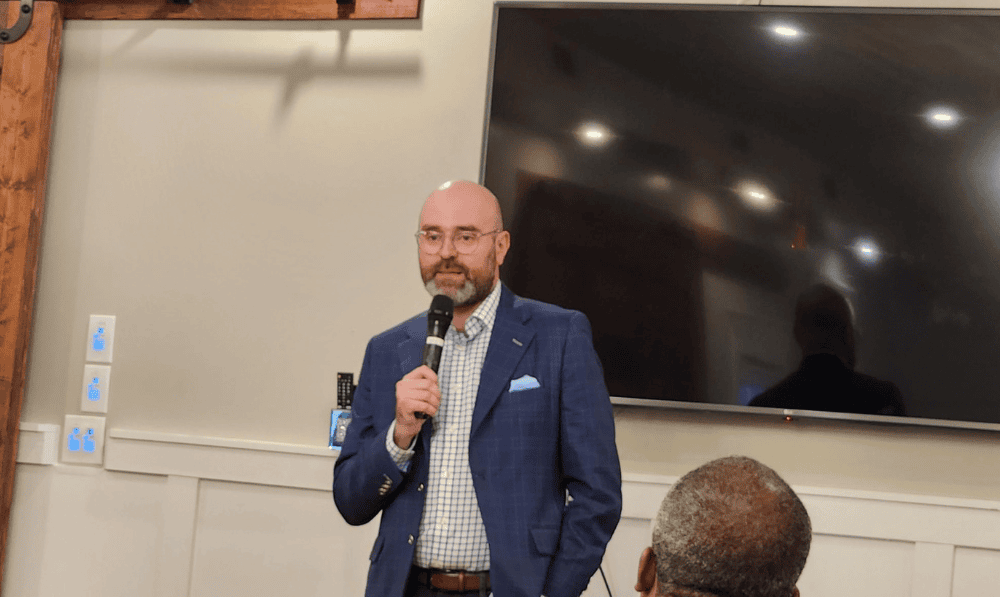
Democratic candidates seeking offices from Fayette County Commission to Congress gathered September 18 in Fayetteville, urging voters to look beyond the top of the ballot and arguing that local, state, and federal elections directly affect families’ everyday costs and quality of life.
The “Square Up 4 Democracy” event on East Lanier Avenue included a community marketplace, candidate meet-and-greet, and an evening program billed as “Voices for Democracy.” The Citizen attended about an hour of the evening program, during which speakers repeatedly returned to affordability, health care, education, utility costs, data centers, and Democratic turnout in November.
Samuel J. Cross, deputy officer for international affairs for the Young Democrats of America, argued that this year’s elections carry consequences beyond the United States.
“This election is a foreign policy issue,” Cross said. “Where the United States goes, the world follows.”
Cross sharply criticized President Donald Trump and the MAGA movement, framing the election as part of a larger international fight over democratic institutions and authoritarianism.
“The Constitution does not say we, the government. It doesn’t say we the oligarchs,” Cross said. “It says we the people of the United States of America.”
Cross also said international volunteers from Germany and Denmark are expected to work with campaigns in Georgia this fall, while volunteers from more than 18 countries will participate around the country. He clarified that the visitors would not serve as official poll watchers but could volunteer with campaigns, including knocking on doors.
Keller shifts from affordability to ‘survivability’
Maura Keller, the Democratic nominee challenging Republican U.S. Rep. Brian Jack in Georgia’s 3rd Congressional District, told the crowd the economic concerns she heard while campaigning in 2024 have intensified. Keller, a retired Army lieutenant colonel, also challenged Jack for the seat in 2024.
“When I ran in ’24, my platform has not changed,” Keller said. “The only difference is when I talked about affordability then, it’s no longer affordability. It’s all about survivability because that ship sailed.”
Keller discussed wages, health care, Social Security, farmers, tariffs, and data centers, telling attendees she has spent much of the campaign traveling across the 15-county district.
She particularly emphasized concerns about access to health care in rural areas and the future of Social Security.
“All the issues I’ve talked about — they’re nonpartisan issues,” Keller said.
County government and quality of life
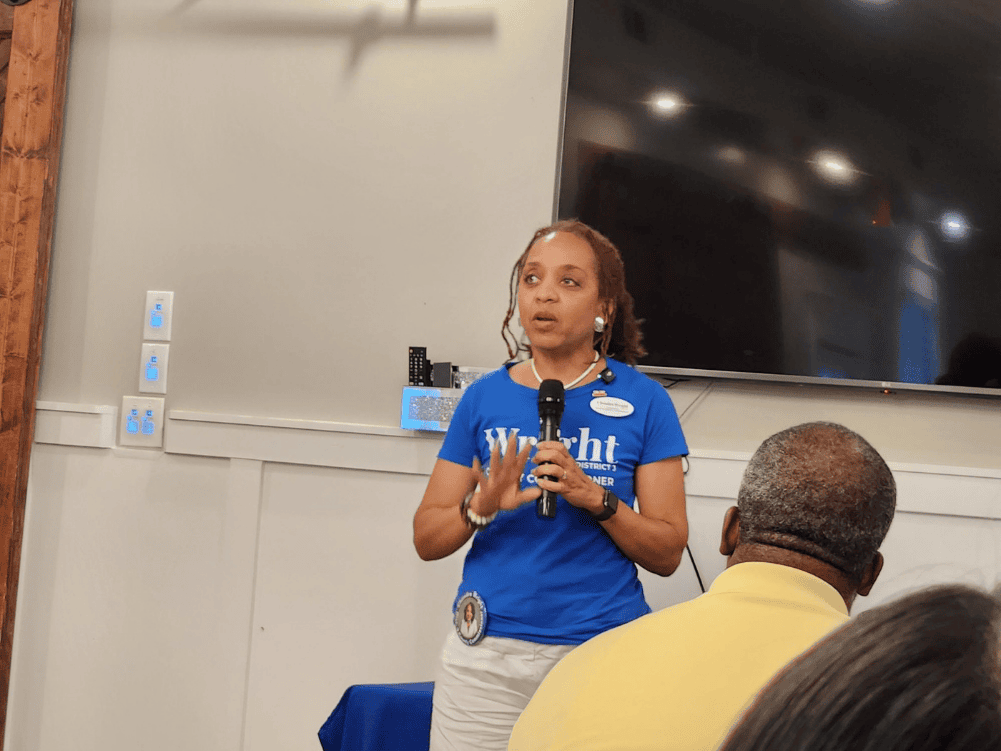
Chandra Wright, the Democratic candidate for Fayette County Commission District 3, focused much of her remarks on an office she said many residents do not fully understand.
Wright, who previously worked in Peachtree City’s planning department and said she earned a master’s degree in public policy from Georgia State University, described county commissioners as central players in decisions involving water, public services, development, and county funds.
“Every time you drive out into your driveway and hit the streets, that’s politics,” Wright said. “If you can turn on your spigot and brown water does not flow out of your spigot … that means somebody made sure that they are holding the water authority accountable.”
Wright said her campaign centers on listening to constituents, protecting quality of life, and what she called “facts over fear.”
“I will tell you the truth,” Wright said. “I will ask you what you feel, and then I am going to bring that information back to the commission and make sure that we make decisions that support the people of District Three and Fayette County.”
Utility bills and the Public Service Commission
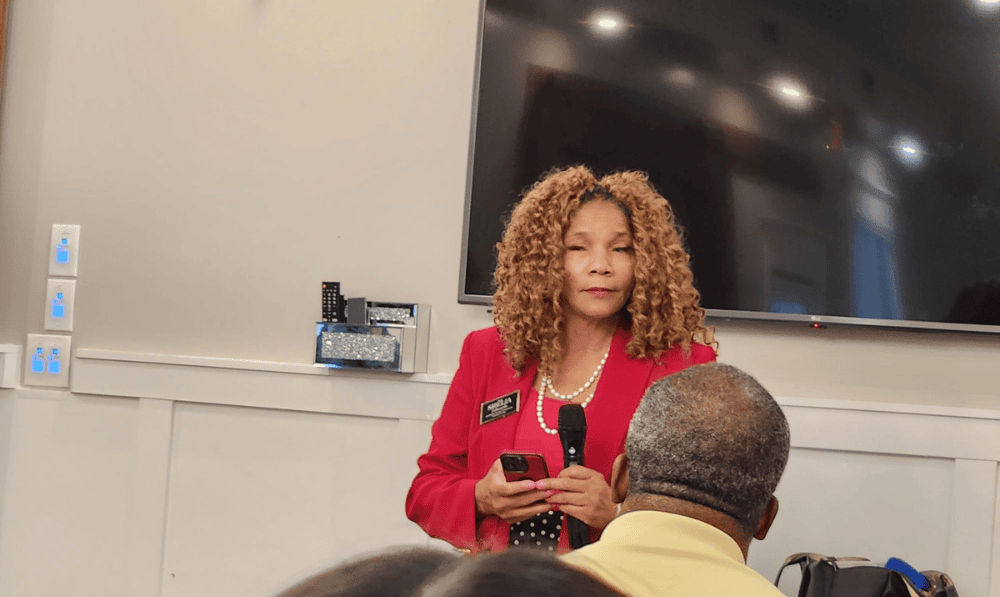
Shelia Edwards, the Democratic nominee for Georgia Public Service Commission District 5, used her remarks to focus on utility rates and consumer protection.
“The Public Service Commission is a statewide body comprised of five people that are supposed to protect you when it comes to rates,” Edwards said.
Edwards also pointed to her professional background as evidence of the experience she would bring to the commission. She said she worked for Lockheed at Kennedy Space Center on the space shuttle program and worked alongside NASA and aerospace engineers during the effort to return the shuttle program to flight after the Challenger disaster.
“I’m what’s called a hidden figure,” Edwards said. “I was speaking up for a pile of papers. I was bossing around the engineers to make sure they got it right.”
Edwards called watching the shuttle return to flight one of her proudest moments.
“We were outside going, ‘Go, go, go,’ because we made that happen,” she said.
She also discussed residents struggling with electricity bills and criticized the commission’s handling of utility rates.
“We’re going to work to put the public back into the service commission,” Edwards said.
McLaurin calls for a broader coalition
State Sen. Josh McLaurin, the Democratic nominee for lieutenant governor, has represented Georgia Senate District 14 since taking office in 2023. He was elected to the Senate in 2022 after serving four years in the Georgia House of Representatives.
McLaurin said Democrats should welcome independents and Republicans dissatisfied with the direction of the country rather than focus on telling those voters they had been wrong in previous elections.
“We got to, you know, bite our lip, widen the tent, welcome the larger coalition because there are independents and Republicans who are going to vote for us,” McLaurin said.
He said Democrats should present themselves as a stabilizing alternative focused on governing.
“We are emphasizing now that Democrats are the adults in the room,” McLaurin said. “We are the ones with the steady hands, and everybody can see it plain as day for themselves.”
McLaurin also pointed to Medicaid expansion, Georgia’s six-week abortion law, public-school funding, and adding a poverty weight to the state’s education funding formula as issues Democrats would pursue.
Powell focuses on early education and school funding
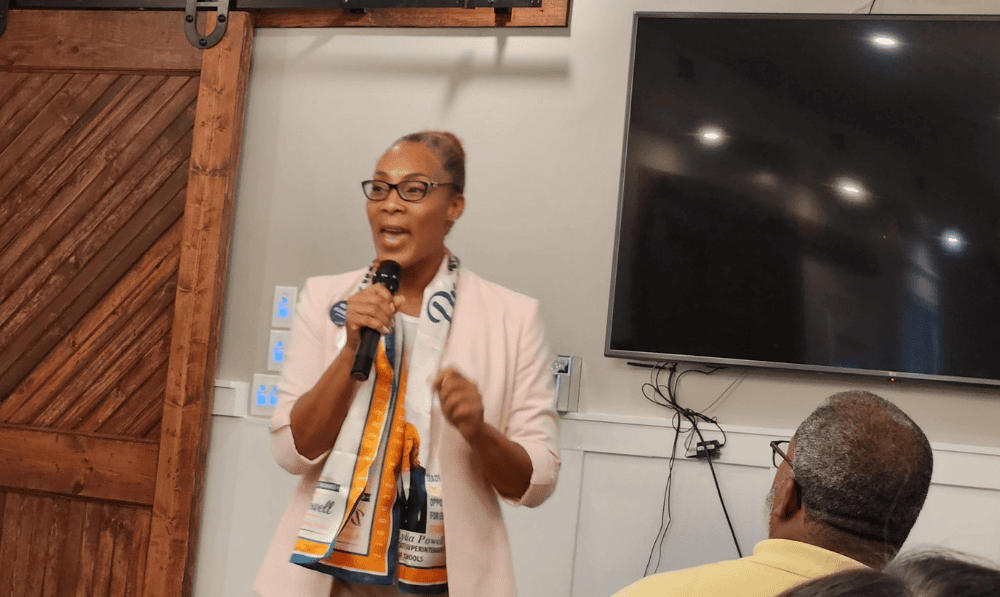
Dr. Lydia Powell, the Democratic nominee for state school superintendent, brought the discussion closer to home.
Powell told the audience she previously served six years as an assistant principal at Fayette County High School and lives in the community. She advocated expanding access to pre-K, improving internet connectivity in rural Georgia, reconsidering the state’s school funding formula, and reducing an education system she said places too much emphasis on standardized testing.
During a question-and-answer period, Powell was asked about artificial intelligence in schools. She said students need to understand AI because it will be part of the workplace, but she cautioned against allowing the technology to replace the role of an educator.
“We have to teach our students how to get along with AI, how to learn AI, so that they’re marketable when they get into the workforce,” Powell said. “So it’s not all bad, but we do have to teach our students and our teachers how to kind of assimilate with that and use it as a tool and not as a replacement.”
“Nothing replaces a teacher,” Powell said. “Nothing replaces your feedback. Nothing replaces your voice in giving the student feedback.”






Leave a Comment
You must be logged in to post a comment.