


 2927
2927 4
4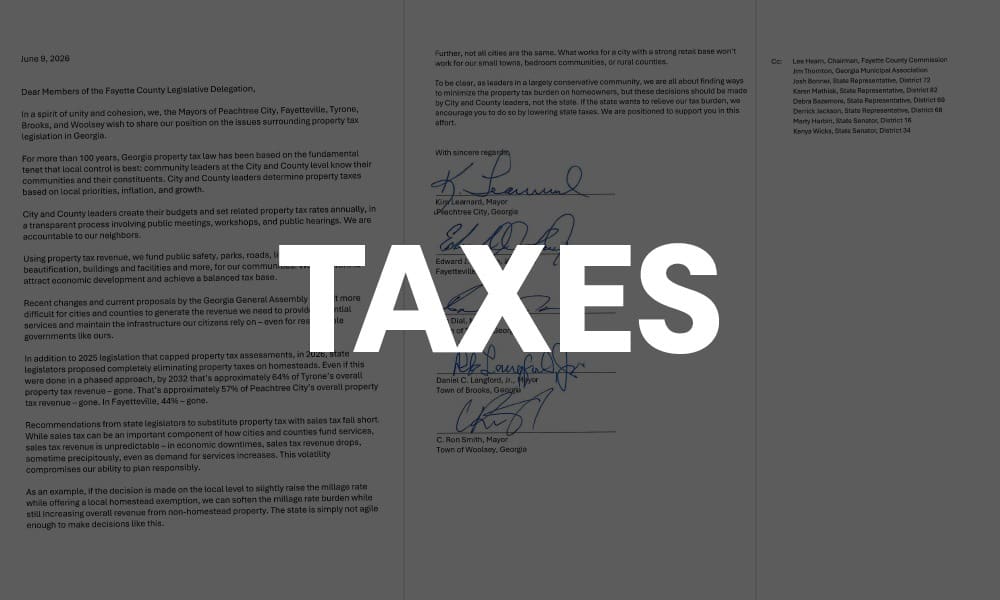
In a rare display of written unity, the mayors of Fayette County’s five municipalities sent a joint letter June 9 to the county’s legislative delegation, urging state lawmakers to leave property tax decisions in local hands and setting up a public debate over who should control local government revenue.
The letter, signed by Peachtree City Mayor Kim Learnard, Fayetteville Mayor Ed Johnson, Tyrone Mayor Eric Dial, Brooks Mayor Dan Langford, and Woolsey Mayor Ron Smith, was sent to State Reps. Josh Bonner, Debra Bazemore, Karen Mathiak, and Derrick Jackson, as well as State Sens. Kenya Wicks and Marty Harbin.
The letter followed a meeting several weeks earlier between local elected officials and members of the Fayette delegation to discuss property tax legislation and other issues facing local governments.
Dial said the mayors viewed the letter as a response to that discussion.
“One of the things that they wanted to see was for the local governments in Fayette County to present to them a unified message, and so that’s what this was doing,” Dial said.
At the heart of the discussion is a growing debate over who should control the purse strings. Georgia lawmakers have pursued legislation aimed at providing property tax relief to homeowners, while local officials argue that decisions about local property taxes — and the local services those taxes fund — should remain in the hands of locally elected leaders.
In their letter, the mayors wrote that “for more than 100 years, Georgia property tax law has been based on the fundamental tenet that local control is best.”
“We are accountable to our neighbors,” the mayors wrote. “Property tax revenue funds public safety, parks, roads, libraries, recreation, beautification, buildings and facilities, and more for our communities.”
Local leaders seek flexibility
The mayors argued that recent state actions and proposed legislation could make it more difficult for cities and counties to fund essential services.
“Recent changes and current proposals by the Georgia General Assembly make it more difficult for cities and counties to generate the revenue we need to provide essential services and maintain the infrastructure our citizens rely on,” the letter states.
Learnard said local governments depend on property tax revenue to provide services residents expect.
“When state legislators pass laws about property taxes, they seem to be forgetting that property taxes are decided locally by local elected officials at the city and county level, because we use those dollars to provide local services,” Learnard said.
She said state lawmakers who want to provide tax relief should focus on taxes controlled by the state.
“If they want to relieve Georgians’ tax burden, they should do it through state tax vehicles like income tax and sales tax, and get their hands out of my bucket of money,” Learnard said.
Dial expressed concern that state-imposed limits may not keep pace with rising costs.
“If inflation goes up 5% but they capped us 3%, then where are we supposed to find that 2%?” Dial said.
He pointed to expenses such as police officers, road maintenance, and other basic services as examples of costs that can rise faster than revenue limits allow.
Langford offered a shorter assessment.
“I wish they would stay in their lane,” Langford said. “I wish the state legislator would stay in its lane and deal with taxes they impose rather than taxes towns and cities impose.”
The mayors also questioned proposals that would shift more reliance to sales taxes.
“Sales tax revenue is unpredictable in economic downturns,” the letter states. “Sales tax revenue drops, sometimes precipitously, even as demand for services increases.”
The letter further noted that homestead property taxes account for approximately 64% of Tyrone’s property tax revenue, 57% of Peachtree City’s property tax revenue, and 44% of Fayetteville’s property tax revenue.
“As leaders in a largely conservative community, we are all about finding ways to minimize the property tax burden on homeowners,” the mayors wrote. “But these decisions should be made by city and county leaders, not the state.”
Legislators point to rising tax bills
Bonner said lawmakers are responding to concerns they hear from constituents throughout their districts.
“The reality is property taxes are high,” Bonner said.
“When I say to you that I have people, constituents in our community tell me, ‘Josh, I can no longer afford to live in the place that I grew up because my property taxes are too high,’ I’m not making those stories up.”
Bonner said state legislators have a responsibility to act when residents raise concerns.
“If there’s an issue that’s impacting constituents, I’m going to act,” he said.
He pointed to legislation approved this year that would allow Fayette County voters to decide whether future revenue associated with data center development could be used to offset homestead property taxes through three separate referendums expected to appear on November ballots.
“We just cannot continue this trajectory of property taxes increasing to the point where it just simply prices people out of their homes,” Bonner said.
State Rep. Karen Mathiak said she also continues to hear concerns about taxes from constituents across her district.
“We hear them, we want to make some changes, some changes for our community,” Mathiak said.
At the same time, Mathiak said she understood the concerns local officials have raised about state involvement in local tax decisions.
“I understand when they say get the state out of, you know, the cities and the counties,” Mathiak said. “I understand that.”
A debate likely to continue
The mayors closed their letter with a direct challenge to lawmakers.
“If the state wants to relieve our tax burden, we encourage you to do so by lowering state taxes.”
While local officials and legislators disagree on who should control property tax policy, Mathiak said the conversation is far from over.
“We’ve got to have better conversations,” she said.



Leave a Comment
You must be logged in to post a comment.