


 3393
3393 0
0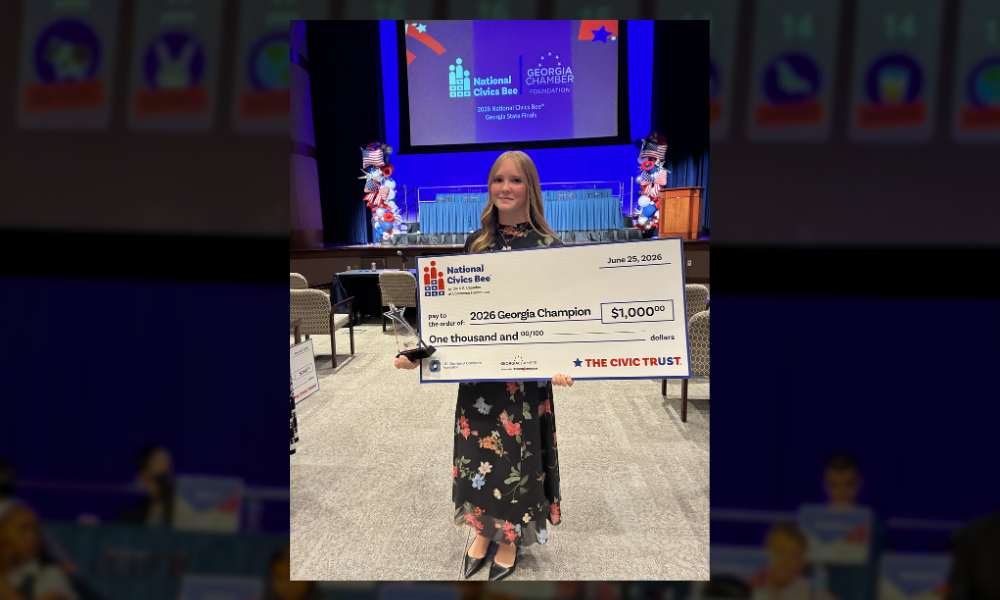
Before Georgia’s top middle school civics students took the stage at the Carter Center last week, Arnall Middle School graduate Ella Hummel reminded herself to do one thing: slow down.
The 14-year-old knew the answers. The challenge was making sure the judges understood them.
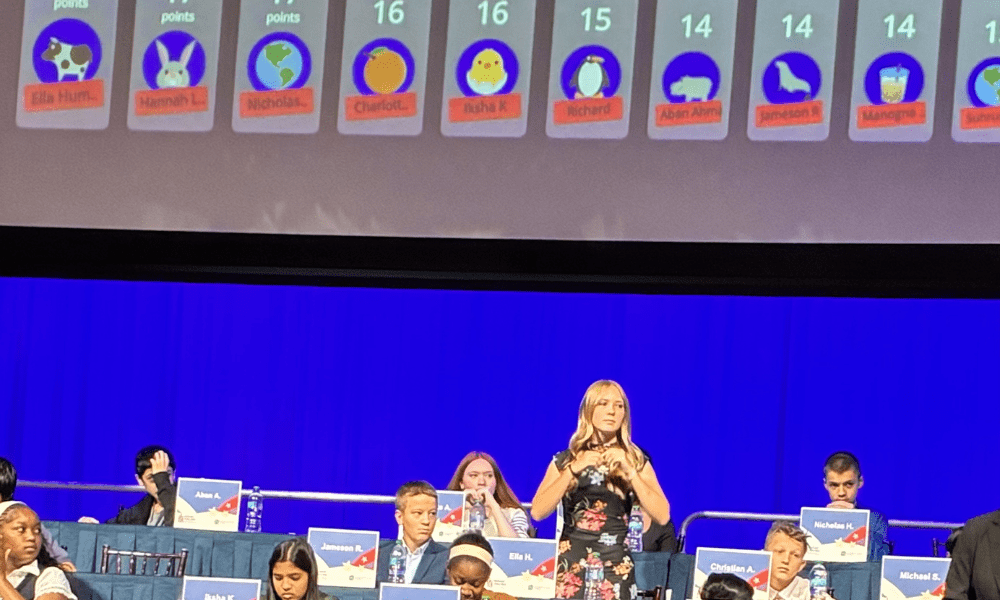
That approach paid off Thursday when Hummel captured first place in the Georgia State National Civics Bee, earning the title of state champion and the opportunity to represent Georgia at the National Civics Bee Championship in Washington, D.C., this November. The Newnan resident also received a $1,000 prize and will compete against state champions from across the country for a $100,000 scholarship.
The victory came just three months after Hummel won the Newnan-Coweta Chamber of Commerce’s district National Civics Bee, earning the opportunity to represent Coweta County at the state competition.
“I was honestly just shocked when they called my name for first,” Hummel told The Citizen about her state win. “I had expected to get second or third.”
The competition began months earlier when middle school students wrote essays proposing solutions to issues facing their communities. Hummel chose food insecurity.
“According to a USDA study, 7.3 million children live in households that are identified as food insecure,” Hummel told the judges during her presentation. “These students who are living in these households are statistically more likely to underperform in class, act out, and overall be less successful within their lives.”
Her proposal focused on redistributing unopened and unserved food from school cafeterias to students who need it.
Rather than stopping with her original essay, Hummel continued researching the issue after winning the district competition. Cynthia Bennett, who coordinates the Newnan-Coweta Chamber of Commerce’s National Civics Bee and serves as board chair of Coweta Meals on Wheels, connected Hummel with the Coweta County School System’s nutrition director to explore whether the proposal could work in practice.
That conversation taught Hummel that federal food safety regulations would likely prevent her original concept from being implemented locally. Instead of abandoning the idea, she researched existing programs, including Georgia’s Share Table initiative, which allows students to place unopened food they do not want in a designated location where it can be redistributed.
“I was surprised, because this program sounds so similar to what I’ve come up with,” Hummel told the judges. “Why can’t mine?”
Although she learned there are obstacles, Hummel said she still hopes to see a version of the idea become reality.
“I’d like to see something like that come to fruition eventually,” she said.
She also researched organizations such as Backpack Buddies, which provides weekend food to students, while arguing there is still a need to address hunger during the school day.
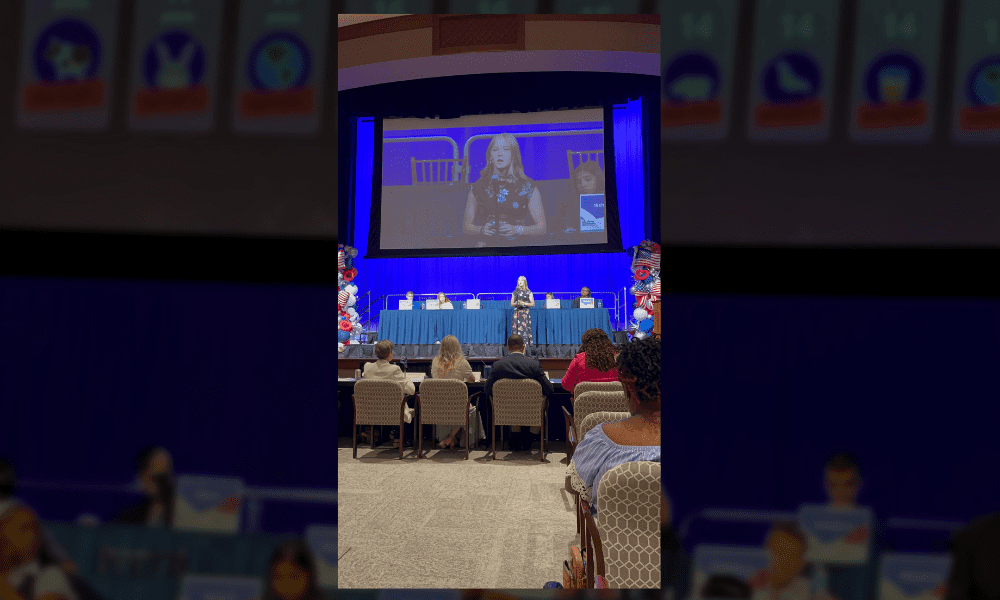
When judges pressed her on food safety, privacy for participating students, and partnerships with local farmers, Hummel answered each question thoughtfully, explaining how food could remain within the school system, how students could discreetly receive food at dismissal, and why nonperishable items would be the safest option.
Asked afterward what she enjoyed most about the competition, Hummel said it wasn’t the multiple-choice rounds.
“I think public speaking is definitely my strong suit,” she said. “I was able to remain calm and speak in a very almost conversational tone to the judges.”
She also credited preparation.
“I was just trying to remain calm as I was speaking, because I didn’t want to talk too fast,” she said. “I was trying to make eye contact with the judges, and keep the information I’m trying to give clear and concise.”
Hummel entered the speaking round after finishing first in the quiz portion of the competition, answering 19 of the 20 civics questions correctly over two rounds.
Her father, Andy Hummel, said watching his daughter perform under pressure was especially rewarding.
“It was a lot of pride seeing her do it,” he said. “The county one was exciting to watch, and then you get to the state level, and the competition goes up. Just seeing how she performs under the pressure was exciting.”
He said the competition rewards students who choose meaningful issues from the very beginning.
“Everything is anchored to your original essay,” he said. “You have to pick a really good original essay topic, because that’s going to carry you forward.”
Dr. Phil Sykes, Coweta County School System’s social studies content specialist, praised Hummel’s accomplishment.
“I am beyond proud of Ella and the work she put into representing the Coweta County School System,” Sykes said. “Her dedication and determination helped her win the state championship and will carry her far in the national contest. Ella’s accomplishment says a ton about our district’s dedication to civics and social studies education.”
Hummel recently completed eighth grade at Arnall Middle School and will begin her freshman year at Northgate High School this fall. A straight-A student in the gifted program, she also competed in four sports during middle school and has already earned a spot on Northgate’s girls flag football team.
Now she is preparing for the national competition, where she plans to continue researching food policy and speaking with experts who can help strengthen her proposal.
With America preparing to celebrate its 250th birthday, Hummel said civics is most valuable when it inspires people to become active participants in their communities.
“I think civics is really important that young people get exposed to it,” she said, “because if people understand what it is from a young age, they’ll be more likely to volunteer and be a member of society who participates in democracy.”
Asked what she believes is most important about being an American, Hummel didn’t point to a historical event or constitutional principle. Instead, she pointed to participation.
“Probably participation, like participating in democracy and making your voice heard within our government,” she said. “Voting, even though I’m currently not old enough to vote, emailing or sending letters to local legislators, volunteering within your community, and just standing up for what you believe in and making that known.”



Leave a Comment
You must be logged in to post a comment.