


 3772
3772 0
0
When sciatica strikes, it can feel like it comes out of nowhere. One day, life moves normally; the next, sharp, radiating pain shoots from the lower back down the leg, making even the simplest movements difficult. According to Dr. Noah Marchese of HealthChoice Chiropractic, a chiropractor who treats sciatica daily in his practice, this sudden shift is more common than people realize — and far more disruptive than many expect.
“It’s a low back pain that’s accompanied with pain radiating down one leg, sometimes both,” Marchese explained. “It can be numbness, tingling, burning, sharp shooting — just excruciating pain.”
What Sciatica Really Is
Sciatica is typically the result of a disc pressing against part of the sacral plexus, especially the sciatic nerve. When those nerves become compressed, pain can travel from the lower back into the hip, leg, calf, or even the foot. Some people feel it only in one area; others feel it from hip to toe.
And while the pain itself can be intense, Marchese said the cascading effects are just as concerning. He explained that when people begin shifting their weight away from the painful side, they end up over-using the opposite hip and knee, often triggering secondary problems that would not have developed otherwise. In severe cases, an untreated herniated disc can even begin affecting bowel or bladder function, which is a sign that the nerve compression is becoming dangerous.
Why People Wait Too Long
Most patients don’t come in at the first sign of trouble. “Unfortunately, most people wait until they can’t walk or move anymore,” Marchese said. “One day they’re good, and the very next day it’s like — bang.” Some people wait because they assume it will resolve on its own. Others don’t realize the issue could be coming from a disc that is degenerating or herniating over time, even without a dramatic injury.
How His Office Treats Sciatica
At HealthChoice Chiropractic, Dr. Marchese begins every case with a full exam to determine which nerve pathways are affected, because where the pain travels tells him exactly which disc is involved. Once he identifies the source, treatment focuses on whether the problem is structural (disc-related) or muscular.
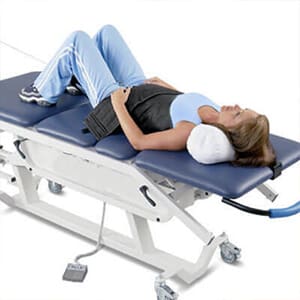
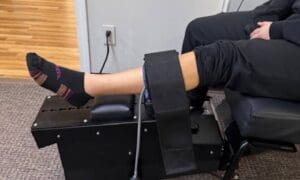
When the issue is structural, such as a disc bulge or narrowing disc spaces, he uses spinal adjustments, decompression therapy, and SoftWave therapy together to relieve the pressure on the sciatic nerve. “Decompression is the main therapy they need,” he said, describing how the table gently stretches the spine to open the disc spaces and relieve nerve pinching. SoftWave therapy enhances healing by reducing inflammation, improving circulation, encouraging collagen production, and stimulating stem-cell activity.
When the problem is muscular instead of disc-related, he focuses on deep stretching and targeted muscular therapy to relax the hip and glute muscles — especially the piriformis — that may be compressing the sciatic nerve. Supportive decompression or SoftWave sessions can be added when needed.
How Fast Does It Work?
Relief depends on the cause. When the pain comes from tight muscles, patients often improve quickly, sometimes in only a few sessions. Structural cases take longer but still often show significant improvement within a few weeks.
Dr. Marchese recalled a recent patient who dragged a “back pull” from a day of golfing. When the pain began radiating into his foot, he finally sought treatment. “After six sessions — decompression, SoftWave, adjustments — he was back out golfing like it never happened,” Marchese said. He also treated a 16-year-old soccer player who developed shooting pain down his leg. In his case, the problem wasn’t a damaged disc but the muscles in his hip and leg. After three sessions, the teen was back on the field, free of pain.
When Is It ‘Too Late’?
Most cases respond well to non-invasive treatment, but advanced degeneration limits what can be done. “There’s always a threshold point where it’s just too far gone,” Marchese said. That’s why he encourages patients to seek an evaluation early — long before sciatica becomes debilitating. Many people consider surgery as soon as the pain becomes severe, but he urges people not to assume that is their only option. “A lot of sciatica can be resolved with non-invasive treatment,” he said.
The Big Takeaway
Sciatica isn’t just about pain. It affects posture, balance, mobility, sleep, and the body’s ability to move safely. Left untreated, it can set off a chain reaction of joint and muscle problems and, in rare cases, can interfere with organ function. Marchese emphasizes one insight above all: “Pain is the last thing we feel,” he said. “Just because you don’t feel pain yet doesn’t mean something isn’t being pressed on.”
For anyone experiencing radiating pain, tingling, numbness or unexplained changes in gait, Dr. Marchese encourages getting evaluated sooner rather than later. Early treatment often prevents long-term damage — and makes it far easier to return to normal life.
Ready to Take the Next Step?
For people experiencing the kind of radiating pain that might be sciatica, they shouldn’t wait. Dr. Noah Marchese and the team at HealthChoice Chiropractic are ready to help. Their office is at 14 Eastbrook Bend #201, Peachtree City, GA 30269, and appointments are available at (770) 408-0184. (HealthChoice Chiropractic)





Leave a Comment
You must be logged in to post a comment.