


 2358
2358 0
0
The Georgia Environmental Protection Division (EPD) has issued a Level 1 Drought Response Declaration for our area, similar to the state’s ongoing outdoor watering rules. The EPD is encouraging residents to conserve water and repair any leaks in their irrigation systems. Rain sensors are required on all irrigation systems to cut down on water waste.
Permanent watering rules require outdoor irrigation systems and lawn sprinklers to operate only between 4 p.m. and 10 a.m. each day, year-round, regardless of weather conditions. There are some exceptions to this rule. You can water any time of the day for personal food gardens and use irrigation for newly planted or replanted landscaping, seed or turf for up to 30 days after installation. Drip irrigation systems and soaker hoses can be used at any time, as well as hand watering with a hose equipped with an automatic shutoff nozzle.
Watering is expensive, however, and it “pays” to learn some tricks to cut down on usage. See if you qualify as a “water-wise” gardener by correctly answering the questions below.
- The best time to water your plants is:
- Anytime of the day or night
- Early in the morning
- Late in the evening
- Watering during midday sun can cause sun-scorch of leaves on your plants. (T or F)
- You should water your lawn three times a week for 20 minutes each time. (T or F)
- More plants die from over-watering than under-watering. (T or F)
- The following are good ways to cut down on water usage in your garden:
- Work compost or soil conditioner into the native soil.
- Select plants that are proven to thrive in the southern climate.
- Add 2-3 inches of mulch around your plants.
- Use soaker hoses in your garden beds.
- Weed often around plants.
- All of the above.
- What is a good instrument every gardener should have to keep track of precipitation in order to know when plants need to be watered?
- For each inch of rainfall, six gallons of water per square foot of roof area can be collected in rain barrels or a cistern. (T or F)
- Which plants need more water:
- Plants in containers.
- New or recently transplanted plants.
- Mature shrubs and trees.
- Vegetable plants.
- Xeriscaping is a term for landscaping practices that use minimal water and protect the environment. Which of the following are characteristics of a xeriscaped garden?
- Less money, time and energy are required to maintain a healthy garden.
- Turf areas are smaller.
- There is less reliance on fertilizers and chemical treatments.
- Water usage is cut by 50%.
- All of the above.
- Overhead watering of plants can cause fungal diseases like mildew and leaf spot. (T or F)
Answers:
- Most experts believe that the best time to water is very early in the morning. Watering before the heat of the day allows water to be used more efficiently, soaking into the root zone and with less loss through evaporation. If you use sprinklers, early morning watering allows the leaves to dry out during the day, cutting down on fungal diseases.
- This is true for plants with hairy leaves. A research team in Hungary has concluded that water left on smooth leaves does not cause leaf burn, regardless of when you water. Water droplets left on hairy leaves (like ferns) can cause sun scorch because the hairs hold the water above the leaf surface and act like a magnifying glass directing light to the droplet. If you have a mix of plants with smooth and hairy leaves, it is best to water in the early morning.
- This is false. You should water your lawn only when it needs it! If your lawn is stressed due to lack of water, it may turn a faded bluish-green color and you’ll leave footprints in the grass when you walk on it. It is better to water deeply and more infrequently than to water three times a week for a short time. Lawns need about 1 inch of water per 7-10 days.
- This is true. More people kill landscape and house plants from over-watering than under-watering. Yellowing leaves do not always indicate a plant needs water. It may be getting too much water and the roots are rotting. Learn the specific watering needs of your plants. Group “like” plants together – those that require less water can be in the same planting beds and those that require more can be grouped together. Don’t forget plants also need to be grouped by light requirements – sun and shade.
- All of the above. For new planting beds, amend the soil with compost or soil conditioner to help the native soil absorb and retain water. Select plants that thrive in our hot and humid southern climate. After planting, add mulch around plants to help retain moisture, slow evaporation and cut down on weeds. Soaker/drip hoses placed around plants send water slowly and directly to the roots, cutting down on evaporation and water run-off. You’ll use water more effectively and won’t have to use as much. Weeds are fighting your plants for existing water. Keep weeds out of the garden beds and your plants get the benefit of the water.
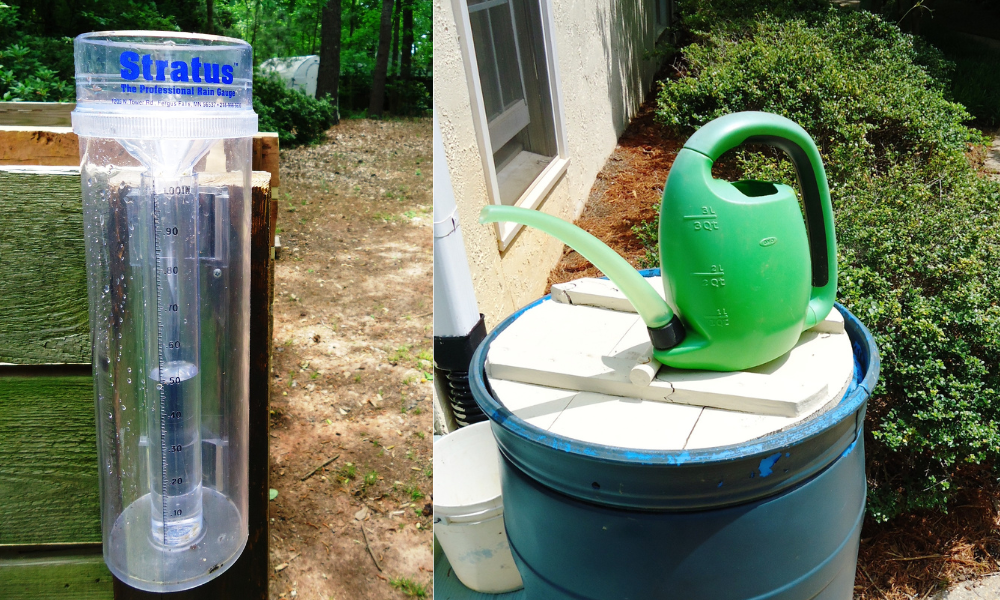
- A rain gauge. A rain gauge can accurately measure how much precipitation your garden has received so you can determine when and if your lawn and plants need additional watering. Tech savvy gardeners can check out the rain app, RainDrop – Rain Totals & Radar, that gives you accurate information on how much it has rained and snowed at your exact location. According to RainDrop, Peachtree City (where I live) has received -43% of its usual rainfall in the last twelve months.
- True. A rain barrel or cistern that collects run-off from house gutters can harvest and store “free” water for you to use to water your plants. You can indeed harvest approximately ½ gallon per square foot of roof area for each inch of rain that falls. That’s a lot of water!
- Xeriscaping is a seven-step approach to a water-wise garden. The seven steps include: Planning and Design; Soil Analysis; Appropriate Plant Selection; Practical Turf Areas; Efficient Irrigation; Use of Mulches; Appropriate Maintenance. For more information about Xeriscaping, contact the Fayette County or Coweta County Extension Offices.
- a. b. d. Plants in containers, new plants added to the garden and vegetable plants need more water than established, mature shrubs and trees in the landscape.
- True. Wet foliage that does not dry out can be susceptible to disease. Try to water at the base of the plant so the roots receive the water and try to avoid spraying the leaves. Hydrangeas and roses are especially susceptible to fungal diseases caused by wet leaves. If you see insects on the front and back of leaves, however, a good spray of water can dislodge insects such as aphids.
How did you do? Hope this will motivate you to become a more “water-wise” gardener!



Leave a Comment
You must be logged in to post a comment.