


 3736
3736 3
3
A heartbreaking tragedy struck the Texas Hill Country over the Fourth of July holiday. In the early morning hours, floodwaters from the Guadalupe River surged unexpectedly, sweeping through Camp Mystic, a private summer camp.
At least 129 lives were lost, including 36 children.
The danger had been clearly identified long before the disaster. Just nine months earlier, Kerr County submitted a 220-page hazard mitigation report to FEMA, warning that a flood was likely within the year. The report urged the installation of a flood warning system, estimated to cost less than a million dollars. Federal grants were available. County officials had tried since 2017 to secure that funding, but their applications were repeatedly denied by the state. A final attempt earlier this year also fell short.
The warning system that could have saved lives was never built.
This failure has struck a national nerve because the real danger was not just the water. It was a system that saw the risk, acknowledged it, and still did nothing.
It raises a question we cannot afford to ignore here in Fayette County: Are we prepared for a natural disaster, or are we just hoping one never comes?
We are not perched along a major river, fault line, or coastline. But we are not immune from harm. Serious threats exist, and each carries its own risks.
Tornadoes And Thunderstorms
According to the Fayette County Hazard Mitigation Plan (last updated in 2019), the county has experienced eight tornadoes over the past 30 years, averaging one every 4.3 years.
While catastrophic tornadoes are rare in our area, the most significant in recent memory occurred on March 25th, 2021. That evening, a violent EF-4 tornado formed in Heard County and carved a 39-mile path through Coweta County. With peak winds estimated at 170 miles per hour, the tornado devastated Newnan’s historic downtown, flattening homes and damaging key infrastructure. When it briefly entered northern Fayette County, it caused limited damage with downed trees, blocked roads, and scattered debris.
Severe thunderstorms are more common in our area and pose a year-round threat. These storms can bring straight-line winds, heavy rainfall, frequent lightning, and hail. For example, our last major thunderstorm on June 26th had estimated wind gusts of 60 mph and quarter-size hail.
In response to such threats, the Fayette County Emergency Management Agency (EMA) maintains a comprehensive emergency operations plan and works closely with the National Weather Service office in Peachtree City to monitor and respond to developing weather systems. During significant events, the EMA activates the Emergency Operations Center (EOC) to coordinate response efforts, and it may request assistance from the state when local resources are exceeded.
To alert residents of life-threatening weather, Fayette County also operates a network of 35 outdoor warning sirens, strategically placed throughout the county. They are silently tested throughout the year and are audibly tested once per year, typically in early February. If the sirens sound at any other time, residents should immediately seek shelter indoors.
Here is a map of where the sirens are located:

In addition to its alert systems, Fayette County undertakes regular storm mitigation efforts, including tree trimming near power lines, upgrades to stormwater infrastructure, and improvements to culverts, bridges, and flood-prone roadways.
In the event of a tornado warning, residents are advised to follow guidance from Ready.gov, which recommends sheltering in a small, interior, windowless room on the lowest level of a sturdy building. But for those without access to a reinforced shelter, the absence of community safe rooms remains a gap in our emergency preparedness.
Flash Floods
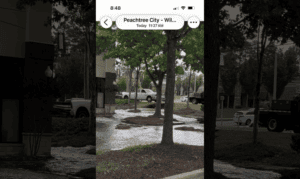
Fayette County is interlaced with a network of creeks and streams, including Flat Creek and Whitewater Creek. This makes our area particularly vulnerable to flash flooding during intense rainstorms and tropical systems.
In a past report, portions of Fayette County have been designated as 100-year and 500-year flood zones, indicating areas with a 1% and 0.2% annual chance of flooding, respectively. These designations are based on historical rainfall patterns, topography, and stormwater drainage capacity.
Here’s a map of our flood hazard zones:

Fayette County has recorded at least 18 significant flooding events in the past 20 years. One of the most destructive occurred in 1994 when Tropical Storm Alberto brought widespread damage and caused $30 million in property losses, along with one fatality. In 2005, Hurricanes Cindy and Dennis struck within the same week, pushing several creeks above flood stage and resulting in the death of an 18-year-old in Peachtree City after being swept into a drainage ditch.
To reduce future risk, Fayette County and its cities have implemented long-term stormwater management strategies. Peachtree City operates a dedicated Stormwater Management Utility that oversees drainage systems, enforces local regulations, and carries out infrastructure improvements. Fayetteville and Tyrone maintain similar programs focused on inspection, maintenance, and capital upgrades.
Many newer neighborhoods are required to include features such as detention ponds, bio-retention basins, or grassed swales. These systems help slow runoff and filter pollutants before stormwater enters nearby creeks and streams.
Fayette County does not operate an outdoor flood siren system. Instead, residents receive alerts through the National Weather Service’s Integrated Public Alert and Warning System, which sends targeted mobile notifications for flash flood warnings and other immediate threats. Additional warnings can be received through NOAA Weather Radios and reliable weather alert apps.
Tropical Storms And Hurricanes
Although Fayette County is located far from the coast, it remains vulnerable to the inland effects of hurricanes and tropical storms. When these systems make landfall along the Gulf or Atlantic, they often weaken but still carry enough wind and rain to cause damage deep into Georgia’s interior counties.
EMA monitors tropical systems in coordination with the Georgia Emergency Management and Homeland Security Agency and the National Hurricane Center. Before major storms arrive, the EMA conducts operational briefings with first responders, public safety agencies, and local officials to discuss projected impacts and prepare coordinated response efforts. Key safety information and updates are also shared through official communication channels, including emergency alerts, social media, and local news outlets.
Wildfire And Drought
Fayette County is not typically associated with wildfires, but prolonged drought conditions can significantly increase the risk. In wooded residential areas and throughout the county’s many undeveloped greenbelts, dry brush and vegetation can serve as fuel for small but potentially dangerous fires.
Wildfire and drought mitigation in Fayette County is managed through a combination of state and local agencies. The Georgia Forestry Commission monitors environmental conditions daily and issues advisories or restrictions when wildfire risk increases. Local fire departments are trained and equipped to respond to brush fires and often assist with prescribed burns to reduce fuel loads and manage undergrowth in vulnerable areas.
To help reduce the risk of accidental ignition, Fayette County enforces seasonal burn restrictions. A burn permit is required from October 1st to April 30th, while a full burn ban is in effect countywide the rest of the year. Municipalities may impose additional rules. For example, as of May 15th, 2025, Peachtree City has permanently banned the burning of yard debris.
However, there is more Fayette County can likely do to educate the public about wildfire prevention. Notably, the county and its municipalities are not currently listed among Georgia communities recognized by Firewise USA, a national program that promotes local action to reduce wildfire risk.
Ice And Snow
Winter storms are rare in Fayette County, but even a light dusting of snow or a thin layer of ice can cause major disruption. Limited snow removal infrastructure and frequent temperature swings make local roadways especially hazardous when winter weather strikes.
This proved especially evident in January 2014 when the “Snowmaggedon” winter storm brought sleet and freezing rain across metro Atlanta, including Fayette County. Roads iced over rapidly, stranding drivers, shutting down schools, and exposing major gaps in emergency response coordination.
Fayette County does not publish a formal winter weather operations plan, but its road crews generally follow Georgia Department of Transportation (GDOT) guidelines. GDOT’s Winter Weather Guide outlines treatment strategies using brine, salt, or calcium chloride, especially on bridges, overpasses, and major roads.
In practice, the county focuses its limited resources on key commuter routes and emergency access corridors. Most neighborhood streets remain untreated and can become dangerously slick when freezing conditions occur.
What Can We Do To Prepare?
Fayette County is, by most measures, well prepared for a range of natural disasters. We benefit from strong coordination among local agencies, real-time weather monitoring, trained emergency responders, and essential infrastructure such as outdoor sirens and reinforced stormwater systems. Emergency managers know how to activate an Emergency Operations Center and how to work with state and federal partners.
These systems are critical, but they only work if we support them. We have to pay attention to alerts, prepare in advance, and continually evaluate where our approach still falls short.
At the same time, emergency preparedness is not just our government’s responsibility. It begins at home.
If you do not know whether your property lies in a floodplain, you can look it up on FEMA’s website. If your family does not yet have a storm plan, now is the time to create one. Make a checklist of essentials. Store enough food, water, medications, and batteries to get through several days without power. Identify where you would go in a tornado or hurricane and talk to your neighbors about how you might support each other. Sign up for National Weather Service alerts and download a trusted weather app.
We cannot control the weather, but we can control how prepared we are. The tragedy in Texas reminds us that awareness is not enough if it is not followed by action.







Leave a Comment
You must be logged in to post a comment.