


 2303
2303 1
1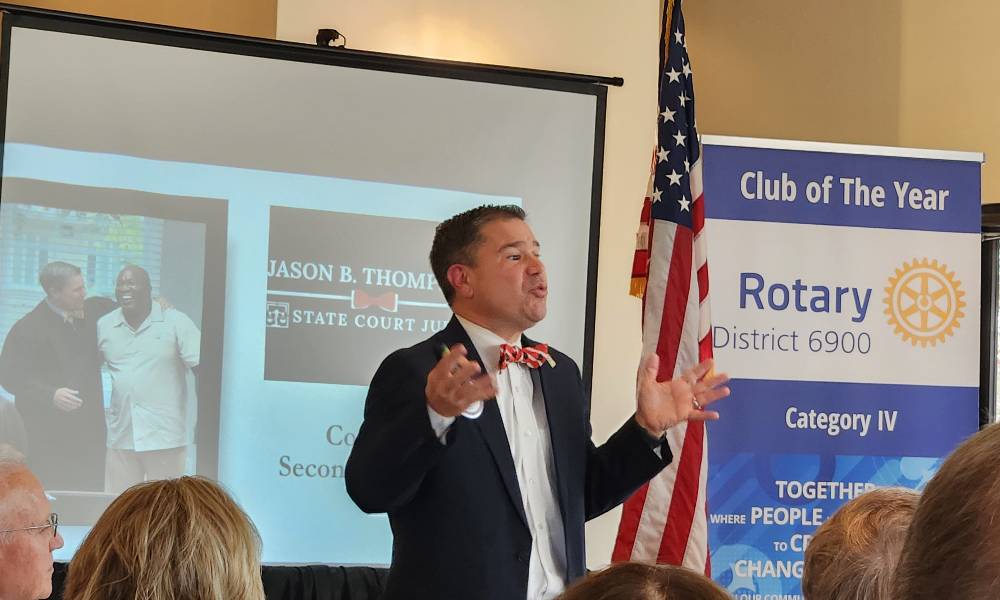
When Alex Nugent entered Fayette County’s DUI/Drug Court, he had two DUIs, no job, and a fractured relationship with his family. Two years later, he graduated sober, employed as a master mechanic, and reunited with the people who once feared he would never change.
Fayette County State Court Judge Jason Thompson, a member of the Rotary Club of Peachtree City, shared Nugent’s story Thursday while speaking to fellow Rotarians about the Fayette County Accountability Courts, a program he founded in 2016 and continues to administer.
The accountability court system includes the Fayette County DUI/Drug Court and the Fayette County Veterans Treatment Court, which offer eligible repeat offenders an alternative to traditional incarceration by combining treatment, close supervision, and long-term accountability. Thompson said the approach was created after he saw firsthand the limits of jail-only sentencing for people struggling with addiction.
“As a trial judge, I had one tool in the toolbox, and you know what the tool was? Jail,” Thompson said. “I knew on that day that I could do better as your judge. I knew that we could do better as a community.”
How the program works
The Fayette County Accountability Courts are designed for individuals with repeated drug- or alcohol-related offenses tied to substance use disorder. Participation is voluntary, but once enrolled, the program typically lasts about two years and requires intensive oversight.
Participants are subject to random drug testing, individual and group counseling, frequent court appearances, and regular meetings with a coordinated team that includes judges, prosecutors, defense attorneys, treatment providers, law enforcement, and case managers.
“Every two weeks we talk about everybody in the group,” Thompson said. “Are they doing well? Are they struggling? And we course-correct as a team.”
That accountability can include rewards for progress or sanctions for setbacks. Thompson emphasized that the program is not an easier option than jail.
“The studies show, if you support somebody with 18 to 24 months of these type of services and that level of accountability, the odds of them reoffend drop from over 70% to under 20%,” Thompson said.
Cost savings and community impact
Thompson said the program has resulted in significant savings for taxpayers by reducing jail time for participants. He noted that incarcerating someone costs roughly $98 to $100 per day.
“We reduce, on average, 102 days in jail per participant,” Thompson said. “When you subtract how we used to do it from how we do it now, you’re talking about close to $2 million that doesn’t have to be spent on the jail.”
Those savings, he said, can instead be directed toward public safety, senior services, recreation, and other county needs.
Beyond financial impact, Thompson said the program helps participants keep jobs, maintain family relationships, and avoid the cycle of repeated arrests.
“If you can say to your employer, ‘I’ll be back Thursday,’ that’s different than saying, ‘I’ll be back in September,’” he said.
Building new habits and support systems
Thompson described how the accountability courts intentionally incorporate positive, structured activities to help participants rebuild their lives. These include community service projects, group outings, and family-friendly events.
“We’re trying to redefine what fun looks like,” Thompson said. “A lot of our participants’ idea of fun used to involve being out at three o’clock in the morning in Atlanta. We’re showing them something different.”
Participants also receive practical support such as resume workshops, interview coaching, and professional headshots by Chey Photography, provided through community volunteer support. Thompson shared examples of graduates who went on to gain promotions, start businesses, or reunite with their families.
“This is court,” Thompson said. “But court has to look different if we want different results.”
Rotary support and new facility
During the presentation, Thompson and program staff highlighted Rotary’s role in supporting the Fayette County Accountability Courts, including grant funding that is helping prepare a new treatment facility on Lee Street.
Accountability coordinator Jourdan Crawford said the building will allow the program to bring counseling and drug testing services under one roof, rather than operating out of a probation office.
“This will be a home for participants and for all of the services they’re receiving,” Crawford said. She said the facility is expected to open later this spring.
Second chances, not guarantees
Thompson acknowledged that not every participant completes the program successfully, and some reoffend. Those cases are handled individually, and some participants are allowed to reenter the program if they qualify.
“They have to pick a lane,” Thompson said. “Some people say the program is too hard, and they choose jail.”
He closed by returning to Nugent’s story, describing the moment Nugent’s father stood before a room of strangers and thanked the program for giving him his son back.
“These are the people who keep coming through the court system,” Thompson said. “They took advantage of the opportunity, and look what they do now.”






Leave a Comment
You must be logged in to post a comment.