


 5858
5858 55
55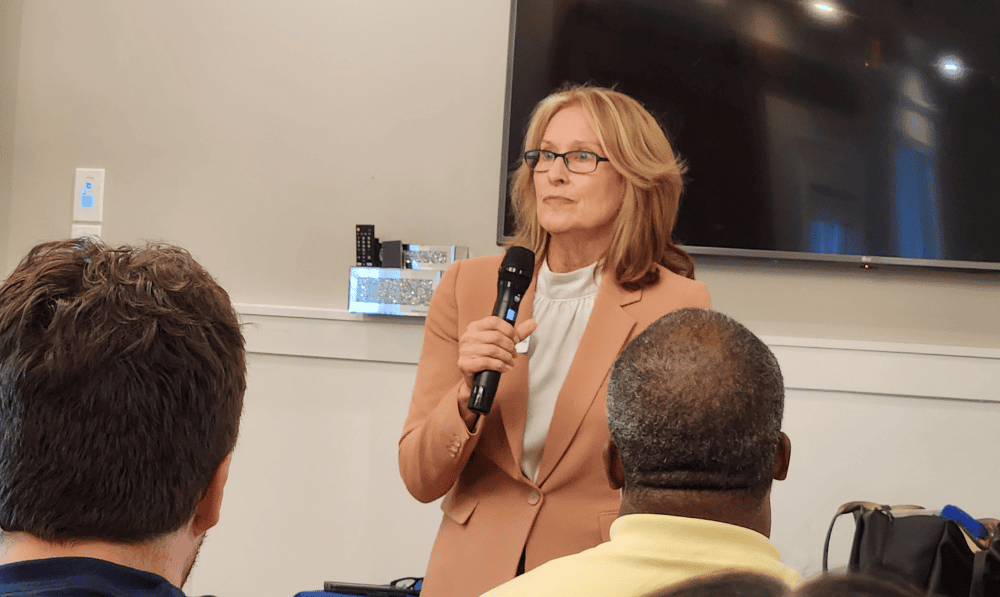
My last long conversation with a candidate for Georgia’s 3rd Congressional District happened in a car.
So did this one.
The difference was that when I interviewed U.S. Rep. Brian Jack, he was driving and his car was considerably cleaner than mine.
This time, Democratic congressional nominee Maura Keller and I climbed into my car, parked outside Fayetteville’s historic Train Depot while a Democratic rally wrapped up inside. It was quieter there, which was the point, and Keller had nowhere she particularly needed to be for the next hour.
That turned out to be useful.
Keller, 67, talks fast, laughs easily and brings considerable energy to a conversation, often illustrating her answers with stories from her military career, family and years of public service. But underneath all of it is a résumé that spans 26 years in the Army, work as a Defense Department contractor, a second career in nuclear medicine and, now, a second run for Congress.
And Keller didn’t have far to go after the rally. She has lived in Fayetteville for about 30 years, near Camp Memorial Park, just a short distance from where we were sitting. Her four children grew up here.
“This is the longest I’ve ever lived anywhere in my entire life,” Keller said. “I consider myself a Georgian, just with a northern accent.”
From enlisted soldier to lieutenant colonel
Keller entered the Army in 1978 as an enlisted military policewoman.
She was 17.
“I was one of the first coed to go through, and so they didn’t know what to do with us,” Keller said of women entering what had been overwhelmingly male military spaces.
She earned her commission in 1982 and eventually retired as a lieutenant colonel after 26 years.
Keller said women entering the military in that era did not always receive the same mentoring men did, so she watched officers she respected and tried to learn from them.
“I like the way you held yourself. I like the way you spoke,” she remembered thinking. “And so I was trying to make myself into what I saw.”
Some of the people who did mentor her were Vietnam veterans.
Keller said they gave her two pieces of advice she carried throughout her career: never forget where she came from as an enlisted soldier, and remember that decisions made by officers eventually reach the people serving in the field.
“Decisions you make or don’t make are going to affect that soldier in the field,” Keller said.
That lesson, she said, shaped her willingness to deliver information that senior officers might not particularly want to hear.
Near the end of her Army career, Keller told me, she briefed a three-star general and informed him that some of the information he had previously received was wrong. She also told him she had already submitted her retirement papers.
Two weeks later, she said, the general called.
“He said, ‘I want you to pull your retirement papers, and I want you to work directly for me,’” Keller said.
His reason, according to Keller: “While everybody’s telling me how good I look, you’re the one that’s telling me I’m running around with no clothes on.”
She withdrew her retirement paperwork.
Keller said she agreed to stay under one condition: she would report directly to the general rather than have another officer placed between them.
“He had all the facts,” Keller said. “That to me was critical.”
That story gets close to the center of how Keller describes herself — someone willing to deliver information upward even when the information is unwelcome.
She also described an earlier episode in her career in which she reported what she characterized as fraud, waste and abuse despite believing that doing so could jeopardize her military career.
“Moral courage is number one,” Keller said when I later asked her to name the qualities she would bring to Congress.
A second and third career
Keller did not leave government work when she eventually retired from the Army in 2004.
For about 10 years, she said, she worked as an independent contractor on Defense Department projects. Companies assembling teams for government studies would bring her in as a subject matter expert.
She had one rule.
“If you’re going to sanitize my information, my project, if you’re going to make it politically correct, I won’t work on it,” Keller said.
Her work, she said, included projects involving the Office of the Under Secretary of Defense for Personnel and Readiness, the Chief of the Army Reserve and the Defense Language Institute.
Then Keller changed directions again.
She went back to school, earned a degree in nuclear medicine and worked as a nuclear medicine technologist, including at the Atlanta VA.
Keller explained nuclear medicine to me in the wonderfully matter-of-fact way of someone who has forgotten that what she did for work sounds fairly exotic to everyone else.
“I deal with radioactive medicine,” she said.
The medicine can be used to observe how organs are functioning, she explained. In a nuclear stress test, for example, Keller could watch the heart working. With a gallbladder study, she could see whether it was functioning properly.
She graduated in 2017 and remained at the VA until January 2024, when she left to make her first congressional run.
Foreign aid as national security
Keller’s military background also shapes how she thinks about foreign policy and U.S. assistance abroad.
She described foreign aid as part of America’s national-security strategy, not simply charity. In her view, when the United States helps other countries build infrastructure, schools, agricultural systems and other basic capacity, it builds relationships and stability at the same time.
Pulling away from that work, she said, creates a vacuum. Keller pointed particularly to Africa and South America, where she said China and Russia can deepen their influence when American engagement recedes.
That matters to her from a military perspective, too. Keller spent much of her career thinking about how decisions made at higher levels eventually affect the service members sent into the field.
For Keller, foreign assistance, diplomacy and military policy are connected: helping countries become more stable and self-sufficient can strengthen American relationships abroad, while abandoning those relationships can leave other powers to fill the gap.
Keller’s contrast with Jack
When I asked Keller the obvious question — what, specifically, does she think separates her from Brian Jack? — she went first to their résumés.
“To me, Brian Jack has been — his whole life has been in partisan politics,” Keller said.
Jack’s career has largely been in Republican politics, including work on presidential campaigns and service in the Trump White House before his election to Congress.
Keller’s career, by comparison, has included the Army, Defense Department contracting and health care.
She said that distinction informs how she views public service.
“In the military, we don’t care if you’re Republican, Democrat,” Keller said. “Politics never came into it. We have a mission.”
Keller said she wants to bring more of that mission-oriented thinking into Congress.
“We don’t have time to play games in the military,” she said. “It’s about getting the job done.”
Two phrases, she said, were essentially forbidden among soldiers working for her: “It can’t be done” and “That’s the way we’ve always done it.”
Keller said she has little patience for accepting a practice simply because that is how it has always been done. She wants to bring that same willingness to question existing systems to Congress.
She also told me she would like to join the bipartisan Problem Solvers Caucus if elected because she wants to work with Republicans on legislation where common ground is possible.
“That’s the group that wants to get stuff done,” Keller said. “That’s the group that’s gonna make the connections.”
What she wants to work on
Earlier that evening, Keller had addressed the Democratic rally inside the Train Depot and told the crowd that the economic conversation had changed since her first run.
“When I ran in ’24, my platform has not changed,” Keller said during the rally. “The only difference is when I talked about affordability then, it’s no longer affordability. It’s all about survivability because that ship sailed.”
In our conversation, Keller returned repeatedly to health care, Social Security, veterans, household expenses, small businesses and data centers.
Her position on data centers is not that they should be stopped altogether.
“We do need data centers,” Keller said. “It just doesn’t have to be in my backyard. We can have them in the heavy industrialized areas.”
She said she has been attending data center meetings around the district and sees the issue as one of balancing the need for infrastructure with the impact on existing communities.
Keller also said she has been making a concerted effort to talk with Republican voters, including people who would not have considered voting for a Democrat two years ago.
Rather than describing those meetings as debates, she talked about coffee.
She said she has met conservative voters at coffee shops around the district after seeing comments online and asking whether they would sit down with her.
“I go wherever you want me to go, and we sit down, and we have had some great conversations,” Keller said.
Her approach, she said, is to ask questions rather than immediately tell someone why she thinks they are wrong.
“I pull them in,” Keller said. “I ask them more questions, and then all of a sudden, sometimes they see things in a different light.”
That does not mean agreement.
Keller is a Democrat whose positions differ from Jack’s on a number of major federal policy questions. The choice before 3rd District voters is not simply between two résumés, but between candidates with different policy priorities and different ideas about the direction of the federal government.
Not particularly interested in retiring
Eventually I pointed out something obvious.
Keller is 67.
A lot of people at 67 are at least contemplating slowing down. Keller left the VA to run for Congress, lost once and then decided to do it all over again.
Why?
“I have to wake up with a purpose,” she said.
She does not describe congressional office as something she is owed, or even as the inevitable culmination of her career.
Instead, she talks about skills she believes could be useful there.
“I want to bring back the days when Congress actually worked,” Keller said. “If it starts with one — if I could be that one, where I could get more people in, more people where we actually start to represent the people, not a party.”
That may be the clearest way to understand Keller’s case for herself.
She spent much of her adult life in institutions where rank mattered, but so did the obligation to tell the person above you when something was wrong. She moved from enlisted soldier to officer, from the military to contracting, and from defense work to health care.
Now she wants another job.
And sitting in my considerably less-than-pristine car outside the Train Depot, Keller kept returning to the same idea she said she learned as a young soldier: whoever holds the title, the decisions eventually land on somebody else.
“If it’s not right for the people of the district,” Keller said, “we’re not doing it.”






Leave a Comment
You must be logged in to post a comment.