


 4071
4071 2
2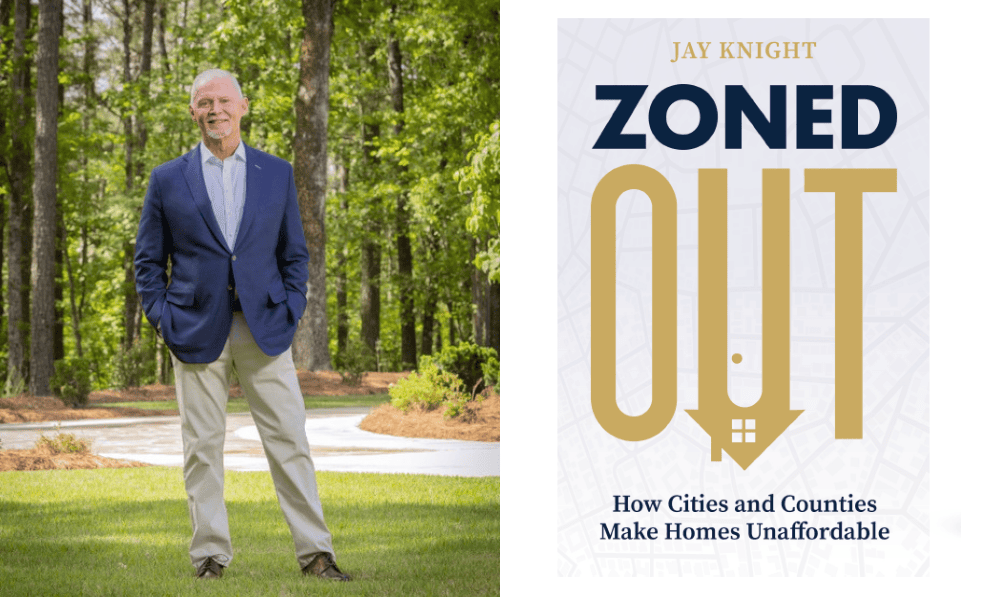
Jay Knight has spent nearly five decades building houses. These days, he is spending an increasing amount of his time asking why so many working people can no longer afford to buy one.
Knight, whose offices are in Fayetteville and who raised his family in Brooks, started as a framing contractor at 14 in 1978. His family eventually built Knight Homes, which he said built and sold about 15,000 houses before the business was sold in 2020.
Now managing member of Templar Development and a consultant with Chisel Mill Homes, Knight remains involved in residential development across Georgia. But his growing focus is public policy — particularly the local zoning and development rules he believes have quietly made starter homes difficult, and sometimes impossible, to build.
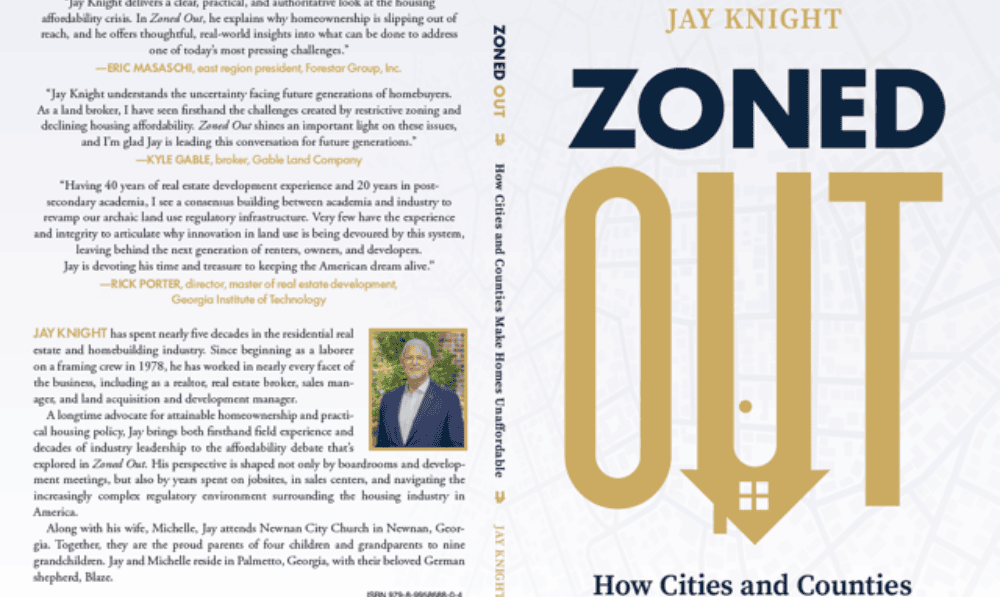
He recently published Zoned Out, a short book aimed not primarily at other builders, but at elected officials and residents who wonder why new homes increasingly seem to come with large lots, large floor plans, and large price tags.
“It’s not,” Knight said, referring to the idea that builders simply prefer expensive homes. “It’s the only thing we’re allowed to build.”
When starter homes become illegal
Knight points to houses that were common across metro Atlanta decades ago: 1,400-square-foot ranches on modest lots, purchased by teachers, airline employees, factory workers, police officers, and young families.
In many jurisdictions, he said, those houses would no longer meet current development requirements.
The issue goes beyond minimum house size. Knight said zoning conditions may dictate lot width, setbacks, roof pitches, exterior materials, garage placement, and other details that each add cost.
“They’ll even have reasonable lot sizes in their zoning ordinance,” Knight said, “but in the process of going through zoning hearings, those are just — they don’t become, they don’t treat them as if they’re their ordinance. They treat them as if they’re the starting point of a negotiation.”
A developer may begin with a 60-foot lot, he said, only to be asked for 70 feet. A 1,400-square-foot minimum becomes 2,400. A request for a side-entry garage can require an even wider lot to accommodate the driveway and turnaround.
Each individual request may sound modest.
Together, Knight argues, they can fundamentally change what a house must cost.
That is the central argument of Zoned Out: housing affordability has been damaged not necessarily by one sweeping policy decision, but by what Knight describes as “death by 1,000 cuts.”
“I don’t think that the municipalities have intentionally made housing unaffordable,” he said.
But he believes the accumulated effect has been the same.
Who gets to live in the community?
For Knight, the question is not simply whether housing is technically available. It is whether the people a community depends upon can afford to live there.
He has begun proposing a plain-language definition of an affordable home: one that a municipal employee could purchase using that employee’s own salary.
That reframes a term that can otherwise mean everything from subsidized housing to apartments to homes below some arbitrary price point.
Knight puts the question more pointedly.
“So you’re telling the police officer, you can police our streets. The firefighter, you can put out our fires. The teacher, you can teach our kids, but you’re not allowed to own a home in this zip code,” he said. “That’s not a reasonable message for those people that we need so desperately in our communities.”
The issue has particular resonance in Fayette and Coweta counties, where new residential developments routinely generate debate over density, traffic, school capacity, infrastructure, and community character.
Knight argues that restricting density can produce some of the very problems communities are trying to avoid.
When employees cannot afford to live near their jobs, they move farther away and commute in, he said. That adds cars to the roads while separating workplaces from the people needed to staff them.
“When you get rid of density, you create sprawl,” Knight said.
He believes the same problem can affect older residents. Communities that resist smaller homes, townhomes, condominiums, or apartments may leave longtime homeowners with few options if they want to downsize while remaining near friends, churches, doctors, and familiar neighborhoods.
Their existing homes, meanwhile, remain unavailable to the younger families who might otherwise buy them.
A different approach to zoning
Knight is not arguing that local government should abandon land-use planning altogether.
He believes communities should still determine where residential, commercial, and industrial uses belong. But within residential areas, he would give property owners and builders far more freedom to respond to what buyers can afford and want.
“The limitations of the municipality should be to say this area is designated residential, and this is commercial, and this is industrial,” Knight said. “But don’t micromanage any of it.”
His preferred model is often called by-right zoning: if a proposed residential project complies with established rules, it can proceed without developers having to negotiate a new set of conditions through a political zoning process.
Knight argues that elected officials can otherwise become de facto home designers, even when their professional backgrounds have nothing to do with construction.
“They tell us how wide the lot has to be, how far it has to sit from the street, the material we can use, the roof pitch, how high it can be, where the garage has to be, what kind of tree we can plant,” Knight said, “and then they complain that the houses all look alike.”
“Well, yeah, the houses all look alike because you design 95% of the house.”
Knight has already taken some of his policy work beyond the speaking circuit and the pages of his book. He helped form the Georgia Residential Land Development Council with other members of the residential development industry.
The organization worked on legislation intended to shorten the process for obtaining land-disturbance permits without changing the underlying development standards.
Knight sees that kind of procedural reform as one piece of a much larger affordability problem.
Why Knight is pushing the issue now
There is also a personal urgency behind Knight’s advocacy.
In 2021, he became seriously ill with COVID-19 and spent months hospitalized, including time on a ventilator. He later went through long-term rehabilitation at Warm Springs before returning home in early 2022.
The experience changed his sense of how much time he had to work on issues he considered important.
“I didn’t really know that life was that fragile until I was hanging in the balance,” Knight said.
When he returned to work, the housing problems he had seen before his illness had not disappeared. They had grown more pronounced, and his own children and their contemporaries were reaching the stage of life when homeownership traditionally became possible.
Knight knew many of them from years of coaching youth sports and volunteering in schools.
A number of them could not afford houses.
“And I’m a home builder and I’ve been developing land and building houses since I was 14 years old,” he said, “and I know why they can’t buy a house.”
Knight knows builders have a financial interest in the rules governing development, and his perspective comes squarely from inside that industry. But he wants the larger public discussion to move beyond the assumption that expensive new housing simply reflects what builders choose to produce.
His argument is that communities themselves have helped define what can be built — and therefore what it costs.
Knight said local officials making those decisions are generally acting with good intentions.
“These are not bad people,” he said.
But after decades of accumulating standards, Knight believes it is time to ask a more basic question: If communities want teachers, firefighters, nurses, young families, retirees, and other working residents to remain part of them, are they still allowing anyone to build the kinds of homes those people can afford?
Zoned Out is available on Amazon.



Leave a Comment
You must be logged in to post a comment.