


 4367
4367 0
0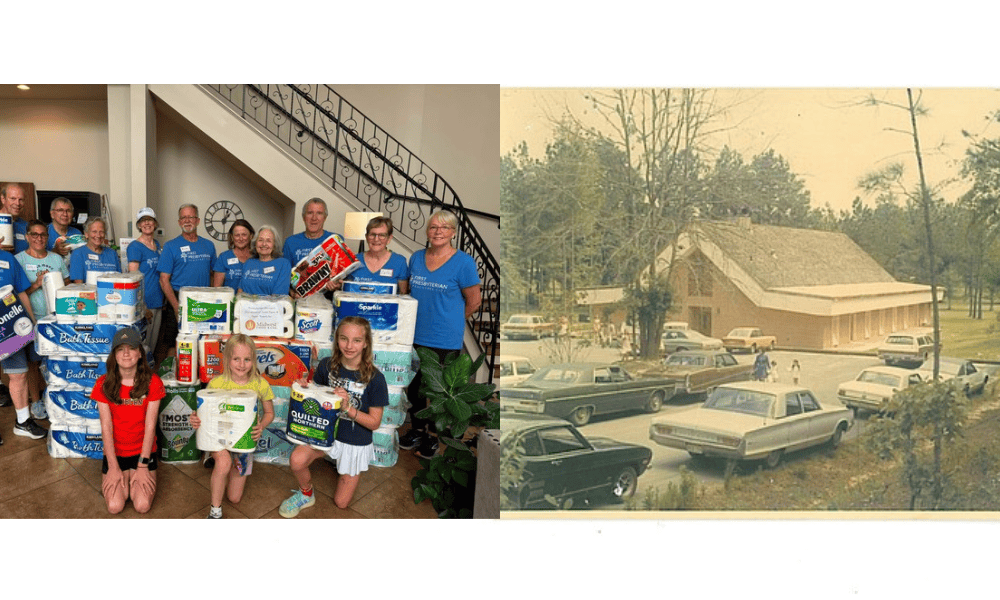
Long before Peachtree City had neighborhoods full of homes, a network of golf cart paths, or enough churches to suit nearly every tradition, a small group of residents began gathering for worship in a building that also served as a post office, bank, civic center, and office space.
Those gatherings eventually became First Presbyterian Church of Peachtree City, which celebrates the 60th anniversary of its 1966 charter on Sunday, August 30.
But the church’s story begins about five years before that charter — and, in many ways, alongside the story of Peachtree City itself.
Joel and Geri Cowan, now 90, were there before either was fully established.
Joel Cowan was still a student at Georgia Tech when he became involved in the effort to assemble land and create the planned community that would become Peachtree City. The Cowans married in December 1957 and moved to the fledgling community on January 1, 1959. When state legislation formally created Peachtree City later that year, Cowan — then about 22 years old — was named its first mayor in the legislation.
What Cowan was trying to build, he said, was more than a subdivision.
“You have to realize that I was building a town,” Cowan said. “Normally, if you a real estate developer, you pick a town like Fayetteville and buy 500 acres adjacent to it, but you had the grocery store, the school, you had the infrastructure there.”
Peachtree City had none of that.
“My job was to create a town, literally,” he said. “You know, with mayor, council, churches, schools, that kind of, even though small.”
A church was part of that plan.
Cowan said denominations approached him about land, but his response was consistent: He was willing to provide property if they were willing to establish an actual ministry in the new community.
“Send the man,” Cowan said. “Don’t worry about the land. I’ll give you the land, but send the man and let’s see what happens.”
The Presbyterians did.
Before First Presbyterian was formally chartered, Peachtree City residents organized what became known as the Community Chapel. Geri Cowan remembers an early organizational meeting at the home of Luther and Catherine Glass, where residents gathered to talk about establishing regular worship services.
“We got together and decided we wanted to start a chapel,” she said. “We wanted to have church services, so we decided everybody in the community was invited to come and talk about this.”
The Community Chapel began about five years before First Presbyterian received its charter in 1966.
Its first home reflected just how little of Peachtree City existed at the time.
Cowan had built a multipurpose community building near the area that is now Peachtree City’s governmental center. One end provided space for a bank. The center included the post office, and other portions were used for offices and community functions.
On Sundays, part of it became church.
The congregation brought out stacking chairs and a wooden podium made by a local craftsman. Cowan remembers perhaps 25 people attending those early Community Chapel services.
When the Rev. Don Smith, now 85, arrived in Peachtree City in 1968, the town was still small enough that he initially had trouble finding it. Smith said he will turn 86 this month.
Smith had come to the area to work with high school and college students through Campus Crusade for Christ, with much of his work centered at Georgia Tech. He did not come intending to become a parish pastor.
Cowan had other ideas.
“The developer, meaning Joel, wanted — he saw me here as an ordained, already ordained Presbyterian minister — and he began to lobby me,” Smith said.
Smith resisted.
“I kept saying, ‘No, no, no! I don’t want to do that. But I’ll be glad to preach for you till you find somebody.’”
Eventually, Smith said, his understanding of the opportunity changed.
He began to see the possibility of helping shape not only a congregation but the spiritual life of a brand-new community.
“The first thing I felt was the opportunity to help influence a whole community, a whole city, for Christ,” Smith said.
Smith became First Presbyterian’s first full-time installed pastor and would remain for approximately 34 years, making him the longest-serving pastor in the church’s history.
In the beginning, though, there was little institutional machinery to run.
Smith remembers setting up about 25 chairs on Saturday and hoping they would be filled Sunday morning.
“They never were they in those first days,” he said. “Like there’d be 12, 13 people at church.”
His office was essentially a closet inside the community building. He had a key to the bank so he could get into the building and arrange chairs before worship.
But Smith said he was not particularly interested in constructing buildings. His focus was constructing a community.
“My call was to build community,” Smith said.
“I knocked on every door in town, I think, during those days,” he said.
He invited people to worship, organized Bible studies in homes, started youth ministry, and helped create a church softball team.
The congregation eventually took a major step toward permanence.
Cowan said the Presbytery offered $25,000 toward construction if the Community Chapel formally became a Presbyterian congregation. Cowan provided the land for the church, just as he would provide sites for other churches as Peachtree City developed.
The new congregation retained the Community Chapel’s broad welcome.
“Nobody even thought about, you know, the fact that it was Presbyterian,” Cowan said of the early congregation. “And that was part of the deal with the Presbyterian Church that had to have its community flavor, you know, because welcome everybody.”
The first church building went up with contributions from multiple sources, including large structural trusses provided for the project. Cowan remembers the construction as something approaching an old community barn raising.
That first sanctuary still exists today as Smith Hall. A larger sanctuary was added later as both congregation and city grew.
Smith said the relationship between the church and Peachtree City was difficult to separate during those earliest years.
“The town was young, the church was young, and I was young,” he said.
For several years, First Presbyterian also served as something of a social center for the new town. There were few established gathering places, and many of the early community leaders were connected to the congregation.
As Peachtree City grew, so did its religious landscape. In the earliest years, people from different denominational backgrounds had worshiped together because there simply were not enough residents to support many separate churches.
Over time, that changed. Baptists who had worshiped alongside Presbyterians eventually left to establish their own congregation, building First Baptist Church next door. Methodists, Lutherans, and others also established churches as Peachtree City grew large enough to sustain them. What had begun as a community chapel serving almost everyone gradually became one church among a growing number of congregations across the city.
First Presbyterian changed, too.
It experienced disagreements and departures over the decades, including divisions related to women’s ordination and, much later, denominational questions surrounding gay clergy. Those departures contributed to the formation of other Presbyterian congregations in Peachtree City.
Smith, looking back, sees those divisions as part of a larger church history in which people sometimes decide they need another expression of their faith.
“There’s been people who, for one reason or another, felt the need to separate,” Smith said.
But, he added, time has softened some of those boundaries.
“We’re all Christians here, even though we disagreed.”
The church faced one of its most significant transitions shortly before the Rev. Morgan Hay arrived in November 2013.
A significant number of the staff and leadership had left First Presbyterian to start Evergreen Church, primarily because of the PCUSA denomination’s change to ordain gay clergy. Only about 90 people remained to begin rebuilding the congregation.
Hay was not a novice. She had already served for years at St. Andrews Presbyterian Church in Tucker and had experience as an associate pastor and temporary head of staff. But First Presbyterian presented a huge challenge: raising up new leaders, rebuilding the congregation, and helping the church find its footing again.
What she found among those who remained reminded her of the spirit that had built First Presbyterian in the first place.
“I think they had that very much that kind of can-do spirit that started the church, where they were up for anything, and would do anything, and it was all about building community,” Hay said.
Today, Hay said, First Presbyterian has about 225 people on its rolls, with approximately 150 to 175 typically attending Sunday worship.
The congregation continues to emphasize something that its founders say was present before it even had a denominational name: welcome.
“I think there’s something really amazing about the size congregation we are because you can really get to know other people, and it’s kind of truly intergenerational,” Hay said.
The church describes its mission in three words: “welcoming, affirming, loving.”
Hay said that includes making sure LGBTQ+ people know they are welcome at First Presbyterian. She said many people have joined the church because they themselves are gay or lesbian, have a family member who is, or simply want to worship in a congregation where LGBTQ+ people are fully welcomed.
“I think for sure, gay and lesbian people, just anybody that has been told that they are other or that God doesn’t love them,” Hay said. She added that people can carry those wounds for many reasons, including divorce, job loss, or other experiences that left them feeling they were “not good enough to be welcomed at a church.”
Hay said First Presbyterian wants people who have felt hurt or rejected by churches to find a place where they feel safe and loved.
“My husband jokes that I have one sermon and it’s God is love,” she said. “I mean, that is the heart of the gospel.”
The Cowans see that openness as a continuation rather than a departure.
“I think it’s the open openness, welcome, genuinely welcome people,” Joel Cowan said.
“We have always been that way,” he added.
Smith, meanwhile, sees another line of continuity.
Although worship styles, leadership, social issues, and even surrounding denominations have changed, he said the church has maintained what he considers the fundamental marks of Christian worship: Scripture, preaching, baptism, and the Lord’s Supper.
“This church has not deviated from that,” Smith said.
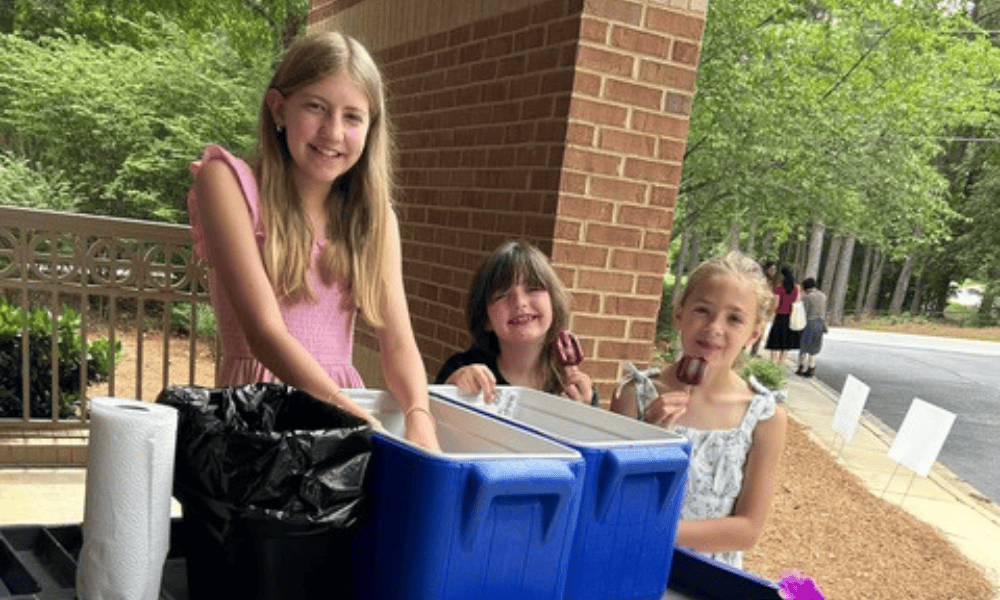
Its ministry now stretches well beyond Sunday worship. The congregation participates in summer lunch programs for children, helps stock Fayette Samaritans’ food pantry, volunteers with Midwest Food Bank and Promise Place, and supports broader Presbyterian mission and disaster relief efforts.
Its preschool and kindergarten ministry also has deep roots in the community. Smith’s wife helped establish the early program, and Hay said generations of Peachtree City children have attended.
“There are a ton of people that grew up in Peachtree City that went to preschool here,” Hay said. “Because it’s an institution for sure.”
On Sunday, August 30, the church will mark its 60th anniversary much as it has spent six decades gathering: with worship and fellowship.
The anniversary worship service begins at 11 a.m., followed by cupcakes on the church’s front porch. The original 1966 charter will be displayed in the narthex, and Smith, the church’s longest-serving pastor, will return to speak for a few moments during the celebration.
Among the names on the charter are Joel and Geri Cowan.
They are now the only living local members of that original group of charter signers, according to Hay.
They were there when Peachtree City had to be built almost institution by institution. They were there when church meant setting out stacking chairs inside a multipurpose building. They were there when the congregation received land, raised its first sanctuary, weathered disagreements, expanded, lost people, and rebuilt.
And 60 years after First Presbyterian became an official church, they are still there.
“Since before it started,” Geri Cowan said. “Since before it was the church, since before it was Presbyterian.”


Leave a Comment
You must be logged in to post a comment.