


 4767
4767 3
3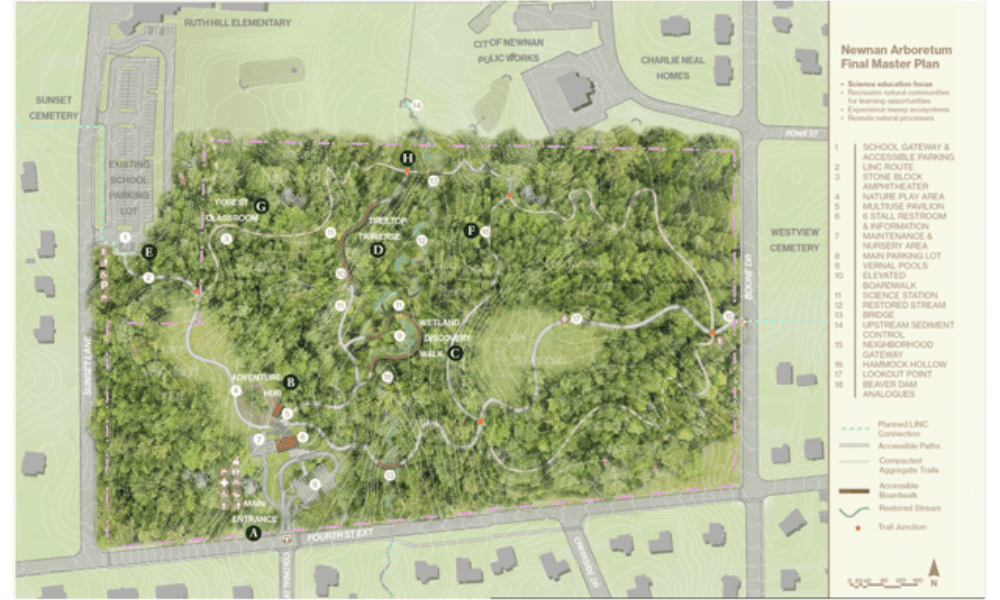
On paper, Newnan’s proposed arboretum sounds like the kind of project many communities would celebrate.
The 28.88-acre site adjacent to Ruth Hill Elementary School would become a living showcase of Georgia’s native Piedmont ecosystems, complete with restored wetlands, educational field stations, forest classrooms, elevated boardwalks and trails designed to connect with The LINC.
The vision is ambitious. The master plan describes a place where future generations can learn about native forests, biodiversity, conservation and ecology long after much of Coweta County’s natural landscape has been transformed by development.
But as city leaders prepare to discuss the project, Newnan Mayor James Shepherd is raising a different question:
Who got to decide what this land should become?
“This is a park that’s going to be adjacent to a working-class, mostly Black neighborhood, but we didn’t get any input from the people who actually live next to it,” Shepherd told The Citizen. “Even though we didn’t get any input from them, we are looking at committing $250,000 per year to this monument.”
The debate surrounding the proposed arboretum is not simply about trees.
It is about representation, public investment, environmental stewardship and what kind of legacy Newnan wants to leave for future generations.
A Vision Measured in Decades
The master plan makes no attempt to hide the scope of the undertaking.
Construction costs are estimated at approximately $5.45 million. Annual operating costs are projected between roughly $215,000 and $330,000 per year depending on the phase of implementation.
The plan repeatedly acknowledges that the project will take decades to reach maturity.
“A project of this scale will take decades to fully realize,” the report states.
Unlike a playground, splash pad or sports complex, the arboretum is designed as a long-term investment. Much of what makes the project attractive to supporters will not fully exist for years.
Young trees will need time to grow. Restored ecosystems will need years to establish themselves. Forest canopies that future generations may enjoy have not yet been planted.
That long view resonates with many residents concerned about the pace of development in Coweta County.
As subdivisions continue replacing forests and multiple data center proposals move through local approval processes, supporters may see the arboretum as a rare opportunity to permanently preserve and restore open land.
Among those who commented during the public-input process was Newnan resident Michael Bowers, who wrote, “I love this idea. Coweta County has lost far too much green space to rampant overdevelopment. Hope this becomes reality as it would be good for the county.”
The project would be Newnan’s first park primarily dedicated to environmental education, conservation and native habitat restoration.
The master plan states that its “primary function is to provide access to nature, promote environmental literacy, and facilitate science education.”
Its proximity to Ruth Hill Elementary is central to that vision.
Outdoor classrooms, science stations, accessible trails and ecological learning opportunities are woven throughout the design.
Even Shepherd says he is not opposed to the concept itself.
“If the community wants an arboretum, that’s awesome, and I support it,” he said. “Part of the goal with this was to create educational opportunities that would be very easily accessible to Ruth Hill.”
The Question of Who Was at the Table
Where Shepherd parts ways with the process is how the vision was developed.
The master plan identifies a steering committee that included city staff, Plant Newnan representatives, environmental organizations, Newnan Utilities, the Housing Authority of Newnan, Coweta County School District representatives and UGA Extension.
The plan does not list residents from the neighborhoods immediately adjacent to the site.
Those surrounding neighborhoods were specifically identified in the master plan as an “Equity Priority Block Group,” with lower median household income, lower educational attainment and a higher percentage of Black residents than neighboring census areas.
The report also acknowledges that a planned neighborhood outreach event never occurred.
Instead, public engagement relied primarily on social media, an online survey and a booth at Market Day.
The master plan reports receiving 28 survey responses and a total of 60 public comments across all engagement channels.
“We don’t know what the folks in the community actually want or need,” Shepherd said.
Shepherd’s criticism is not that the arboretum would serve a historically Black neighborhood.
His criticism is that residents of that neighborhood were not meaningfully involved in defining the project before the vision was established.
“I think it’s obvious that there was not any significant effort put into making sure that the community most impacted by this had a say on what was put here,” he said.
What Residents Asked For
The public comments collected through the master plan process tell a more complicated story than either supporters or critics might suggest.
Many respondents supported the arboretum concept.
Residents frequently requested:
- More public green space
- Access to nature
- Educational opportunities
- Family-friendly trails
- Conservation features
- Connections to The LINC
Lindsey Wisely wrote that she supported the concept because it would become more than simply another city park.
“This project is something I support in theory, it is something my family and I would actively use, value, and be part of,” Wisely wrote. “An arboretum is far more than a green space in my opinion.”
But the comments also revealed a different set of desires.
The single most-mentioned category involved edible and medicinal plants, including fruit trees, nut trees, berry bushes, food forests and community gardens.
Several residents specifically asked planners to incorporate those ideas into the project.
“Love concept 2 and 3 but would love to see a community garden and lots of fruit and nut trees included as well,” wrote Greer Heller.
The report notes that these ideas ultimately were not incorporated because they did not align with the mission established by the stakeholder group.
Some respondents also requested fishing access, gathering spaces and other recreational uses.
The final plan prohibits many activities commonly associated with traditional community parks, including fishing, sports activities, large gatherings, family reunions and barbecues.
Those restrictions became one of Shepherd’s most pointed criticisms.
“Who is making decisions about Newnan?” he asked. “Do we care at all about the people who are impacted, or do we care more about spending hundreds of thousands of taxpayer dollars on monuments to the folks who live downtown?”
A Different Way to Think About the Debate
The easiest version of this story would pit conservation against community needs.
The master plan itself suggests the issue is more complicated.
The same document that identifies nearby neighborhoods as an equity-priority area also proposes one of the most significant long-term investments in Newnan’s west side.
The same project criticized for lacking neighborhood input would place educational resources directly beside a Title I elementary school.
The same plan that would require millions of dollars in investment also seeks to preserve and restore one of the city’s remaining undeveloped natural spaces.
Shepherd believes those goals are not mutually exclusive.
“I am dead set on us investing more in the west side because we have not done so in a long time, and they deserve it,” he said. “But the question is, how do we invest, and why aren’t we listening to the people who we are ostensibly investing in and asking them what they need?”
Before moving forward, Shepherd says he wants three things: meaningful community engagement with nearby residents, additional environmental testing and a clearer understanding of long-term costs.
“What I absolutely need out of this to be comfortable with it is for us to do some real community engagement with the folks who live over there to make sure that they have a say in what’s being put in their backyard,” he said.
The debate now facing Newnan may ultimately have less to do with whether an arboretum is a good idea than whether the people who will live beside it should have a larger role in shaping what it becomes.
As the city weighs a project designed to reach its full potential decades from now, officials are being asked to answer a more immediate question:
Who gets to help decide Newnan’s future?




Leave a Comment
You must be logged in to post a comment.