


 15151
15151 3
3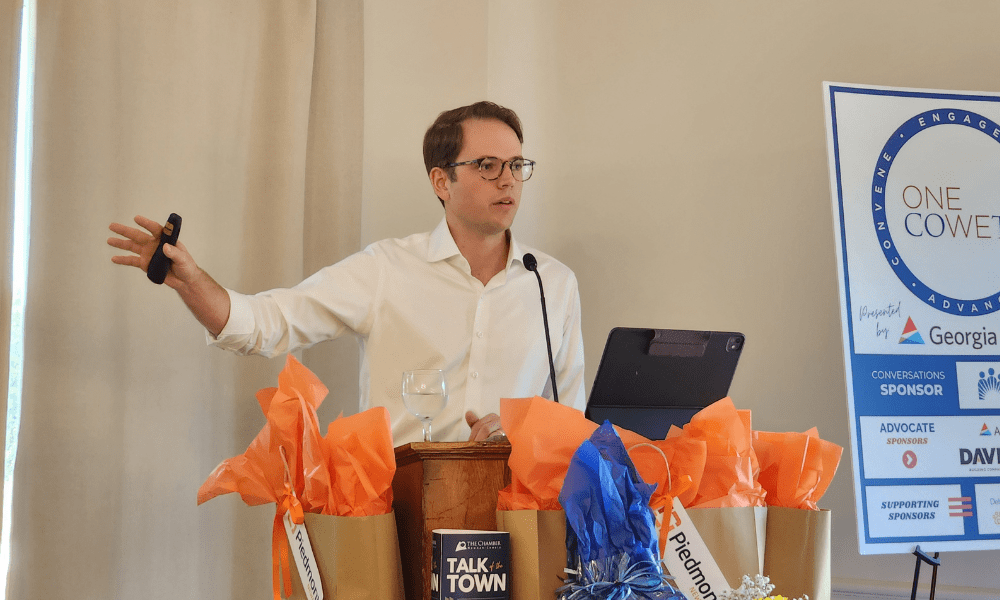
The Newnan-Coweta Chamber of Commerce devoted its latest Talk of the Town luncheon to a subject that has become increasingly prominent across Georgia: data centers and the infrastructure needed to support them.
Held at the Newnan Country Club, the event featured a presentation by J.C. Witt of Prologis, developer of the approved Project Sail data center in Coweta County, followed by a panel discussion with Witt, Michael Olajubutu of Georgia Power, and Santiago Escobar of Headwaters Site Development. The discussion was moderated by Georgia Power’s John Pritchett.
While the panel acknowledged concerns often raised by residents about water consumption, electricity demand, and growth, the overall focus of the program was on the economic and technological benefits of data center development.
All three panelists represented organizations involved in developing, powering, or supporting data center projects, and no speakers representing opposition viewpoints were included in the program. Speakers repeatedly described data centers as critical infrastructure supporting artificial intelligence, cloud computing, online banking, healthcare systems, and other digital services that have become woven into daily life.
“We do need data centers,” Escobar told attendees. “There is no cloud up in the sky. The cloud is a data center.”
Much of Witt’s presentation focused on artificial intelligence and what he described as the transformative impact AI could have on healthcare, transportation, and workforce productivity. He compared today’s AI-driven technology boom to previous technological revolutions involving electricity, railroads, and automobiles.
“It’s supposed to be an extension of who we are and all of our roles,” Witt said of artificial intelligence. “It’s amazing that that extension is being democratized to everybody.”
Witt also highlighted Georgia’s emergence as a national data center hub, citing the state’s fiber infrastructure, business climate, and reliable electric service.
According to Witt, Georgia’s data center economy represents approximately $34.7 billion in economic impact and supports an estimated 180,000 direct and indirect jobs statewide.
Water use remains a key concern
One of the most discussed aspects of data center development in Coweta and neighboring communities has been water consumption.
Asked about concerns regarding water demand, Witt pointed to Coweta County’s recently adopted data center ordinance, which requires closed-loop cooling systems.
“When you’re looking at that type of use on a building, that single data center building is using the same equivalent as what a restaurant would use,” Witt said.
Escobar echoed that point, saying newer facilities increasingly recycle water through closed-loop systems.
“What we see is on a daily basis, water is used for sinks, toilets, and maybe limited building humidification,” Escobar said. “It really is a low water use.”
The panelists’ comments focused primarily on water use once a facility is operational. Escobar also said water use during construction is “extremely low” and largely associated with employee use, erosion control, and washing stations.
Construction-phase water consumption, however, has become a separate point of public debate around some Georgia data center projects. The Citizen has previously reported that the QTS data center project in Fayette County uses approximately 174,000 gallons of water per day during construction.
Economic benefits emphasized
Panelists repeatedly stressed what they described as the fiscal advantages of data center development.
Escobar called data centers “fiscally efficient taxpayers” because they can generate substantial property tax revenue while requiring relatively few government services compared to residential development.
Witt cited statistics from Loudoun County, Virginia, one of the nation’s largest data center markets, arguing that data centers produce significantly more tax revenue than they consume in public services.
The panel also emphasized indirect economic impacts generated by construction, maintenance, vendors, contractors, hotels, restaurants, and other businesses that support data center operations.
“When we build a data center, we want to hire local,” Escobar said, praising workforce development efforts underway at West Georgia Technical College.
Georgia Power addresses rate concerns
Questions about whether data centers could drive up electric bills have surfaced throughout Georgia as power demand increases.
Olajubutu argued the opposite is occurring.
“Growth is good,” he said. “We’ve seen that as indicative last year through our rate case, where we’re able to freeze rates for the next three years.”
Olajubutu said Georgia Power’s planning process requires large customers to pay for infrastructure needed to serve their facilities and includes safeguards if projected growth fails to materialize.
He also pushed back against concerns that data centers could compromise reliability for residential customers.
“We will not put the lion’s share of our customers at jeopardy to serve some of these large-load customers,” he said.
Balancing growth and community concerns
The discussion concluded with a broader conversation about balancing economic development with quality-of-life concerns.
Escobar pointed to Coweta County’s data center moratorium and subsequent ordinance as an example of local governments carefully evaluating growth.
“What we’ve seen recently is that communities are holding developers accountable for data center development, as they should,” Escobar said.
Witt argued that communities benefit from maintaining a mix of residential, commercial, industrial, and data center development rather than relying too heavily on any single category.
The Chamber indicated Thursday’s program was intended as part of a continuing community conversation about digital infrastructure and economic growth.
As artificial intelligence, cloud computing, and data storage demands continue to expand, the debate over where and how data centers should be built is likely to remain a significant topic for Coweta County and communities across Georgia.





Leave a Comment
You must be logged in to post a comment.