


 3783
3783 0
0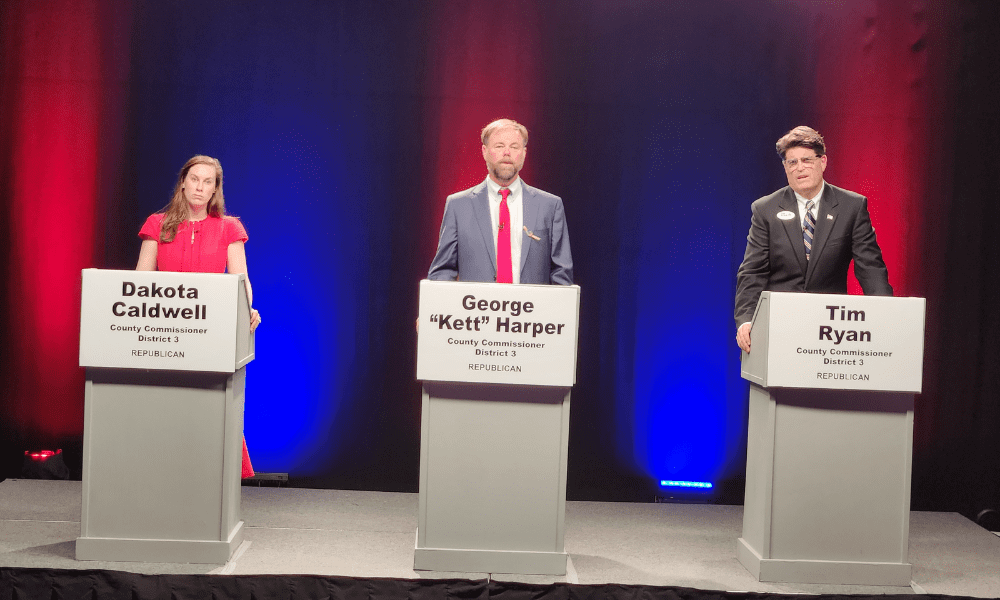
Dakota Caldwell opened Monday night’s Coweta County Commission District 3 debate by emphasizing her financial background and long-term planning approach, positioning herself as a candidate focused on discipline and structure in county government. “I possess a unique qualification as a CPA to be able to look at the allocation of the budget, to figure out where we can cut or how we can reallocate,” Caldwell said.
George Harper followed by centering his candidacy on experience and local involvement, pointing to more than a decade of service on the Coweta County Board of Zoning Appeals. “Leadership wasn’t about making headlines, it was about understanding the details, listening to the residents, and making wise decisions,” Harper said.
Tim Ryan took a different approach, using his opening statement to frame himself as the target of a coordinated effort to undermine his campaign. “When someone challenges the establishment, the responses often are smears, half truths and attempts to destroy people’s reputations,” Ryan said. “I will not be canceled.”
That framing comes as The Citizen has published multiple reports examining Ryan’s record, including one on a 152-page personnel file containing complaints from students, parents, and staff at two Coweta middle schools, as well as a separate article featuring testimony from two former students and their parents, and the parent of another student. Additional reporting documented a failed fundraiser that used Meals on Wheels branding without authorization and listed a $600 donation from Krista Frost, the wife of First Liberty Ponzi scheme owner Brant Frost IV, along with further connections to Brant Frost V, former Coweta Republican Party chair.
The forum, hosted by the Newnan-Coweta Chamber of Commerce at the Central Educational Center, comes ahead of the May 19 Republican primary to replace retiring Commissioner Bob Blackburn.
Data centers draw unified concern — with different reasoning
The proposed Project Sail data center dominated early discussion, with all three candidates expressing opposition to the project as approved.
“I would have voted no,” Harper said, citing uncertainty about long-term impacts. “I don’t think Coweta County needs to be the guinea pig.”
Caldwell said she opposed the project’s placement in rural conservation zoning. “I did not like where Project Sail is located and the farms and families that were impacted,” she said.
Ryan focused on infrastructure impacts, particularly transmission lines tied to data centers. “I know people that are losing their homes for a data center that won’t even possibly be in Coweta County,” he said.
All three candidates pointed to the county’s comprehensive plan as a key guide, though each suggested it has not been consistently followed.
Growth, housing, and infrastructure
Candidates agreed Coweta County is growing, but differed on how to manage that growth.
“What I fail to see is a plan for that growth,” Caldwell said, calling for intentional economic development and long-term financial planning.
Harper emphasized his experience navigating zoning and development decisions. “My vision is simple — smart, responsible, well-planned growth,” he said.
Ryan framed the issue around limits and balance. “Property rights do not mean every parcel should be entitled to every possible use,” he said. “That’s chaos.”
A discussion on housing affordability led to direct exchanges. Ryan argued for relaxing some zoning constraints to allow smaller homes, while Caldwell warned against increasing density without corresponding infrastructure improvements.
Taxes and economic approach
All three candidates identified as fiscally conservative and opposed raising taxes, though their approaches varied.
Ryan emphasized budgeting discipline and public involvement. “Citizens should not feel blindsided,” he said.
Caldwell pointed again to her financial background. “We can look at the allocation of the budget to determine where we can cut or reallocate,” she said.
Harper focused on balancing the tax base through economic development. “We need to go out and recruit more high-paying jobs to help offset the tax burden,” he said.
Controversy surfaces during debate
The most pointed exchange came during a question about political donations tied to the First Liberty Building & Loan collapse and the Frost family.
Both Caldwell and Harper said they had not received support connected to those sources.
Harper then referenced recent reporting and pressed Ryan directly. “I’m curious to hear what Mr. Ryan has to say in light of the article that was in the paper today,” he said.
Ryan responded, “My campaign has never received any money from the Frost family.”
The exchange reflects ongoing scrutiny documented in The Citizen’s reporting, which has become a central issue in the race. Harper later referenced that coverage again in his closing remarks, saying it raised “real, clear concerns” about Ryan’s judgment.
Closing contrasts
In closing statements, each candidate drew clear distinctions.
Ryan emphasized his engagement with local issues and positioned himself as an outsider. “I’m not running to protect the system. I’m running to challenge it when it fails the people,” he said.
Harper pointed to his experience and readiness. “Observation is not leadership. Watching is not deciding,” he said.
Caldwell returned to financial planning and collaboration. “A commissioner must get along well with others and have exceptional judgment,” she said.
What comes next
The Republican primary will be held May 19, with the winner advancing to face Democrat Render Godfrey in the November general election.
As growth pressures and political tensions continue to shape the race, Monday’s forum highlighted not only differences in policy, but competing narratives about experience, leadership, and accountability.
When the link is made available from the CEC, we will link it here.





Leave a Comment
You must be logged in to post a comment.