


 7176
7176 16
16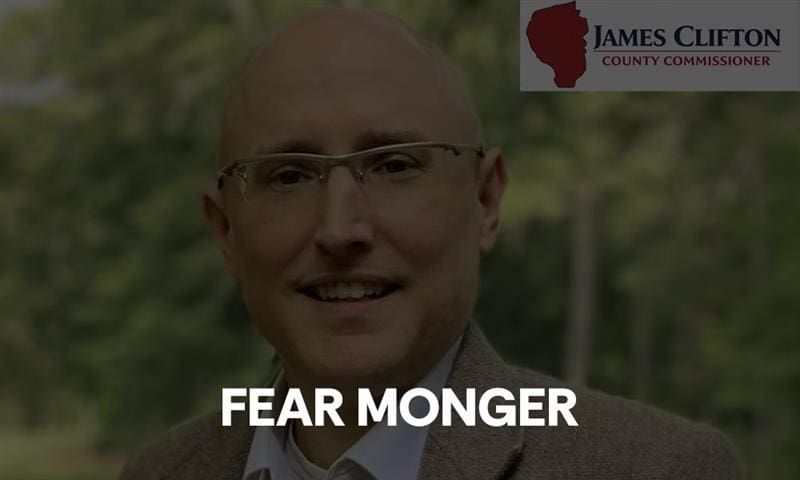
Three candidates qualified for the Fayette County Board of Commissioners District 3 seat that will represent Peachtree City and be decided on May 19th. Phil Crane (Republican) qualified on March 2nd, the first day. Chandra Wright (Democrat) qualified on March 3rd. James Clifton (Republican) qualified on March 6th after watching who else got in.
The seat they are competing for carries real weight. The Board of Commissioners governs land use, zoning, transportation, the county budget, and public services for every resident across every city and every unincorporated community. The person who holds it makes decisions that shape how this county looks and functions for decades. It requires someone who has earned the public’s trust rather than manufactured its fear.
Clifton has spent the past four months doing the latter. Since losing the Peachtree City Council Post 4 race last November, he has built a Facebook group around a data center conspiracy theory he invented, misrepresented public officials, and organized residents around a threat that three independent officials have denied in writing. He then filed for county commissioner on the last day of qualifying and is now asking Fayette County voters to give him authority over the very zoning and land use decisions his central claim has already been proven false about.
At a recent Peachtree City Council meeting, Clifton acknowledged he has been called a conspiracy theorist and a liar, and he raised it as though it were an injustice committed against him.
He has been called those things because that is what he is, and voters deserve to know it before May 19th.
Who Clifton Is and What His Record Shows
Before examining what Clifton has done to this community over the past several months, it is worth understanding who he is and what his record actually shows.
Clifton is an attorney at The Clifton Law Firm in Fayetteville. He also operates an AREA real estate brokerage at the same address and runs Justice Pinball in Newnan. His campaign materials describe him as “a dedicated business owner and conservative who has committed his life to community engagement.”
That is the version Clifton wants Fayette County voters to see, but there is more to his story.
Clifton has spent the better part of twelve years running for office. In 2014 he entered a crowded seven-candidate Republican primary for Georgia Senate District 16 and finished sixth, collecting 1,252 votes out of more than 16,000 cast.
In 2016 he tried again, running for Georgia House District 72 in the Republican primary. He finished last of three candidates with 14% of the vote. The winner, Josh Bonner, took nearly 60% and went on to win the general election unopposed.
After that second loss, Clifton went quiet for nearly a decade. There is no record of him serving on a city board, a county advisory committee, a planning commission, or any civic body at any level, which makes his claim to have “committed his life to community engagement” plainly disingenuous. He did not build toward public service. He simply disappeared, and then reappeared in Peachtree City in 2025 to run for city council with no prior service to the city he was asking to represent.
That Peachtree City campaign did not go any better than his previous races. Rather than running as an independent voice, Clifton attached himself to Steve Brown, the former mayor whose return bid was built entirely on grievance and was rejected decisively by voters. He copied Brown’s talking points and made his candidacy an extension of someone else’s agenda rather than his own. When Brown told voters at a public forum that if they weren’t voting for Clifton they shouldn’t vote for him either, it confirmed what the campaign had already made obvious: Clifton wasn’t running to represent Peachtree City. He was running to represent Steve Brown. Voters recognized it. Michael Polacek won Clifton’s race with 54%.
The campaign also revealed something important about how Clifton operates. Every major platform claim he made was wrong or misleading. For example, he was wrong on public comment rules, wrong on the Parks and Recreation Master Plan price tag, and wrong on the millage rate.
I wrote in July 2025 that I did not believe Clifton was being intentionally dishonest. I gave him the benefit of the doubt because that is what you do with a first-time candidate who may not yet know what he does not know.
That courtesy was a mistake.
Clifton Has Been Poisoning This Community Since He Lost
After losing last November’s council race, Clifton created a Facebook group called “Stop Peachtree City Data Center” and began posting claims that city officials, working in coordination with the Fayette County Development Authority (FCDA), are quietly laying the groundwork to annex land from Coweta County and rezone it for a data center, all without telling the public. He built the group’s membership steadily through the winter, posting regularly and framing every routine action by the city government as evidence of a hidden agenda. By the time he filed for Fayette County Commissioner on March 6th, he had spent months organizing residents around a threat he invented.
What makes his operation more sophisticated than a simple rumor is how he constructed it. Clifton is an attorney, and he writes like one when it serves him. He presented his case as a formal evidentiary record, each point anchored in something that actually happened and then drew false conclusions from each one. But because the invented conclusion is framed with the precision of someone who argues for a living, most of his followers never questioned it.
When making his case, he pointed to four primary things as proof:
- The first was a city council retreat held in Kennesaw on January 29th and 30th, where the FCDA made a presentation to council members. Clifton claimed the retreat was deliberately hidden from the public, that it was not on the city’s main government calendar, and that the FCDA’s involvement was never disclosed. In his telling, the retreat was where the data center plan was discussed behind closed doors, away from public scrutiny.
- The second was a meeting the FCDA requested with him on February 8th. Rather than treating the outreach as a routine response to his public claims, Clifton told his followers the meeting was an attempt by officials to manage him and neutralize his criticism before he could alert more people. He framed a public official returning his concerns as evidence that he was getting too close to the truth.
- The third was the February 11th purchase of approximately 1,100 acres on the southwest side of Lake McIntosh near the Peachtree City airport, across the Coweta County line by Brent Scarbrough and Company. Clifton pointed to Scarbrough’s previous work at the QTS data center site in Fayetteville as the link between the land purchase and a data center coming to Peachtree City. In his framing, the timing of the purchase, just one day before the annexation study vote, was not a coincidence. It was the developer positioning to move once the city created the legal pathway to annex the land.
- The fourth was the city council’s unanimous February 12th vote to commission an annexation study. Clifton presented the study as the mechanism by which the city planned to annex that Coweta County parcel, rezone it for data center use, and complete a plan that had been in motion since at least the January retreat. The fact that every council member voted yes, including members who had never expressed any interest in data centers, did not give him pause. In his telling, unanimity was not evidence of routine planning. It was evidence of coordination.
He packaged these four points into a timeline and posted it publicly across Facebook, presenting his conclusions as confirmed fact to anyone who would listen. When The Citizen asked him directly about his evidence, he acknowledged in writing that “this is circumstantial evidence.” But his followers rarely hear this nuance. They see headlines like “PEACHTREE CITY DATA CENTER UPDATE” and read his conclusions stated with certainty.

He also made sure the story could not be corrected. He has told his followers that city officials “will not publicly announce” the data center, framing every denial as proof of the cover-up rather than evidence against it.
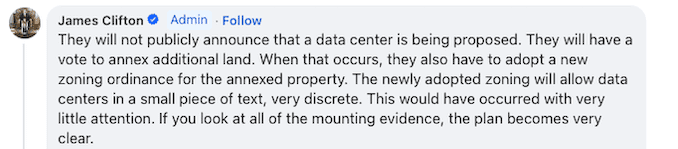
Given all this, Clifton has not just spread a false claim. He has built a system designed to make the false claim immune to contradiction. Every official denial confirms the conspiracy. Every correction proves how deep the deception runs.
The Official Record Demolishes Every Claim
Before working through Clifton’s claims with facts, I want to revisit something I just mentioned. Clifton told The Citizen directly, in writing, on March 2nd: “This is circumstantial evidence, and it is very clear to me what is happening.”
Circumstantial. His word. Said to a reporter. Then he posted it to thousands of followers as a data center update, built a Facebook group around it, and launched a county commission campaign on top of it.
Every refutation that follows is almost beside the point. He already told you what his case actually is. He told his followers it was fact. He told the press it was a hunch.
So it is worth going through his four pieces of evidence one at a time, because each one falls apart on its own terms before you even get to what the officials say.
On The Data Center Itself:
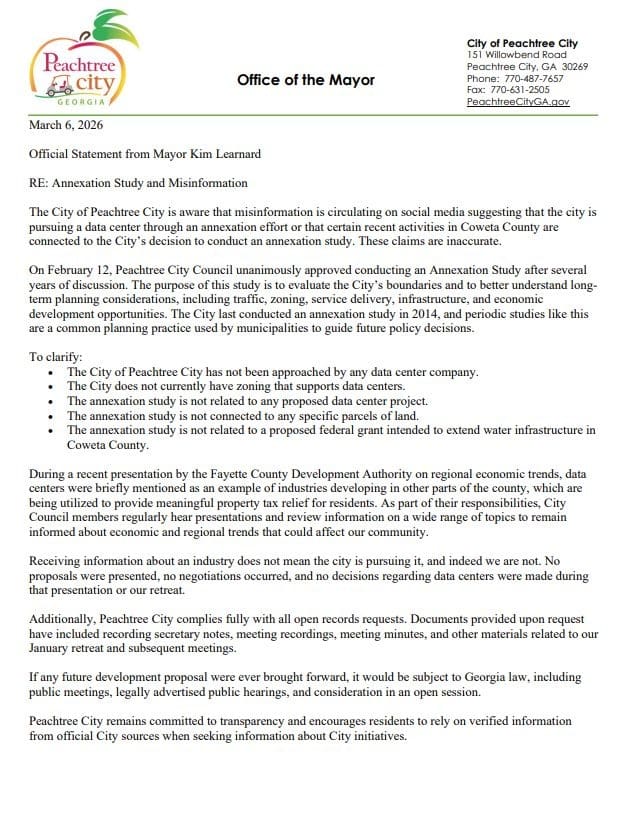
The City of Peachtree City has not been approached by any data center company. Not one.
But set that aside for a moment and consider what it would actually take for a data center to come to Peachtree City. Data centers are not a permitted use in any zoning district the city currently has. Before a single shovel touched the ground, the city would need to amend its zoning ordinance or approve a rezoning application. Either path requires a public hearing with posted notice, an open deliberation before the Planning Commission, and a recorded vote by the city council. Every step happens on the public record, in a public meeting, with public comment.
No rezoning application has been filed. No zoning amendment has been proposed. No public hearing has been scheduled. No vote of any kind on data center use has occurred.
What Clifton has been telling his followers is happening cannot happen the way he describes because the first step toward making it happen would be visible to every resident in the city.
Mayor Kim Learnard said exactly that in a formal letter on March 6th in response to Clifton’s misinformation:
The FCDA’s president echoed this denial publicly in a letter published in The Citizen on March 3rd. The agency she runs is responsible for economic development across Fayette County. If a data center were being pursued, she would know. Her letter was direct: “The FCDA is not pursuing additional data centers in Fayette County. Period. We are offering no incentives for data centers.”
Council Member Clint Holland, who pushed for the annexation study, told The Citizen in writing: “To be clear, what is posted online about data centers for Peachtree City is not true. As of today, no data center company has approached the city to discuss placing a data center in Peachtree City.”
Three people across three separate institutions have gone on the record, all saying the same thing while Clifton continues to promote his conspiracy.
On The Retreat:
Clifton is right about two things.
The city did not clearly communicate in advance what would be discussed at January’s Kennesaw retreat. There is also a gap in the available recording during the portion when the FCDA addressed the group. Those are real transparency shortcomings, and they deserve to be called that regardless of anything else in this column.
What they do not deserve is what Clifton did with them.
Mayor Learnard’s formal statement addresses the retreat directly. Data centers came up briefly as an example of industries developing elsewhere in the county, not as a proposal, not as a target, but as a passing reference in a broader economic discussion.
Clifton took a legitimate complaint about communication and a legitimate complaint about a recording gap and built a conspiracy on top of them. He did it knowing that the gaps would look suspicious to people who had not engaged with the documents and recording. He did it knowing that most of his followers would not file an open records request to check.
That is the tell. The real story here is that the city handled the retreat poorly and left a gap in the public record. A genuine watchdog would have stopped there. Clifton used it to fill in the gaps for his conspiracy theory.
On The FCDA Meeting:
Clifton framed his February 8th meeting with FCDA President Niki Vanderslice as an attempt by officials to silence him before he could alert more people.
The record tells a different story.
After the meeting, Clifton published claims about what Vanderslice had told him, then sent her follow-up questions. Her written reply: “Based on your representation of our conversation, I am not going to be able to answer your questions below. I think it would be best for you to reach out to those entities that could answer your questions directly.”
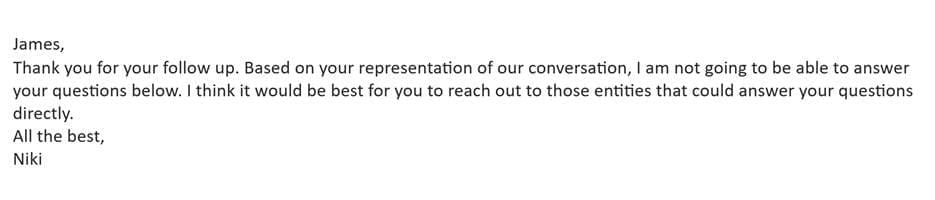
The president and CEO of the Fayette County Development Authority told Clifton in writing that he had misrepresented what she said in a private meeting so badly that she could no longer engage with him through his questions. She did not refuse to talk to the public. She refused to continue being used as a source for claims she had never made.
Clifton continued posting regardless, which is what led Vanderslice to publish a public letter in The Citizen on March 3rd to correct the record directly. That is what it took: the head of the county’s economic development agency writing a letter herself because the person misquoting her would not stop.
The FCDA is the primary vehicle through which Fayette County recruits businesses, negotiates incentives, and manages major economic development projects. Clifton has not held office for a single day, and he has already lost the trust of its top official, not over a policy disagreement, but because she caught him putting words in her mouth and publishing them to thousands of people. Every county leader he would need to work with has now watched it play out in public.
On The Coweta County Land Purchase:
On February 11th, Brent Scarbrough and Company purchased approximately 1,100 acres southwest of Lake McIntosh near the Peachtree City airport. The land is in Coweta County. Clifton headlined his post about the purchase “PEACHTREE CITY DATA CENTER UPDATE” and pointed to Scarbrough’s previous work at the QTS data center site in Fayetteville as the connection.
The Citizen reported that Scarbrough’s connection to QTS was limited to site grading work. He was not the developer or the investor. A Scarbrough-affiliated entity did file a Development of Regional Impact for a proposed data center, but that project is on a separate site in central Coweta County, predates the February purchase by months, and has nothing to do with Peachtree City. Clifton presented none of that context to his followers.
However, none of that is the most important part. The most important part is where that land actually sits and what getting to it would require.
Cross-county annexation in Georgia is legally possible but it is not simple, quiet, or routine. Under O.C.G.A. § 36-36-23, a city seeking to annex land in an adjoining county must provide formal written notice to that county’s governing authority, submit to a mandatory intergovernmental meeting if the county requests one, and then wait for the county to act. Critically, the statute is explicit: no municipality may annex into an adjoining county unless the county governing authority agrees, or fails to oppose the annexation within 30 days. Coweta County can block the entire effort with a single resolution. Every step of that process is public, documented, and subject to Coweta County’s veto before it goes any further.
But the geography makes this specific parcel even more difficult. Lake McIntosh straddles the Fayette-Coweta County line, with most of its shoreline in Coweta County. The Scarbrough parcel sits southwest of that lake. For Peachtree City to annex it, the city would first need to establish contiguity across land it does not currently own or control, crossing a county line and a reservoir, to reach a parcel that does not abut anything Peachtree City currently governs.
Peachtree City has been here before. A proposed development called McIntosh Trail Village, situated directly on the eastern border of Coweta just below Lake McIntosh, was discussed as a potential annexation target for years and never happened. That property was closer and more accessible than the Scarbrough parcel and still never moved forward.
Clifton is a real estate attorney. He should know what contiguity requirements look like. He should know that Coweta County holds a statutory veto over any annexation attempt into its territory. He should know no cross-county annexation process has been initiated. He should know the parcel he called a Peachtree City data center update is separated from Peachtree City by a county line, a lake, and a legal framework that requires Coweta County’s cooperation to even begin.
He posted it anyway.
On The Annexation Study:
The February 12th vote to commission an annexation study was unanimous. Every council member voted yes, including members who have never expressed any interest in data centers.
Council Member Holland explained the actual reasoning on the record. Peachtree City has no more large industrial tracts available within its current limits. If the city wants to continue attracting light industrial businesses, it needs to look beyond its existing boundaries. That is why the council commissioned a study, the first annexation study the city has undertaken in twelve years.
A Georgia Tech analysis supports the logic. Industrial land uses return significantly more in tax revenue relative to the cost of city services than residential development does. A city that wants to maintain its financial footing without raising taxes on residents has good reason to think carefully about where its next industrial land comes from. Commissioning a study to answer that question is not a conspiracy. It is basic fiscal planning.
No annexation application had been filed when Clifton started raising alarms. No zoning change had been proposed. No vote on anything beyond the study itself had occurred or been scheduled. The study had not even concluded. There was no annexation to stop because no annexation had been initiated.
Clifton told his followers that public pressure was the “only way to stop” the process anyway. He told people they needed to act immediately to prevent something that existed only in the timeline he had constructed and posted to Facebook. He did not misread the public record. He ignored it entirely and replaced it with a fabricated political emergency designed to generate the fear and urgency his campaign needed to exist.
The Damage Clifton Has Done
Real people are genuinely frightened by something that does not exist.
Residents are attending council meetings alarmed about a data center that the city has confirmed in writing was never proposed, never applied for, and never discussed with any developer. They are showing up because a man with a Facebook group is telling them they need to.
I obtained through an open records request an email a Peachtree City resident sent to city council asking a simple question: Is it true that a survey is being done that would allow for a data center to be put in Peachtree City? She had read Clifton’s posts and did not know what to believe. City Manager Justin Strickland responded the same day to reassure her that the annexation study is a general boundary review, that council has given no direction to pursue a data center, and that the city’s current ordinances do not permit one.
She should never have to ask her city manager to reassure her about a threat that does not exist. She is asking because Clifton is misleading her.
She is not alone. Across his Facebook group, followers are responding to his posts with expressions of deep distrust toward people who have not lied to them once. One commenter writes that she is “100% done being gaslit by our local government.” It is worth taking that sentiment seriously, because distrust of government is real, it is widespread, and it is not without historical basis.
What Clifton has done is take that legitimate skepticism and weaponize it. He has not channeled distrust of government toward accountability or transparency. He has channeled it toward himself. The commenter who says she is done being gaslit by her government has not found a truth-teller. She has found someone who recognized her distrust and handed her a conspiracy theory shaped to fit it.
The mayor, council members, and the FCDA president are being pulled into formal written responses to Facebook posts. That is public time and public resources being spent correcting a fiction, time that belongs to the actual work of governing this city.
And because Clifton has pre-inoculated his followers against every official denial, some of them will never be reached. The damage to public trust does not end when the election does. He is building something designed to outlast the moment that makes it useful to him.
I wrote in June 2025 that when an untruth goes unchallenged, it sows confusion and undermines the foundation of local democracy.
Clifton has spent the months since proving this.
Why Clifton Is Doing This
One question cuts through everything: who benefits from this?
When residents distrust their government, who benefits? When a Facebook group organized around a manufactured threat grows its membership daily, who benefits? When fear crowds out every other conversation about the county’s future, who benefits?
James Clifton. Always.
Consider what he has never been able to build on his own. Four campaigns across twelve years, and he has never won a single race. He has no record of civic service, no base of supporters built through years of showing up, and no political infrastructure of any kind. What he has, for the first time, is a Facebook group with a growing membership of alarmed residents who believe he is the only person telling them the truth.
That group is free campaign infrastructure. His followers are the asset. The commission seat is the prize. He did not build “Stop PTC Data Center” out of civic concern. He built it the way a candidate builds a mailing list because the people inside it are reachable, motivated, and primed to vote for the man who told them the truth everyone else was hiding.
Every failed campaign taught him this. The 2014 and 2016 losses taught him that running on policy in a crowded primary gets you nowhere. The 2025 loss taught him that attaching yourself to someone else’s agenda is not enough either. What the 2025 campaign also taught him is that fear scales faster than facts, that a Facebook group costs nothing to run, and that a manufactured crisis can do in three months what years of civic engagement could not: put his name in front of thousands of motivated voters who feel they owe him something.
He manufactured the threat, organized people around it, and is now selling himself as the cure for a disease he created.
What Clifton Should Do — But Won’t
At this point, Clifton has three options.
The first is to prove himself right. If he has documents contradicting three officials across three institutions who have stated in writing that his claims are false, he should produce actual documents that support what he has been telling thousands of people for months. He should prove he is right, not speculate.
The second is to acknowledge what he has done, apologize to the people he misled, and rebuild his campaign around something true. He should post that correction in the Facebook group he administers, on his personal page, and in every thread where his followers reshared and amplified his misinformation. The people he frightened deserve to hear the truth in the same place they heard the lie.
The third option is to withdraw from the race entirely, which is what any candidate with genuine regard for this community would do after being caught doing what the record shows he has done.
He will do none of these things because all three require an honest accounting of what he has built and why he built it. Fear gave him something twelve years of campaigning could not. Giving that up would mean admitting that the only thing he has ever successfully built in politics is a lie, and as a politician, Clifton has never once demonstrated the integrity that kind of admission requires.
One more thing readers should know.
When I criticized his 2025 council platform, Clifton answered with a letter questioning my motives and directing readers to his campaign website. He did not correct a single factual error or answer a single specific question. Whether he responds to this column the same way, takes his grievances to Facebook, or simply says nothing, the pattern is the same: attack the messenger, ignore the record.
What he will not do is produce a document contradicting three officials, explain why he called his own evidence circumstantial to a reporter while presenting it as fact to his followers, or post a correction to the group he administers. Those are the questions that matter, and he will not answer them because he cannot.
Readers do not have to take my word for any of this. The record is public. Three officials said in writing that his claims are false. Clifton told a reporter his evidence was circumstantial. He told his followers it was confirmed fact. That is not my interpretation. It is a choice he made, and voters get to decide what it tells them about who he is.
A Challenge to Those Who Have Stayed Silent
Clifton has not operated in a vacuum. Council Member Suzanne Brown publicly supported Clifton’s 2025 Peachtree City council campaign.
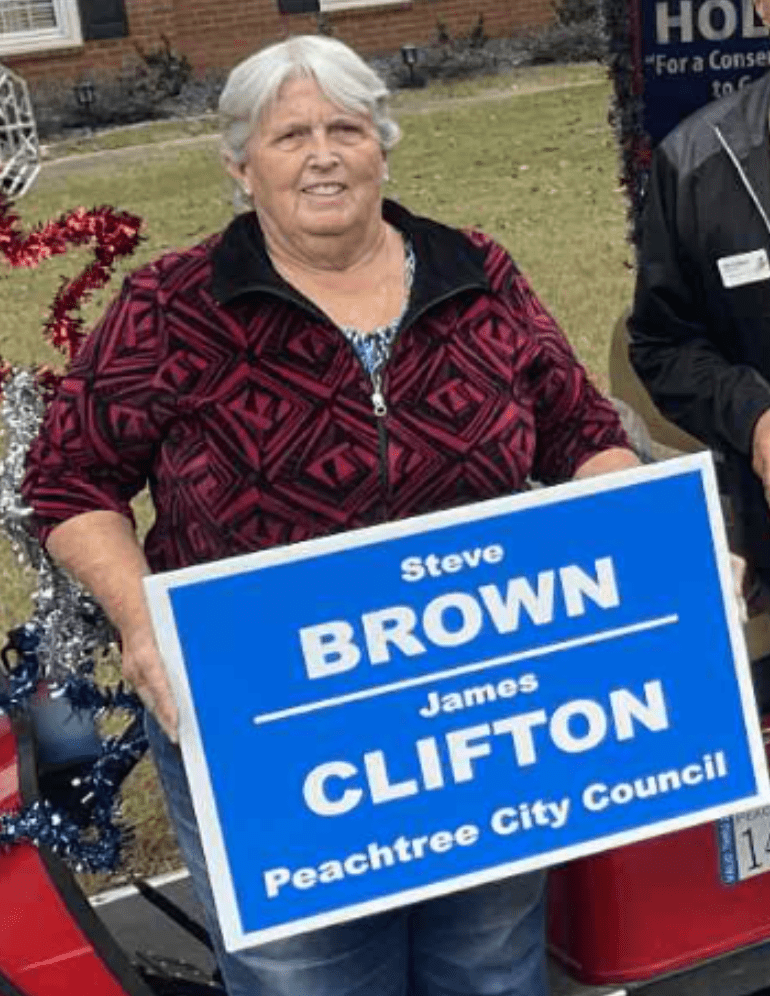
She sits on the same council whose mayor had to issue a formal written denial of claims made by the candidate she backed. She represents the same community that spent months alarmed about a data center threat that did not exist. That is not a comfortable position for an elected official, and it is one she has not addressed publicly.
Her constituents deserve to know where she stands. Some specific questions worth answering:
- Mayor Learnard, who serves on the same council you do, issued a formal written denial of claims made by the candidate you endorsed. Do you believe she was telling the truth, or do you stand by the claims he made?
- Residents you represent spent months frightened by a data center threat that three officials have confirmed in writing does not exist. What do you tell them about the person who frightened them?
- The president of the FCDA published a public letter in this newspaper after the candidate you endorsed misrepresented her words to thousands of people. Do you believe that is how a candidate for public office should conduct himself?
- After everything documented in this column, do you still support James Clifton?
Brown can respond at [email protected]. Her constituents are watching, and what she does next will tell them something important about who she is as their representative.
Elaine Kilgore, Chairwoman of the Fayette County Republican Party, may also want to weigh in. Clifton is running as a Republican, and the documented record of what he has done to this community is now fully public. The question for Chairwoman Kilgore is not whether she supports his candidacy. It is whether she supports his conduct. Those are different things, and Fayette County Republican voters deserve to know where their party stands on the difference. She can respond at [email protected].
The Record Is Clear. So Is the Choice.
Fayette County faces real decisions about growth pressure on its borders, land use and zoning choices that will define the county for a generation, and public safety and infrastructure questions that require honest, evidence-based leadership from someone who has earned the public’s trust rather than manufactured its fear.
James Clifton’s campaign slogan is “Fighting for Fayette’s Future. Preserve Our Quality of Life.” A man who spent four months inventing a threat to frighten his neighbors is not fighting for anyone’s future. A candidate who poisoned his community’s relationship with its own government is not preserving quality of life. Someone who misrepresented public officials, misrepresented his own evidence, and reserved his qualifying language for reporters while performing certainty for his followers is not equipped to make decisions of the magnitude this county’s future requires.
We do not have to settle for this. Both Phil Crane and Chandra Wright are on the ballot, and the county deserves a commissioner who tells the truth when no one is holding them accountable. James Clifton has spent two campaigns in less than a year demonstrating that he is not that person.
Fayette County has seen exactly who James Clifton is. May 19th is the opportunity to make sure he sees it, too.





Leave a Comment
You must be logged in to post a comment.