


 3639
3639 2
2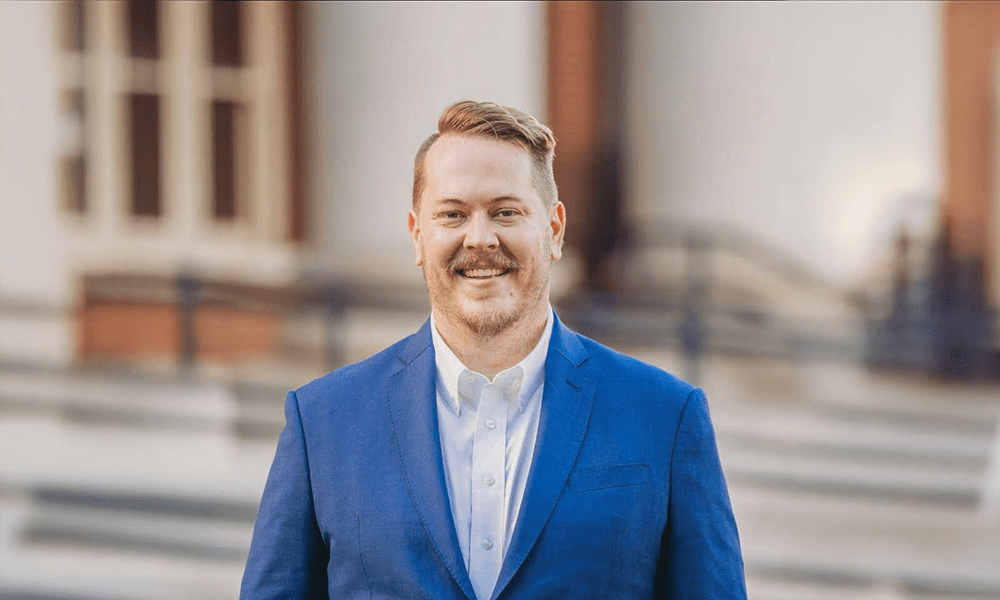
James Shepherd didn’t set out to become mayor — or even to move back home so soon. When the pandemic hit in 2020, he and his wife left California intending to stay in Newnan only temporarily. But as months stretched into years and his parents’ health declined, the decision became permanent.
“We moved down here and were kind of waiting for it to blow over,” Shepherd said. “But then it didn’t, and it didn’t and it didn’t. After just over a year and a half, we decided, look, we’re not moving. We’re going to stay here.”
By the time his father passed and his son was born, Shepherd had stepped back from commuting to a law firm in Atlanta. “It was a huge time commitment,” he said. “I just didn’t have those priorities anymore.” Since then, he has worked independently from Newnan, providing legal and strategic advice to startup and venture capital clients across the country.
That slower pace — and the perspective that came with it — led him to think more deeply about how his hometown was changing.
As he settled back into Newnan life, Shepherd began noticing the city’s rapid growth and the unease that came with it. “There was this kind of sense that something was wrong,” he said. “People feel like what they love about Newnan — about the county — they’re losing that.” Applying his experience in finance and strategy, he saw local leadership struggling to keep pace with rapid change. “We’re dealing with very rapid growth in a town that hasn’t accepted where it is,” Shepherd explained. “I look at this as the same kind of challenge I faced helping large organizations adapt — only now it’s my hometown.”
The first week in November, voters agreed with his vision, electing Shepherd to replace longtime Mayor Keith Brady, ending an era of leadership that stretched over two decades. Shepherd will take office in January.
A campaign built on transparency
Shepherd’s campaign emphasized public accountability and financial openness. “We made it very easy to see that we were being transparent,” he said. “We walked through my finances publicly to show that I don’t have significant real estate interests. I own two houses, which is pretty good for a millennial, but that’s it.”
He said voters appreciated that clarity — especially after years of concern about how the city handled development decisions. “Even though Mayor Brady recused himself from votes on certain developments,” Shepherd said, “I don’t think he met the standard for impartiality that’s required. People saw that, and they were ready for something different.”
From global consulting to local service
Shepherd’s story spans continents and careers. Born on a U.S. military base while his father served in the Air Force, he grew up in Newnan after the family settled there when he was eight. A graduate of Newnan High School and later the University of Georgia, Shepherd earned a degree in history before moving west to work in consulting.
He joined Accenture Strategy in San Francisco, where he advised large technology firms like Facebook, Cisco, and Dropbox. “I was doing financial analysis for big tech companies, helping them understand their return on investment,” he said. “It was valuable experience, but not fulfilling.”
After several years in consulting, Shepherd decided to pivot toward law. “I took the LSAT, did fairly well, and ended up going to Columbia Law School,” he said. He graduated in 2020, right into the pandemic, and moved back to Newnan with his wife to be near family.
Now 35, Shepherd works remotely from his Greenville Street home, advising startups and venture clients. His historic Spanish-style house — built in 1891 — is one of the few of its kind in downtown Newnan. That house, and the challenges of maintaining it, shaped some of his thinking about the city’s future.
“When we tried to build a small in-law unit for my father, we found that zoning regulations basically made it impossible,” he said. “We’ve overregulated our housing market in ways that don’t make sense for ordinary families.”
Rethinking growth and housing
If there’s one issue that will define Shepherd’s term, it’s housing. “I’m laser-focused on housing affordability,” he said. “We need zoning that allows the market to do what it’s good at — providing more options — instead of having seven people dictate every little element of how homes get built.”
He pointed to the lack of variety in Newnan’s newer developments as a key concern. “We’ve been building either huge apartment blocks or large single-family homes, with nothing in between,” he said. “Downtown Newnan has duplexes, triplexes, row houses — a real mix. That’s what creates affordability and community, and we haven’t built anything like that in decades.”
Shepherd believes in what he calls “incremental, organic development” — allowing homeowners to adapt their properties over time, adding accessory units or downsized spaces for aging parents. “That’s how we keep families together and neighborhoods stable,” he said. “It’s about freedom and flexibility, not bureaucracy.”
Looking ahead
Shepherd’s background in finance and technology gives him a pragmatic lens for city management. “Newnan is essentially a $40 million-a-year organization,” he said. “We need to guide it like one — efficiently, transparently, and with long-term vision.”
As he prepares to take office in January, Shepherd said he plans to keep the same open-door philosophy that helped him win the election. “In local politics, nobody’s looking for you,” he said. “You have to go to them. That’s how you earn trust — by showing up.”


Leave a Comment
You must be logged in to post a comment.