


 2158
2158 0
0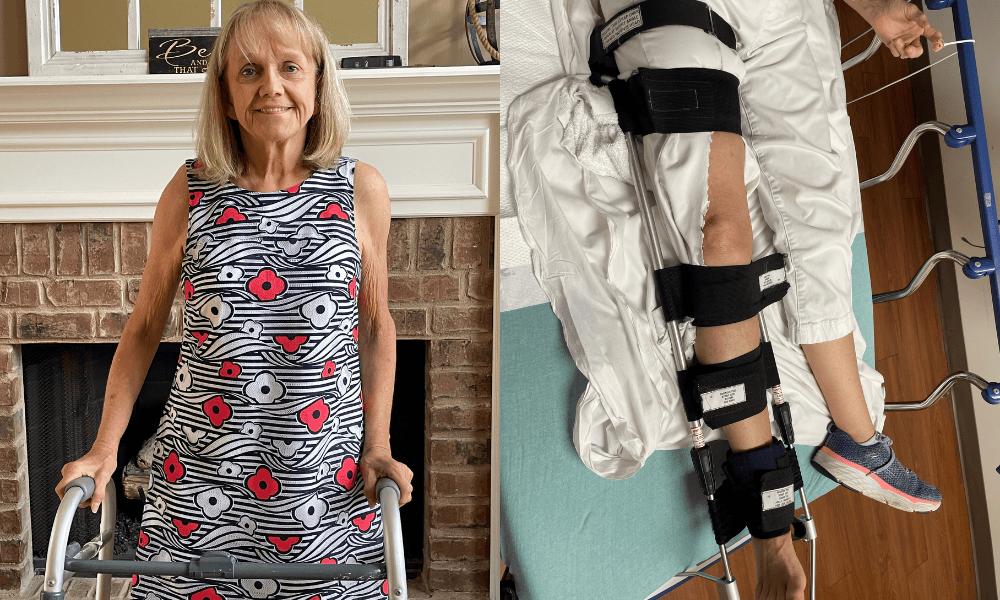
Not content with the neighborhood fireworks display on July 3, my wife, Nan, provided some of her own. She turned a simple fall into a complicated fracture. After fifty years together, there are some sights you hope never to see, and your wife’s leg pointing the wrong direction is one of them. A functioning femur turns out to be surprisingly useful for standing and walking.
While awaiting emergency services, our wonderful neighbors swing into action. Pediatrician Kristine Andrews anchors beside my wife, offering professional guidance and much-appreciated comfort and reassurance. The always delightful Jaye McBride takes full custody of our grandchildren—no feat for the faint of heart. By the time the ambulance arrives, we have assembled another doctor and several nurses, a veritable M*A*S*H unit.
As soon as the EMTs ascertain that Nan isn’t a contortionist, they confirm the irregular angle of her leg, gingerly apply a brace, and start communicating with headquarters. With no bone doctors excited about operating on July 4 at Fayette Piedmont Hospital, they first propose Grady. I gulp heavily. I’m not thrilled about a visit to the healthcare zoo on Friday night. They suddenly pivot to Piedmont Henry Hospital, and I follow along in my car, still worried about her pain, but no longer concerned about our safety.
A Friday night Emergency Department is always an adventure, and the addition of a holiday weekend elevates the spectacle. The folks being treated may be in pain, but the folks waiting for them are in a profound state of boredom visible in grimaced faces, uneasy relationships with their chairs, and snoring. Before I have a chance to join their misery, I am united with Nan in an exam room. Arriving by ambulance is the hospital equivalent to Sky Priority. Unfortunately, getting to your plane quickly doesn’t translate into speedily getting to your destination.
Morphine eases Nan’s pain, but they don’t rustle up anything for me. The emergency physician hurries in and makes the obvious diagnosis, but she also informs us that a treatment protocol is on its way to enliven our evening. In American medicine, it would be unconscionable to leave $30,000 of testing on the table. We begin the alphabet soup course: CBC, ECG, APTT, CT scans, X-rays.
At 3:00 AM, I’m tottering on my straight chair. Every time I start to feel sorry for myself, the door opens, and I see a man sitting on a backless stool in the brightly lighted hall attending his groaning mother. I remind myself, if you’ve got to be stuck on the tarmac, it’s better not to have boarded in Zone Seven.
We’re finally shown to our room at 4:30 AM, and the third-floor accommodations on the newly constructed East Wing are lovely. The wing has been open only a few weeks, and I can almost smell the newness beneath the isopropyl alcohol. Drugs have rendered my wife insouciant, so I stretch out on the couch under a blanket and quickly fall asleep.
The orthopedist arrives around 6:30 AM and proposes a surgical rod to straighten Nan out. I must be punch-drunk because the idea of a rod for spousal correction seems hilarious. Dr. Sexton will operate this afternoon, and we are invited to enjoy our home away from home with its concierge service. The only caveat: Nan must abstain from all food and drink, even water.
This is an offer I can gladly refuse. Assured that my wife is in good hands, I return home and hit the sack for two more hours before retrieving my granddaughters. They arrive fresh from the Peachtree City July 4th parade with a sack full of candy and tales of new friends and adventures. They have no curiosity about their ailing Nana, whom they last saw being carted away on a stretcher, and I’m unsure whether to be relieved or annoyed by this.
My grandparental responsibilities end when I drop the children off at a swim date arranged by their parents. My spousal duties begin soon, but not before I raid the refrigerator—a pleasure I’ll not share with my famished wife when I return to her bedside. After all, she got all the good drugs last night.
The interminable waiting game has been delayed by a miscommunicated order to the cardiologist for clearance. He finally arrives with more apologies than a gate agent on a stormy afternoon. It’s 6:00 PM, and we’re finally off to surgery with an orthopedic who has been on duty at least thirteen hours. After your femur’s been split like bad kindling for twenty-one hours, a heavy brace confines your leg, and eating is a distant memory, you tend not to be overly picky.
Everything moves swimmingly in pre-op until the anesthesiologist appears, makes little eye contact, and announces an emergency that requires her attendance. The pre-op nurses shift moods from jovial to intense floor inspectors. Finally, a freshly arrived anesthesiologist comes in cheerily, and it seems likely that the emergency was that the previous consciousness-eradicator feared delaying her 7:00 PM departure. To escape a doctor so much more committed to her comfort than her patient’s, I gladly accept the delay.
An hour later, Dr. Sexton pronounces the surgery a complete success, and Nan arrives in a haze with plenty of staples in her right leg. I can finally celebrate both personally and nationally on this Independence Day.
Nan has a penchant for breaking bones in July. Two summers ago, she fractured her wrist in rural France, where we did the same ambulance, ER, and surgery drill, received comparable nursing care, and were out of the hospital less than twenty-four hours after arriving. The bill was about $1,500. Piedmont Henry’s initial invoice is $130,405.60, and I haven’t yet heard from EMS or the surgeon.
So if you must break a bone, I’ll give you some pointers. Choose a midweek time for your calamity far from any holiday. Arrive at the hospital by ambulance and bring a book and pillow. Expect excellent medical care, but understand that you’ll be overtreated. And if money is an issue, the cost of a flight to Europe will be a fraction of what you’ll pay for treatment here. Otherwise, enjoy the performance and break a leg.






Leave a Comment
You must be logged in to post a comment.