


 3381
3381 1
1
I lost him.
It was a split second, and that is all it takes. I had stepped inside to grab something to drink. His siblings, seven and four years old, followed me in. I looked around and said, where is Joshie? They said he was still outside. I stopped what I was doing, rushed back out, and the gate was open.
Thirty seconds. Maybe less.
I work in healthcare. I understand elopement. I know the statistics, the risk factors, and the clinical language professionals use to describe what happens when a child with autism wanders away from safety. I have read the literature and have had the conversations. None of it prepared me for that moment.
Joshie had no shoes on. He never does when he is just playing in our backyard. He is five years old, nonverbal in the moments when it matters most, unable to tell a stranger his name or where he lived, or that his father was running through the neighborhood, calling his name in a frantic voice.
I went in one direction. He had gone to another.
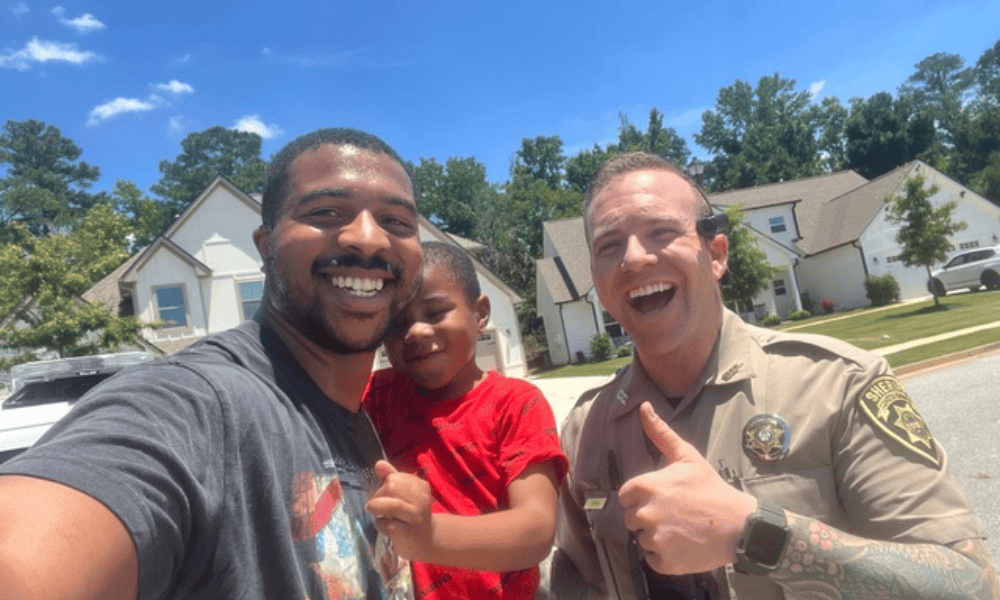
What I did not know in those five minutes was that someone in our neighborhood had already seen him. They recognized immediately that something was not right. They called 911. The dispatcher connected that call to mine. And by the time I was running toward the address they gave me, drenched in sweat from the Georgia heat, a Coweta County police officer pulled up alongside me and said, “Hey, are you Dad?”
I said yes, and he instructed me to get in. We rode together to the home of Sarah and Ricky Walker, two blocks away, a part of the neighborhood I had barely taken Joshie to on a walk before. There was already another officer there when we arrived, a woman, professional and calm and kind. Both officers were exactly what you hope law enforcement will be in a moment like that.
And inside that house, completely unbothered by any of it, was my son.
He had found his way into the home of Ricky and Sarah Walker, met their family, discovered their toys, and made himself at home. He was crashing on their furniture, stemming, happy, doing exactly what Joshie does when he finds a new environment he loves. He did not want to leave.
When I told him it was time to go, he ran into their laundry room.
I had to get down on his level, speak softly and slowly, and tell him his siblings were waiting for him at home. That is how it works with Joshie. You do not pull him out of a moment. You meet him inside it and walk him gently toward the next one. He looked at me, settled, and came into my arms.
I held him there for a moment longer than I needed to.
I am a Black man in America, and I will not pretend that calling law enforcement is something that comes without a complicated history for many people in my community or for me. But I want to make it clear: on that day, in that moment, every officer I encountered treated my son and my family with professionalism, care, and human decency. I am grateful for that, and I think it matters to say so out loud.
When we take Joshie out in public, he wears a harness leash. I know some people see it and do not understand. It is not because we do not trust him. It is because we love him and we know how fast the world can change. One distraction, one unlocked gate, thirty seconds, and everything becomes urgent in a way that is very hard to explain until you have lived it.
After that afternoon, we put real locks on every gate. That is what you do when theory becomes lived experience. You adapt. You add another layer. You lie awake at night thinking about what else you can do.
We have also spent a lot of time researching GPS tracking options for Joshie. The challenge is that he removes everything. He does not like things on his body. Clothes are already a battle in our house. A wristband or watch does not stand a chance currently. Finding something he will tolerate and keep on is something our family is actively navigating right now, because the truth is that what happened in our backyard could happen again. We want to be ready. We want to be able to find him in minutes, not hours.
That word, hours, brings me to Ramon Jett.
RJ. Six years old, nonverbal, autistic, and had ADHD. He disappeared from his sister’s apartment in Riverdale on June 28th. His mother was at work. His sister had been caring for him, and they lay down for a nap. When she woke up, the front door was open, and RJ was gone. A community showed up in force. Neighbors searched alongside family members. Law enforcement from multiple counties deployed K9 units, drones, helicopters, and dive teams. Volunteers stayed out through the night. One neighbor flagged down police after spotting a pair of white tube socks near where RJ was last seen, and stayed out searching until midnight because she knew if it were her grandchildren, she would want someone to do the same. His body was recovered from a pond approximately 125 yards from where he was last seen, on the morning of June 29th.
RJ was one year older than Joshie. I sat with that for a long time.
There is a version of my story that ends the way RJ’s did. I do not say that to be dramatic. I say it because it is true, and because I think parents of children with autism carry that truth with them every single day, and most of us do not talk about it. We are afraid of the pity. We are afraid of the judgment. We are afraid that if we say out loud how scared we are, it will somehow make it more real.
But here is what I learned from those five minutes, and from reading about what RJ’s community did in Clayton County. People have good hearts. Neighbors will show up. A stranger will call 911 for a barefoot child who cannot say his own name. Someone will flag down a police officer over a pair of white socks because something feels wrong. A neighbor will stay out until midnight, searching for a little boy she has never met, because she knows what it would mean if it were hers.
If you live near a family with a child who has special needs, let them tell you. If you sense it and they have never mentioned it, ask gently. Know what elopement looks like. Know that a child wandering alone is not always lost, as you might assume. Know that calling 911 quickly, the way someone did for Joshie, may be one of the most important things a neighbor ever does.
His siblings know. A seven-year-old and a four-year-old understand, as children do with things that are too big for them, that keeping Joshie close is serious. They did not do anything wrong that afternoon. They followed their dad inside. That is what kids do. Elopement does not happen because of bad parenting or inattentive siblings. It happens in the space between one ordinary moment and the next. That is what makes it so hard to prevent and so important to talk about.
We cannot watch our children every second of every day. We try. We use every tool available to us. We check the gates. We add the locks. We install door alarms. We research tracking devices and test what our children will actually keep on their bodies. And still, sometimes, a gate swings open and thirty seconds feel like a lifetime.
Joshie is home. He is safe. He is probably somewhere right now jumping on something he is not supposed to jump on, completely delighted with himself, because that is who he is.
RJ is not coming home.
His family deserves our prayers. And our neighborhoods deserve the kind of awareness that might mean the next child who wanders finds a neighbor who knows exactly what to do.
It really does take a village. When I reached out to Sarah to ask if I could mention her family in this article, she wrote back:
“We are just always praising the Lord that he is safe and back at home.”
That is it. That is the whole thing. A neighbor who opened her door, let a barefoot five-year-old play with her family, and called 911 without hesitation. And when I thanked her, she gave the credit straight to God and called it a blessing.
I am grateful for the Walkers. I am grateful for the dispatcher who connected the calls. I am grateful for the county officers who showed up with professionalism and care. I am grateful for a neighborhood that saw something and said something.
And I am asking you to be that neighbor for someone else.



Leave a Comment
You must be logged in to post a comment.