


 4625
4625 0
0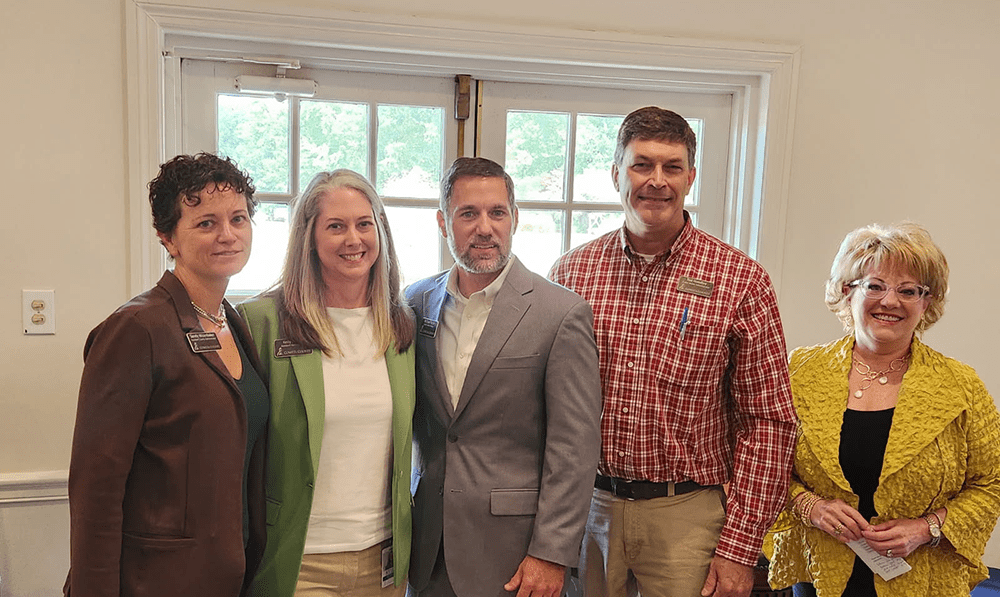
The Newnan Country Club filled quickly, a mix of business owners, elected officials, and longtime residents finding seats around tables with catered lunch served from the buffet. A prayer opened the gathering, asking for “clarity, compassion, and courage” for Coweta’s leaders. It was a fitting start for a lunch meeting focused on how the county is navigating growth, infrastructure, and community needs in the year ahead.
The annual State of the Community: State of the County luncheon, hosted by the Newnan-Coweta Chamber and sponsored by Piedmont Newnan Hospital, brought together a cross-section of local leadership. Over the course of the program, county commissioners, administrators, and public service directors painted a picture of where Coweta stands today and where it is heading.
Healthcare: Expanding Local Access
Mike Robertson, CEO of Piedmont Newnan, was among the first to address the crowd. He began by showing a video of a local patient who survived a cardiac arrest thanks to quick care across multiple Piedmont facilities.
“This little video is really an example of what we look at from what we call our mission,” Robertson said. “It’s to make a positive difference in every life we touch and to keep healthcare local.”
Robertson noted that Piedmont has recruited aggressively over the past year: five new obstetricians, four primary care doctors, three cardiologists, two pediatricians, and specialists in oncology, neurology, and endocrinology. Recruitment, he emphasized, is key to ensuring Coweta residents don’t need to drive to Atlanta for specialized care.
“We want to keep your care right here close to home,” Robertson said. “We’re recruiting lots and lots of physicians so that when your family needs help, we’re ready.”
Leadership and Values
Commission Chairman Bill McKenzie followed with a reminder that public service is both challenging and deeply personal.
“From time to time there are people who disagree with what the board of commissioners or Michael [Fouts] tells them,” McKenzie said, referring to the county administrator. “But we can agree to disagree and still be friends at the end of the conversation. Folks, we need peace—and it will never start until we start it, right here on the local level.”
McKenzie praised Fouts, who was recently named Administrator of the Year by the Association County Commissioners of Georgia. He also stressed the importance of fiscal responsibility, safe communities, and planning for families of all ages as Coweta grows.
“There’s no question businesses want to come here. They want to grow here. They want their employees to build a life here,” McKenzie said. “So how are we handling it all? That’s the question we have to keep asking.”
Growth by the Numbers
County Administrator Michael Fouts took the microphone next, flanked by his senior leadership team. He reminded the audience that Coweta’s commissioners rotate chairmanship every two years—a rarity among Georgia counties—and underscored how teamwork shapes the county’s decisions.
Fouts pointed to data showing the county’s population is projected to rise steadily, reaching 217,000 residents by 2050.
“Whether you’ve lived here six months or 61 years, you’ve experienced the growth,” he said. “The biggest boom was in the late nineties and early 2000s, when we were issuing over a thousand residential permits a year. We don’t see that pace today, but we’re still averaging 600 to 800 new homes annually.”
Growth, however, has consequences. About 70% of Coweta’s tax digest comes from residential property, compared to only 17% from commercial. That imbalance places pressure on the county to recruit more industry and jobs to offset the cost of services.
“It’s really important that we maintain economic activity,” Fouts explained. “We need target industries and higher job growth so that homeowners aren’t carrying so much of the tax burden.”
Data Centers: The Hot-Button Issue
Perhaps no topic has drawn more public attention in recent months than data centers. Fouts acknowledged the confusion as two separate projects—known as Project Peach and Project Sail—moved through the county’s approval process while commissioners also worked on drafting an ordinance.
“Coweta’s been on the map for several years now for data centers,” Fouts said. “The board approved Project Peach with about 20 zoning conditions earlier this year. Then they passed a moratorium, and during that time another project came in. These are separate conversations, but they’re happening at the same time, which has created a lot of questions.”
The moratorium on new applications expires November 3, and commissioners plan to hold a work session October 16 followed by a public hearing November 18. Fouts urged residents to stay engaged.
“The comprehensive plan is a guide—it’s not the gospel,” he said. “Data centers are new to Georgia. We need to figure out how they fit into industrial areas, and your feedback will shape that.”
Roads and Transportation
Public Works Administrator Tod Handley outlined major projects already underway. Among them:
– Shaw Road Connector: linking Fisher Road to Shaw Road near Northgate High to ease school traffic with a new signalized intersection.
– Southwest Connector: providing a second entrance to the Coweta fairgrounds and eventually tying into U.S. 29 with a bridge over the CSX railroad.
– McIntosh Parkway Connector: a multi-phase project that will eventually provide a new route from Heritage School to I-85, with a new interchange at Amlajack Boulevard.
“We maintain about a thousand miles of road and 130 bridges,” Handley said. “That’s like driving from here to Toronto. It’s a lot of pavement, but we prioritize based on pavement evaluations, safety, and community needs.”
Public Safety and Services
Assistant Administrator Sandy Wisenbaker gave updates on several initiatives:
– Next-generation 911: “Right now we’re using 20-year-old technology,” she said. “It’s like comparing a rotary phone to a smartphone. The new system will allow law enforcement, fire, and EMS to share information instantly, rerouting in real time to save precious minutes.”
– Fire stations: Station 5 near Smokey and Belk roads is set for completion in late 2026, while Station 10 near Senoia will be ready earlier in the year.
– Public Safety Training Center: set to break ground in 2026, including a skills pad and fire tower for advanced training.
– Real-Time Crime Center: already in operation at the Sheriff’s Office, using cameras and tag readers to assist investigations.
Wisenbaker also highlighted the popular Doggy Day Out program at Animal Services, where residents can “check out” dogs for park outings. Plans are underway for a modern adoption center on the Bypass, designed with input from national experts.
“This will be in addition to our current shelter,” Wisenbaker said. “It’s about giving these animals the best chance at adoption while creating a community space with walking trails and passive park land.”
Budget, Taxes, and Recreation
Assistant Administrator Kelly Mickle broke down the county’s $117 million general fund. Nearly half is devoted to public safety, with the Sheriff’s Office alone accounting for about $40 million.
Residents will notice a change on tax bills this year: three new special service districts for 911, EMS, and parks and recreation.
“In terms of transparency, this lets you see exactly what you’re paying for,” Mickle said. “For example, 911 fees cover about half of operations. The rest comes from property taxes.”
Mickle also described the November ballot question on the floating local option sales tax (FLOST), which would raise the sales tax to 8% but earmark the additional revenue for property tax relief.
“It’s tough to say exactly how much taxes will be reduced, since costs rise each year,” she noted. “But for context, the county collected about $47 million in property taxes in 2024, and FLOST could bring in around $27 million in 2026.”
On the recreation front, voters can expect to see new facilities: four baseball fields and pickleball courts at Leroy Johnson Park, and the start of the much-anticipated Prowell Park complex, which will include soccer fields, disc golf, and walking trails.
Looking Ahead
As the program drew to a close, Fouts returned to the stage to sum up the county’s direction.
“We see our work built on five pillars,” he said. “Strategy, infrastructure, fiscal discipline, citizen focus, and employee focus. Those are what carry us forward.”
The message from county leaders was clear: Coweta is growing steadily, with opportunities to shape that growth through public input. From new doctors and fire stations to major road projects and a tax referendum, 2026 will bring visible changes.
For residents, the bottom line is simple. Stay informed, stay engaged, and be ready to help Coweta balance rapid growth with the small-town values that make it home.


Thanks Mike, for the kind words. Showing up at Mimi’s was simply a matter of courtesy. I do respect you…





Leave a Comment
You must be logged in to post a comment.