


 14958
 0
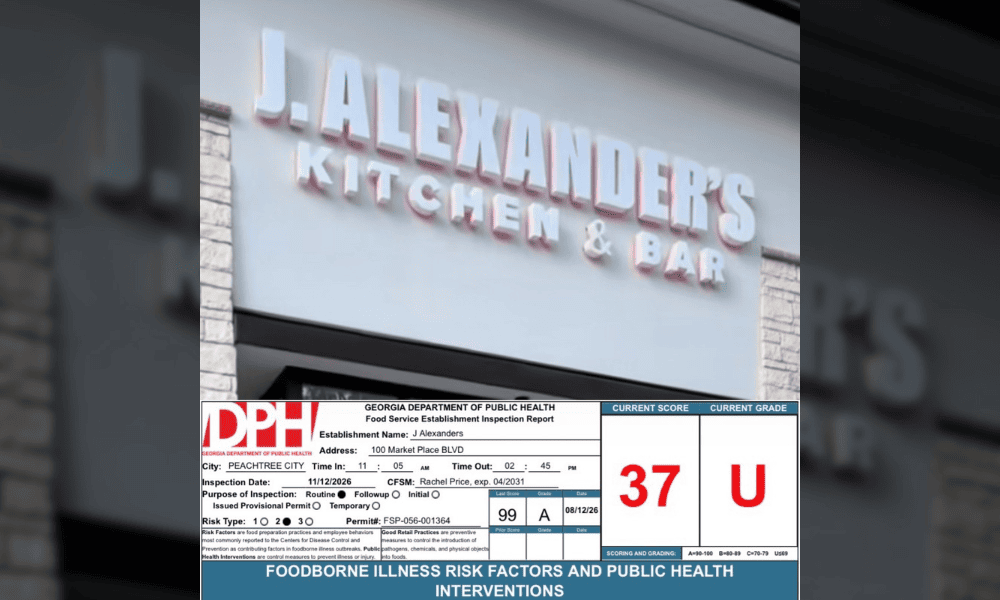
J. Alexander’s, which opened August 31 on Market Place Boulevard in Peachtree City, received a score of 37 on a routine health inspection conducted Thursday, November 12, by the Georgia Department of Public Health.
The restaurant had been open for just 73 days when inspectors documented numerous food safety violations, including improper handwashing, cross-contamination involving raw chicken, unsafe food temperatures, and problems with sanitation equipment.
Located at 100 Market Place Blvd. in the former Smokey Bones building, J. Alexander’s is the chain’s fourth Georgia location. The restaurant specializes in wood-fired steaks, seafood, and contemporary American cuisine.
Under Georgia’s restaurant inspection system, a score below 70 is considered failing. The restaurant’s score of 37 places it well below that threshold.
Handwashing and cross-contamination violations
Among the most serious findings were multiple violations involving employee handwashing and food handling.
According to the inspection, servers began handling food and drinks without washing their hands. Kitchen employees were also observed wiping soiled gloves on their clothing and continuing to prepare food without washing their hands or changing gloves.
The inspector intervened, employees washed their hands, and the affected food was discarded.
Inspectors also found raw chicken stored next to cooked chicken and above raw beef, creating a risk of cross-contamination. Employees rearranged the food during the inspection.
Additional violations involved employee drinks stored near food preparation areas, employees handling food with long, painted fingernails without gloves, and employees wearing jewelry while preparing food and drinks.
Improper cooking and food temperatures
The inspection identified several problems involving cooking, cooling, reheating, and holding food at safe temperatures.
Chicken was removed from an oven at temperatures between 123 and 125 degrees Fahrenheit. Employees planned to hold the chicken hot and finish cooking it before serving customers, but the restaurant did not have an approved procedure for cooking chicken in stages.
The chicken was discarded, and management told the inspector the practice would stop.
Mashed potatoes and gravy also failed to reach the required reheating temperature of 165 degrees within two hours. Both were discarded.
Other foods requiring refrigeration were being held above the maximum permitted temperature of 41 degrees, while foods requiring hot holding were below the minimum temperature of 135 degrees. The affected food was discarded.
Inspectors also found beef ribs, coleslaw, orzo, and grilled chicken cooling too slowly to meet food safety requirements. Some items were stored in densely packed containers, and the grilled chicken was tightly covered. The report noted that food was moved to a freezer to speed cooling.
Sanitation and equipment problems
The restaurant’s bar dishwasher was found to be dispensing no sanitizer. Employees replaced the chlorine supply and verified that the machine was dispensing sanitizer.
Other violations included utensils stored in a handwashing sink, wiping cloths blocking access to that sink, and sanitizer buckets stored near food and food-contact surfaces.
Inspectors also found cakes, ice cream, deviled eggs, pasta, cut produce, and other foods stored uncovered in refrigerators and freezers.
Additional findings involved unlabeled food containers, wet wiping cloths left on counters, grill tongs stored in standing water at 87 degrees, and clean containers stacked before they were dry.
Clean plates and bowls were stored upright without protection from overhead contamination, while some single-use containers were stored outdoors where they were exposed to contamination.
The inspection also identified several pieces of refrigeration equipment that were not operating properly or were in disrepair.
Many violations were corrected during the inspection, including the disposal of improperly handled or temperature-controlled food. Those immediate corrections do not establish that all cited problems have been permanently resolved.
The November 12 inspection was classified as routine. The information provided does not establish whether a follow-up inspection has been scheduled or completed.
All inspection scores are reported by the Georgia Department of Public Health.
This reporting is part of a partnership between The Citizen and Eat Safe Fayette. For up-to-date Fayette County health inspection scores as they happen, visit Eat Safe Fayette’s Facebook page or Instagram @eatsafefayette.





Leave a Comment
You must be logged in to post a comment.