


 9024
9024 2
2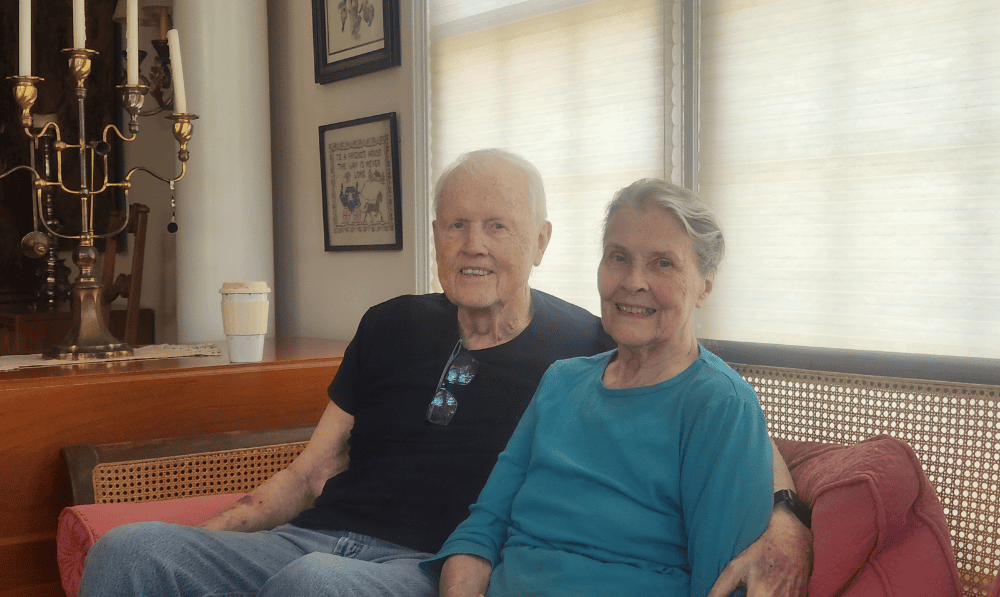
At 90, Peachtree City’s founder Joel Cowan can sit in his Peachtree City home and describe the time he drove around with two cases of dynamite in the back of his car.
He had a reason.
Cowan was trying to drain swampy land where beavers kept rebuilding their dams almost as quickly as he could destroy them. He was trying to figure out where a lake should go, where a golf course might fit, how water should flow and, on a much larger scale, how to turn thousands of acres of mostly fallow farmland and pine trees into something that did not yet exist.
A town.
“I learned to use ditching dynamite,” Cowan said.
He and equipment owner Tom Mitchell would push dynamite into the beaver dams, run the wires away and take cover.
“I’d get behind a tree over there, blow the dam all at once,” Cowan said.
There was one problem.
“The beavers could build it back virtually in 24 hours,” he said. “I couldn’t get ahead of them.”
It is one of many stories Joel and Geri Cowan can tell about the improbable beginnings of Peachtree City — stories involving farmers, bootleggers, a prefab house, a party-line telephone, a $1,200 lakefront lot, a young mayor named by the Georgia Legislature and a newlywed couple barely out of college who moved into a place that, by almost any modern definition, was the middle of nowhere.
Nearly seven decades later, the Cowans are still here.
And this year, for the first time in a long time, age has begun making itself felt.
“We’ve been lucky up to really this year,” Joel Cowan said. “Then I start falling apart.”
Before there was a city
Joel and Geri married in December 1957. They were both 21.
Joel was still a Georgia Tech student studying industrial management when he became involved with a group attempting to assemble enough Fayette County land to create a new town.
The opportunity arrived almost by accident.
Cowan was eating breakfast in his fraternity house when he saw a newspaper story about a proposed new town in Fayette County. One of the men pictured was Pete Knox Jr., father of Cowan’s fraternity brother.
Cowan turned to his friend.
“Does your dad need a mayor for that town?” he asked.
They laughed.
A few weeks later, Cowan got a call. Knox wanted to meet him.
“He and I hit it off right away because he was kind of a dreamer and planner, like me,” Cowan said.
By his final year at Georgia Tech, Cowan was working on the project while still attending school. He and Geri lived in an Atlanta apartment where he also maintained an office.
On Jan. 1, 1959, the young couple moved to Fayette County.
There was not much waiting for them.
“Well, there’s nothing here,” Cowan said.
There were old farmhouses and land that was no longer being actively cultivated. The federal government had paid some landowners to plant pine trees, he said, and Cowan planted plenty himself.
“Most of the property was just lying fallow because the farmers had gotten old, and they weren’t farming anymore,” Geri Cowan said.
The area also had a reputation.
Geri said young women in Fayetteville were warned by their parents not to venture west into the area then known as Shakerag. The countryside was known for bootleggers, illegal whiskey stills and other activity that gave the remote area a rough reputation.
“This bad place,” Joel said.
The Cowans did not know that when they arrived.
What Joel knew was that a new town required land, and land closer to Atlanta’s existing growth corridors was too expensive and too difficult to assemble in sufficiently large tracts.
“You had to have a lot of land,” he said.
That meant going where the growth was not.
The mayor had to live somewhere
The Cowans built their first home near what is now Ga. Highway 54 and Shakerag Hill.
“We built it in 30 days,” Joel said.
It was a Knox prefab home, and according to Cowan, it was the first new house constructed in that immediate area since before World War II.
Geri remembers why they were in such a hurry.
“We had to be here by the first of the year so that he could be mayor,” she said.
Peachtree City did not simply elect its first mayor. Its charter had to be created through the Georgia Legislature, and that legislation named Cowan mayor along with several local farmers as council members.
He was about 22.
His father, meanwhile, was mayor of Cartersville.
Joel would serve as Peachtree City’s mayor for roughly five years, although the title represented only a fraction of what he was doing.
“You have to realize that I was building a town,” he said.
A conventional developer could build next to an existing community and inherit its schools, stores, roads and institutions.
Peachtree City did not have those.
“You’ve got to have a reason to exist,” Cowan said. “Nobody wants to just move out of a farm out in the middle of nowhere.”
So he needed all of it.
Homes. Water. A grocery store. A school. A bank. Churches. Industry. Roads. Recreation.
One thing could help make the next thing possible.
“You get a grocery store and more people,” he said. “You get a school and so on and so forth.”
A name he never particularly liked
Before Cowan could incorporate a city, however, he needed something fairly fundamental.
A name.
“Had to have a name to have the bill,” he said.
Cowan wanted something that would make people elsewhere associate the community with Atlanta and Georgia. “Peachtree” accomplished that.
So Peachtree City it became.
“I frankly never liked the name,” Cowan said.
He never came up with something he liked better.
And soon enough, it no longer belonged only to him.
“The funny thing caught on,” he said. “People wouldn’t take anything for it.”
The city charter itself was assembled in the practical fashion of the day: Cowan and attorney Henry Neal borrowed heavily from an existing municipal charter because the legal provisions had already been tested.
That produced a document containing some antiquated powers.
Among them: the ability to regulate “circuses and flying jennies.”
Peachtree City may have been a futuristic idea, but apparently its first charter was ready if a traveling carnival got out of hand.
$485,000 and a town to build
The earliest development effort struggled financially.
Eventually, Cowan brought the Phipps family into the project. The closing paid debts owed on the land and left Cowan with approximately $485,000 to begin building the town.
“Okay, you take this and start your town,” Cowan recalled.
Even then, Cowan immediately spent a large portion acquiring another critical piece of property — land belonging to Dr. McDaniel in what would become the Flat Creek area.
He had paid roughly $35 to $65 an acre for much of the earlier land, Cowan said.
McDaniel wanted about $220 an acre.
Cowan bought it.
It was, he believed, too important to lose.
That pattern repeated itself again and again. Immediate profitability was not always the point. Cowan was trying to assemble enough pieces that people would begin seeing Peachtree City as a real place.
Lakefront property helped.
The first lakefront buyers, Jim and Miriam Fulton, paid just $1,200 for their lot.
The catch was that buyers could not simply hold property.
“If you bought the lot, you had to build on it,” Geri said.
Joel wanted residents, not speculators or a collection of weekend homes.
“Anything get somebody to live here,” he said.
Two gas pumps and a party line
The Cowans remember what passed for commerce when they first arrived.
Across from their early home was a tiny establishment operated by Bunky Collier and his wife.
“He had two pumps,” Geri said.
Inside were a few provisions, ice cream and a large round of cheese.
“It wasn’t where you go for grocery shopping,” Joel said.
Telephone service could be equally primitive.
The Cowans initially had a four-party line, meaning several households shared the same telephone connection.
Geri remembers trying to speak with her mother long-distance when another woman came onto the line.
“She said, ‘I’ve got to make a business call. Will you hang up and let me use?’” Geri said.
After enough interruptions, the Cowans managed to get a private line.
Even mailing addresses illustrated just how little of a “place” Peachtree City initially was. Rural delivery routes from different communities ended there. Depending on which side of the road a family lived, its mailing address might have been associated with a completely different town.
“We were at the end of the line,” Joel said.
Building what people needed
Some of Cowan’s most consequential projects began because Peachtree City needed something immediately and ordinary processes would take too long.
Peachtree City Elementary was one.
As Fayette County schools moved toward integration, the school system needed additional space. Cowan offered to build a school in Peachtree City and have it ready by the fall.
That conversation happened in January.
“I’ll have it ready by September,” he told them.
He called college friend and builder Bill Collins.
“We got a job,” Cowan said.
They designed around materials they could actually obtain quickly. Plans sometimes reached architects after decisions had already been made.
The school included carpet tile, then a relatively new product, and a cafeteria Cowan wanted designed so it could double as community meeting space.
At first, the school system could only lease the building one year at a time. Cowan gambled that once children were enrolled there, the county would not want to take the school away.
Eventually, voters approved the bond funding necessary for the school system to purchase it.
“Everything like that, you had to look at an angle,” Cowan said. “It wasn’t anything straightforward.”
The goal, however, never changed.
“Build a community.”
A city that outgrew the drawings
Peachtree City eventually developed around a village concept, with residential areas, shopping and other community needs grouped together.
Cowan said some elements of his original planning would not have survived changing consumer habits anyway.
A village retail center imagined around a roughly 22,000-square-foot grocery store and a 7,000-square-foot drugstore made sense at the time.
It does not look much like modern retail.
“Where does that go with the super stores now?” Cowan said.
That willingness to adapt may be part of why he remains pleased with the city today.
“I think it’s good,” he said.
Not everything worked exactly as he hoped.
Cowan wanted a community where people could “live, work and play,” including housing affordable to the people working in Peachtree City.
That proved difficult.
“The workers never could live,” he said.
Winmeade was intended in part to provide lower-cost housing. Decades later, many of those once-modest houses have been expanded, remodeled or replaced.
Geri sees the same evolution across older Peachtree City neighborhoods.
“People have torn down houses and built big, big houses,” she said.
It is an extraordinary transformation for a couple who remember when $30,000 a year sounded like an unusually high salary and $1,200 could purchase a lot on a Peachtree City lake.
Ninety years old, and suddenly a difficult year
For decades, Joel Cowan remained remarkably active.
He said he began a regular fitness routine in his late 30s or early 40s, including jogging, and continued going to a local fitness center well into older age.
Then, within a matter of months, several health problems arrived almost together.
Geri said doctors discovered atrial fibrillation. Joel had a heart valve procedure. Skin cancer was removed from his ear.
Then, shortly before the Cowans sat down for this interview, Joel became dizzy and began seeing double.
Geri called his doctor.
“He said go straight to the emergency room,” she said.
Doctors determined that Joel had suffered a stroke that affected his vision, the Cowans said. At the time of the interview, he was wearing a heart monitor as physicians continued evaluating what had happened and what his heart was doing.
“This is all brand new,” Geri said. “They don’t know yet exactly where we stand.”
Asked how he was doing after the stroke, Joel’s answer was characteristic in its economy.
“Doing okay.”
He is temporarily away from his workouts.
But the stories remain — detailed, funny and occasionally astonishing.
The 90-year-old man sitting in a comfortable Peachtree City neighborhood remembers the place before the neighborhoods, before the golf carts, before the grocery stores and schools, before there was even a Peachtree City address.
He remembers farmers and pine trees. Two gas pumps. Four families sharing a telephone line. Beaver dams that refused to stay blown up.
And he remembers being 21 years old, looking at all that empty land and believing there could be a city there.
Asked what kept him healthy for so many years, Joel pointed partly to a lifetime of exercise.
Then he offered a simpler explanation.
“Good living, good eating, and so on.”
Geri’s explanation was simpler still.
“We’ve been lucky,” she said.


Leave a Comment
You must be logged in to post a comment.