


 2596
2596 8
8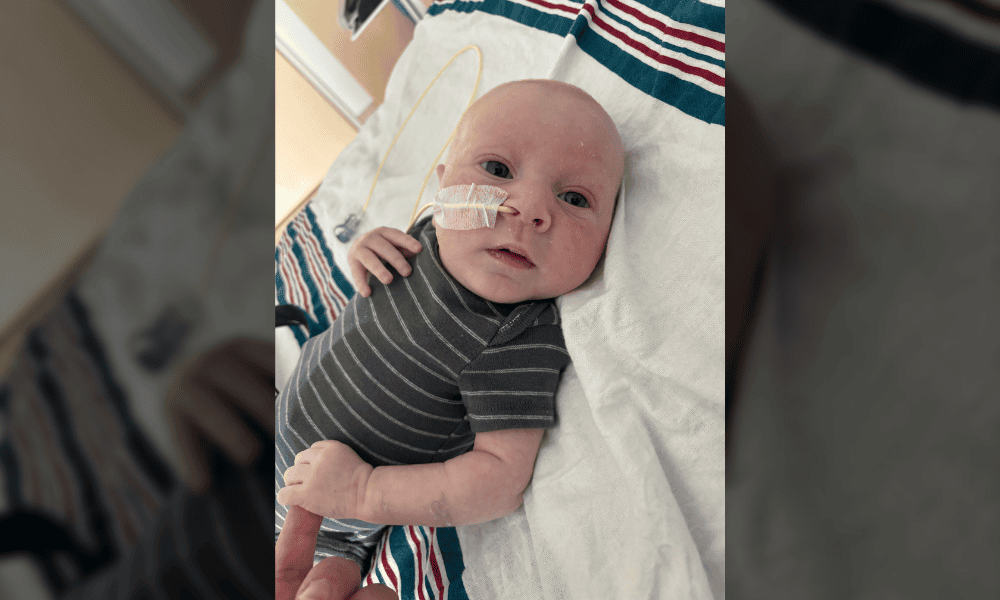
For the first few days of Tobias “Toby” Lyles’ life, his parents thought they had brought home a healthy baby.
Then, at five days old, Toby began making a strange sound when he breathed.
“He was making kind of like a wheezing, grunting sound,” his mother, Trisha Lyles, said. “It just kind of sounded like he was having trouble getting a real good breath in.”
Trisha and her husband, Evan, did not know it yet, but deep inside their newborn son’s chest, a critical pathway carrying blood from his heart to the rest of his body was closing.
Within hours, Toby would be intubated, rushed from Piedmont Newnan to Arthur M. Blank Hospital-Children’s Healthcare of Atlanta, and admitted critically ill.
Without treatment, pediatric cardiologist Dr. Michelle Wallace said, the condition could have killed him.
“It could have been life-threatening,” Wallace said. “Death could have been the worst case scenario in this case.”
A long-awaited baby
Toby was born May 22 at Piedmont Newnan. The Lyles family lives in Grantville, and Trisha, 30, has spent most of her life in Coweta County.
Toby was particularly precious to his parents. Trisha had experienced two miscarriages before becoming pregnant with him.
As far as his parents knew, Toby seemed healthy after birth, although he had some trouble latching and did not seem particularly interested in eating.
Then, on May 27, everything changed.
The Lyleses had visitors at their home that day. After everyone left, Trisha noticed Toby’s breathing.
Like many new parents, she searched online to see whether the noise was normal. What she found convinced her that it was not something to watch and wait on.
They put Toby in his car seat and headed for Piedmont Newnan.
Hospital staff heard the grunting almost immediately.
“We got rushed back to one of the rooms, and there were probably 15 doctors and nurses in there at one time, just trying to figure out what was going on,” Trisha said.
Toby was cold. He was struggling to breathe. Doctors and nurses moved around him while his new mother watched.
“Most of it’s kind of a blur,” she said. “As a new parent, you don’t expect any of that to happen. And then seeing a whole bunch of doctors around your newborn baby is just a lot.”
She remembered how she felt in one word: “Terrified.”
What was happening inside Toby’s heart
Doctors at Piedmont suspected Toby’s heart was causing the crisis.
He was intubated, and because rain prevented an air transfer, an ambulance took him to Children’s.
A room was waiting for him in the cardiac intensive care unit.
Wallace, a pediatric cardiologist with Children’s Healthcare of Atlanta Cardiology who now follows Toby as an outpatient, said he arrived in shock.
“He wasn’t getting good blood flow to various parts of his body, particularly the lower half of his body,” Wallace said.
The largest problem was a congenital defect called coarctation of the aorta — a narrowing in the major artery that carries blood from the heart to the body.
Wallace described the aorta as shaped somewhat like a candy cane. The long portion carries blood toward the lower half of the body.
Toby had a narrowing in that pathway.
“It was making it difficult for his heart to pump blood out to his body, and it created higher pressure as well for his heart to have to pump against,” Wallace said.
Over time, the strain can cause the heart itself to stop functioning normally.
Toby also had two holes in his heart: a ventricular septal defect, or VSD, between the lower chambers, and an atrial septal defect, or ASD, between the upper chambers.
Those defects can require treatment, but Wallace said the coarctation was the immediate threat to his life.
By the time Toby arrived at Children’s, the effects extended well beyond his heart.
Trisha said his liver and kidney numbers were bad. He later was found to have suffered a brain bleed and experienced seizures.
“He was really sick when we got into Children’s,” she said.
Why he seemed healthy at first
One of the most frightening aspects of Toby’s condition is also one of the reasons it can escape detection immediately after birth.
Before birth, babies have an additional blood vessel called the patent ductus arteriosus, or PDA. It allows blood to bypass the lungs while a baby is still in the womb.
After birth, that vessel normally begins to close.
In babies with coarctation, tissue near the PDA can also tighten as that vessel closes, Wallace explained. A baby may therefore initially appear healthy because blood is still finding another route through the PDA.
“They look great in the hospital because a lot of times they’re still closing their PDA,” Wallace said.
The PDA typically closes during the first 72 hours, although Wallace said it can take as long as a week.
Once it closes completely, the narrowing in the aorta can suddenly become a crisis.
That made Toby’s fifth day of life a medically significant moment.
“The timing that this was picked up in, in terms of having symptoms, is pretty classic for patients that are diagnosed postnatally with coarctation,” Wallace said.
His mother hearing that strange breathing and deciding not to ignore it may have saved her son’s life.
“I really applaud his parents,” Wallace said. “They recognized that something was not correct, and they acted upon their instinct, and they sought care.”
Keeping Toby alive long enough for surgery
Doctors first had to stabilize a baby whose heart and other organs had already been under significant strain.
Trisha remembers doctors giving Toby medication that reopened the fetal blood-flow pathway that had recently closed, allowing his body to receive better circulation while his kidneys, liver, and heart began to recover.
“A lot of the first couple of weeks before his surgery was just trying to keep him breathing and give him the medications that were going to help fix his kidney and liver, just to get him in the healthiest place possible,” she said.
Children’s physicians repeatedly examined his heart through echocardiograms, which use ultrasound to show the heart’s structure and function.
His first echocardiogram at Children’s revealed all three heart defects.
Because Toby had arrived so sick, doctors also used medications to support his blood pressure and heart function and repeated the scans to make sure he was recovering enough to undergo surgery.
He arrived at Children’s May 27.
On June 12, at just three weeks old, Toby underwent open-heart surgery.
The operation corrected all three defects.
“The main thing that the most life-saving thing that the surgeon did was to remove that coarctation of the aorta,” Wallace said.
Surgeons cut out the narrowed portion and reconnected the healthy ends of Toby’s aorta.
They also closed the VSD between the lower chambers of his heart and the ASD between the upper chambers.
Before leaving the operating room, the medical team could examine the repaired heart and check pressures to make sure blood was moving properly through the reconstructed aorta.
The tiny pathway that had nearly cost Toby his life was open.
From intensive care to home
Toby remained at Children’s through July 7, spending more than a month in the hospital.
Recovery brought another complication. One of his vocal cords became paralyzed, something Trisha said doctors told the family can occur after heart surgery. Because the condition makes swallowing difficult, Toby has needed a feeding tube.
But his heart has done remarkably well.
“Everything is great,” Trisha said. “His heart seems to be functioning as good as a heart could possibly function.”
Developmentally, she said, specialists have told the family that Toby is right on track.
He also began gaining weight quickly after coming home.
“He was really small whenever we left the hospital, but he’s been on a higher calorie formula, so he’s gaining weight like crazy,” Trisha said.
Wallace said the long-term prognosis following successful coarctation repair is very good.
Children like Toby need continued cardiology follow-up as they grow because doctors want to ensure the repaired section of aorta grows with them. In some cases, a later catheter procedure may be needed to widen the area.
But most children do not require another operation.
For Toby, Wallace expects childhood to look much like anyone else’s.
“That is our expectation: is for him to be able to do normal kid things,” Wallace said. “They’re able to run, play, and you wouldn’t even know that a child had this if you put them against other children of the same age.”
Eventually, Wallace expects Toby’s cardiology visits to decrease to about once a year.
And his cardiologist comes to Newnan, meaning the Grantville family can receive much of Toby’s ongoing specialty care close to home.
Trusting a parent’s instinct
Wallace said Toby’s story carries an important lesson for other parents, particularly those who might hesitate because they are caring for their first baby and are not sure whether something they are seeing is serious.
“You are still the expert on your child at the end of the day, and you have instincts,” Wallace said. “And frequently, your instincts are right.”
If something does not feel right, she said, seek help.
That is exactly what Trisha and Evan did.
“This was a life-saving thing for him,” Wallace said.
The Lyleses also had help surviving those weeks away from home. Family members helped with bills and food so both parents could remain near Toby throughout his hospitalization, and their employers gave them the time they needed.
Trisha said she remains grateful to everyone at Piedmont Newnan and Children’s who cared for her son.
“I would just want to thank them,” she said. “Everybody was such a blessing to be able to do what they do and take care of everybody’s babies and get him to the point where we were able to take him home again.”
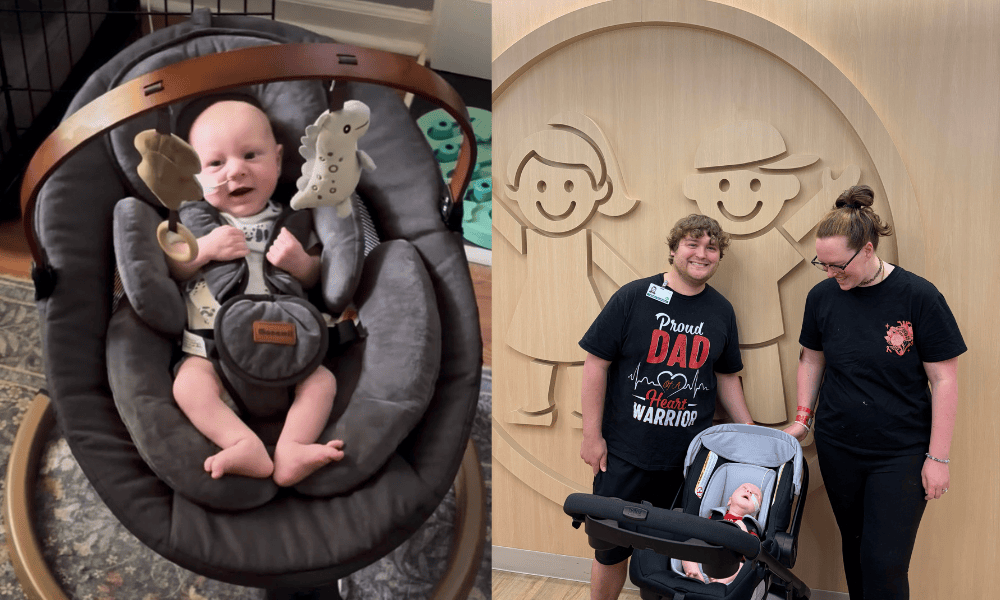
Now Toby is home.
He is growing. He is gaining weight. He is meeting developmental milestones.
And he smiles.
“He has the biggest grin,” Trisha said. “It’s the best thing ever.”
After two miscarriages, a terrifying fifth day of life, weeks of intensive care, open-heart surgery, and more than a month in the hospital, Trisha finally gets to spend her days doing what she had waited so long to do: simply be Toby’s mom.
“It is the best thing ever,” she said. “I absolutely love it. The best thing I’ve ever done in my life is be able to take care of this baby.”





Leave a Comment
You must be logged in to post a comment.