


 3203
3203 7
7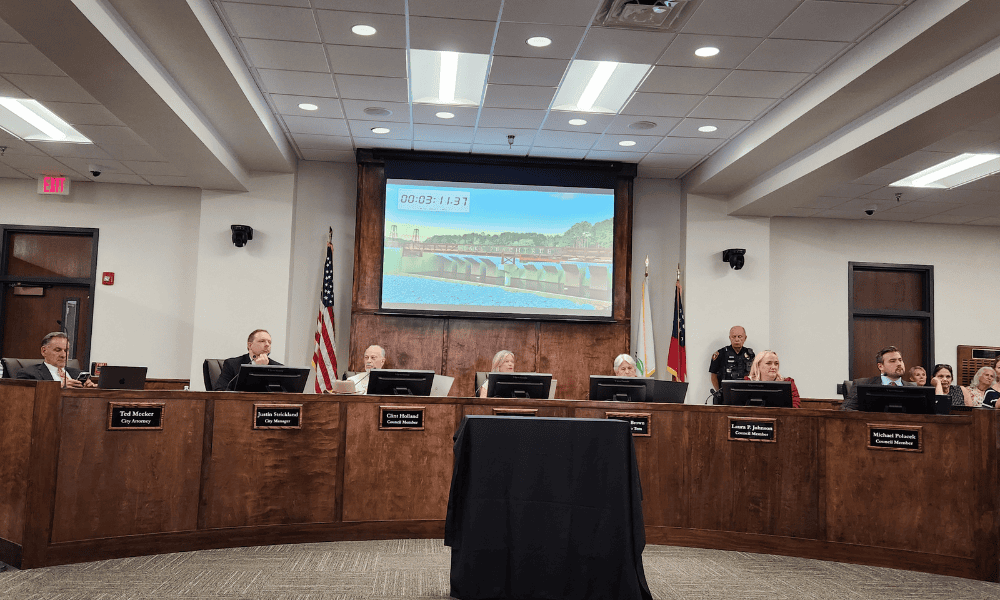
Former Peachtree City Mayor Steve Brown is accusing Mayor Kim Learnard of using a city survey to create a false impression of public support for the single-hauler trash proposal defeated by City Council last week. City Manager Justin Strickland says Brown’s allegations are false.
The criticism comes less than a year after Brown tried to return to the mayor’s office. Brown challenged Learnard in the November 4, 2025, municipal election, but Learnard won reelection with 6,131 votes to Brown’s 5,124, according to Fayette County’s certified election results.
Brown made his latest accusations both in an email to council and publicly in a comment on The Citizen’s coverage of the August 20 trash vote.
“Learnard’s trash collection plot came out of a secret meeting held out of town in Kennesaw,” Brown wrote on social media. “At the August 20 meeting, she claimed overwhelming popular support for her proposal citing a Zencity poll. Zencity is tool she used to fake public support.”
Brown also wrote that a Zencity employee had previously said the company’s polls were not scientific, were not known or accessible to all residents, and could not be used as reliable polls.
“The mayor pays for the Zencity propaganda with your tax dollars,” Brown wrote.
Brown’s reference to Kennesaw is to the council retreat where the single-hauler concept was among the issues discussed earlier this year. At the August 20 meeting, Councilman Michael Polacek said council had discussed the issue during its January retreat and that council members agreed at that time to put out a request for proposals. Brown characterized the out-of-town retreat as a “secret meeting.”
The trash proposal itself is over for now. Council voted 4–1 on August 20 to terminate further action on an exclusive solid waste provider, with Learnard casting the only vote against ending the process. The Citizen has previously reported extensively on the debate and the hours of public discussion surrounding it.
But Brown’s accusation centers on one particular part of Learnard’s explanation for her dissent: preliminary results from a Zencity survey.
“We also have preliminary data on Zencity, and that is a targeted survey company that we use to represent a cross section of our citizens,” Learnard said.
She then read the question respondents had been asked.
“To what extent would you support a citywide single company curbside pickup for trash, recycling, yard waste, and bulk item pickup program if the bill was around the same or less cost than your current curbside provider that only provides trash and recycling pickup,” Learnard said. “And the answer is 66 percent positive.”
The wording matters.
The survey did not ask whether respondents supported Amwaste, the company selected through the city’s request-for-proposals process. It asked whether they would support a single-company system if the price were around the same or lower than what they were already paying while also including additional services.
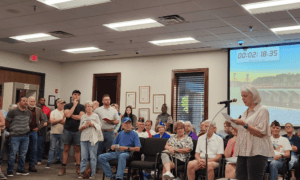
The Zencity result also stood in sharp contrast to the public comments council heard that evening. Twenty-two people spoke during public comment. Twenty addressed the trash proposal, and every one of those 20 opposed it. Council members also referenced approximately 350 emails they had received on the issue.
Learnard acknowledged that opposition before citing the survey.
“I know how to count,” she said. “We vote as a panel of five and majority rules.”
But Learnard said residents in the room were not necessarily representative of everyone in Peachtree City.
“I will speak for the rest of the city who couldn’t be here or isn’t otherwise hearing their voice here tonight,” she said.
Brown interpreted her use of the 66% result as an attempt to manufacture support.
Strickland responded to Brown’s email Friday afternoon and directly rejected that accusation.
“I just want to let everyone know that these claims are false,” Strickland wrote. “The mayor has nothing to do with Zencity and their surveys are statistically reliable.”
According to Strickland, Zencity distributes its surveys randomly rather than making a public survey link available for anyone to complete.
“That keeps the surveys from being influenced by bias,” he wrote.
Strickland also disputed Brown’s assertion about what a Zencity employee had previously told council.
“No Zencity employee has ever stated what is claimed below,” Strickland wrote. “On the contrary, they have thoroughly reviewed their methodology with City Council during multiple public meetings.”
The city considered moving away from Zencity when its contract was expiring last year, Strickland said, but other companies the city examined cost roughly the same while providing fewer capabilities. He said Zencity lowered its price by $5,000 for the next three years, putting the city’s cost at $20,000 annually.
“I do not question the reliability of their community surveys having used similar methodology myself for surveys multiple times before,” Strickland wrote.
By the time Learnard spoke, the outcome was no longer in doubt. Each of the other four council members had already indicated opposition to moving forward.
“I know how to count,” Learnard said. “We vote as a panel of five and majority rules.”
Her vote was knowingly symbolic. She said her dissent was intended to represent residents whose views were not reflected by the speakers in the room.
“I will speak for the rest of the city who couldn’t be here or isn’t otherwise hearing their voice here tonight,” Learnard said.
It is not difficult to imagine residents favoring the proposition presented in the Zencity question: more services for roughly the same or a lower price. But that question did not ask respondents to weigh the specific concerns raised about Amwaste during the August 20 meeting, including residents’ accounts of difficulty reaching the company, criticism of its customer-service record, and concerns about its Better Business Bureau rating.
So the 66% figure and the unanimous opposition from the 20 trash speakers were measuring different things. One captured reactions to a hypothetical single-hauler package. The other came after residents had examined the specific proposal, the proposed provider, and the trade-offs that would come with giving up their current choice of trash companies.
Learnard ultimately cast the lone vote against ending the proposal, knowing the other four council members had already said they would not support it.


Leave a Comment
You must be logged in to post a comment.