


 2795
2795 0
0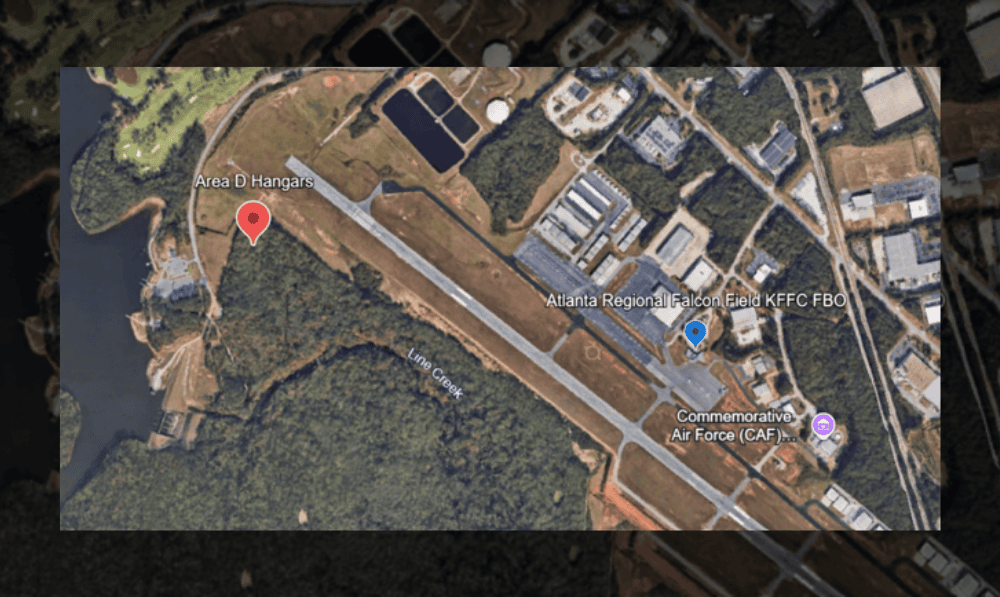
A new hangar development at Atlanta Regional Airport–Falcon Field found its market almost immediately: all 33 hangars planned for Phase 1 were verbally reserved within one week of being offered.
FFC Area D Development LLC is developing the new privately owned hangars on leased airport property within Area D, part of more than 34 acres recently brought under the Peachtree City Airport Authority’s ownership and management.
The developers asked that their individual names not be published, saying they wanted the focus to remain on the project. They told The Citizen that marketing began Aug. 25, and within a week every Phase 1 hangar had been spoken for.
That does not mean the units have formally sold yet.
“Reserved does not mean a contract has been signed and money is in hand,” Airport Director Hope Macaluso said. “So that is the next step.”
The developers said formal reservation agreements are being finalized. Prospective owners will then have to make substantial refundable deposits to hold their hangars.
The response reflects a demand Macaluso said reaches well beyond Peachtree City.
“Honestly, statewide across the state of Georgia, there is a huge need for hangar space,” Macaluso said.
A shortage that is difficult to solve
Macaluso said a Georgia Department of Transportation Aviation Programs study has documented hangar demand across the state.
Building additional space, however, is not as simple as developing ordinary commercial property.
“It’s not easy to do to just go out and develop land on an airport because that property was paid for with tax dollars — with your tax dollars,” Macaluso said.
Airport projects come with federal and state requirements, and Macaluso said public funding generally goes first toward safety and capital needs on the airfield rather than hangar construction.
“The FAA, the state, won’t give any funding toward these hangar projects unless every safety issue on the airfield has been addressed,” she said.
That has led airports across Georgia to increasingly look toward private investment to address hangar shortages.
“That’s what’s happened here at Falcon Field,” Macaluso said.
The Area D property includes the future expansion of U.S. Aviation Academy, which holds a contract to provide initial flight training for U.S. Air Force cadets. That operation did not require the entire tract, leaving additional usable acreage available for other aviation development.
“We took the opportunity to partner with these folks to develop the usable part of that property,” Macaluso said.
33 hangars already spoken for
Phase 1 includes 33 T-hangars and box hangars.
A T-hangar is generally designed around the shape of a single aircraft, while a larger rectangular box hangar can accommodate additional aircraft or provide more usable space.
Buyers will own the hangar building itself, but not the land underneath it. The ground will remain airport property and will be leased to the hangar owner.
Those ground leases run for 40 years, giving owners an unusually long period of control compared with many airport hangar arrangements.
The developers said Phase 1 pricing reached $222,074 for some T-hangars and $359,500 for box hangars.
Phase 2 is expected to add roughly another 33 to 35 units. Those hangars are expected to cost more because the property becomes more difficult to develop farther from TDK Boulevard, requiring additional grading, fill, paving, and infrastructure.
The developers expect to have Phase 2 pricing after additional engineering work is completed.
Demand may extend beyond the sizes currently planned. The developers said they received about five or six inquiries for hangars larger than the current box-hangar design, including spaces capable of accommodating corporate aircraft.
They are working with airport officials to determine whether larger hangars can be incorporated.
New space also helps existing tenants
Falcon Field currently owns only 24 T-hangar units itself, Macaluso said.
Most other hangars at the airport are privately owned, with their owners leasing the land underneath them from the Airport Authority. Macaluso said there are 32 privately owned hangars in one area, five in another, and four in another section, with two additional units coming.
The approximately 60-plus new units envisioned across the first two phases will not simply serve people waiting to move onto the airport.
Some existing tenants also know the areas where their current hangars stand are expected to be redeveloped eventually.
“There are current tenants here at the airport who they know that their hangar lease is short-lived; it won’t last forever, and so they’ll need some place to go,” Macaluso said.
Those tenants may also simply want a different size.
“They have a smaller hangar, they want a larger hangar, or vice versa,” she said. “So we’re doing our best in partnership with these folks to accommodate as many of these folks that want to be here in Peachtree City that can be.”
One older hangar area is expected to be redeveloped in approximately five to eight years. Those tenants were recently offered another five-year lease beginning Oct. 1.
They were not given first refusal on the new Area D hangars because those buildings will be privately owned, Macaluso said. However, information about the development was distributed to current tenants and people on the airport’s waiting list as soon as it became available.
More aviation development coming
The Area D expansion also includes new facilities for U.S. Aviation Academy.
Macaluso said the company plans a roughly 15,000-square-foot maintenance hangar, a separate classroom and office building of approximately 12,000 square feet, automobile parking, and 60 aircraft tie-down spaces.
The academy bought an existing Falcon Field flight school in October 2024 and began accepting U.S. Air Force cadet students in summer 2025 before being awarded its Air Force contract in October 2025.
Macaluso emphasized that the academy is a private company with an Air Force training contract, not a military-owned flight school.
The cadets train in small piston-powered airplanes.
“They will not have jets here, not now, not in the future,” Macaluso said. “That’s not what Air Force cadets train in. They train in these small airplanes.”
Falcon Field already has four flight schools operating at the airport.
Taxiway will determine opening
Before aircraft can begin using the new Area D hangars, the site must be connected to Falcon Field through a taxiway.
The developers said they are working with Macaluso, airport consultants, and the Airport Authority on the engineering and schedule for that work. Hangar construction is expected to proceed alongside taxiway construction so both can be ready at approximately the same time.
The developers said they expect to provide prospective owners with a clearer timeline as engineering progresses.
For now, the speed with which Phase 1 was reserved has already answered one question about whether the new space was needed.
All 33 units were spoken for in about a week.
More information about the development is available at ffcdhangars.com.



Leave a Comment
You must be logged in to post a comment.