


 8239
8239 1
1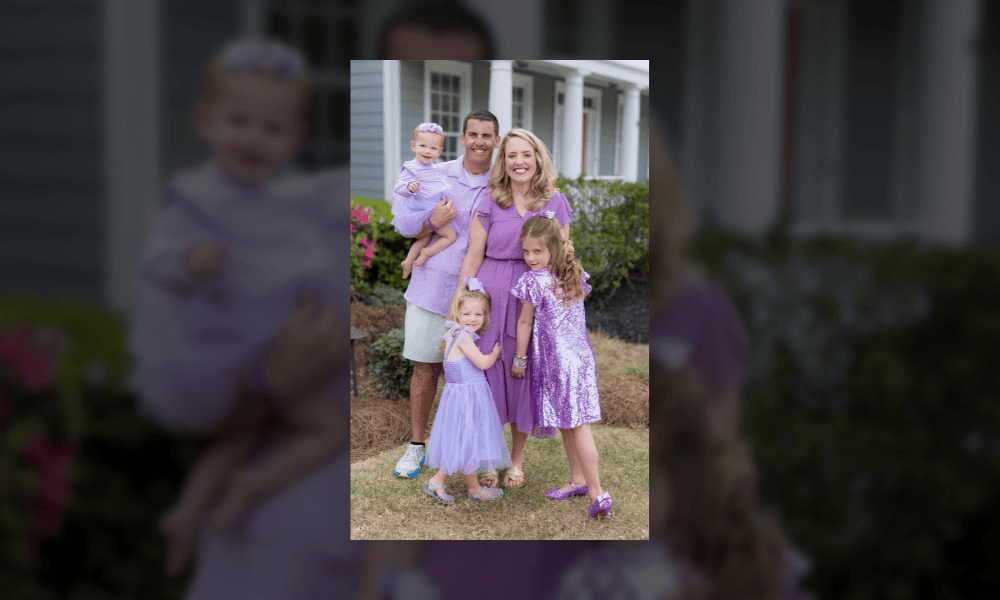
Purple bows appeared on mailboxes throughout Centennial, around Braelinn Elementary School and in other Peachtree City neighborhoods.
Purple is 6-year-old Aubrey Ward’s favorite color.
The bows became a visible sign of support for a child who, to most people looking at her, did not appear sick.
Aubrey still had her hair. She went to kindergarten. She played sports, hugged her doctors and made people laugh.
“That’s the problem with DIPG,” her mother, Lisa Ward, said. “Right now she looks great, so people don’t realize how much is going on.”
Behind that outward normalcy, Aubrey’s family was preparing to travel across the country in pursuit of an experimental treatment for one of the most aggressive cancers diagnosed in children.
At the time Ward spoke with The Citizen, Aubrey had completed six weeks of radiation and was preparing for a CAR T-cell clinical trial in California. By the time this story runs, she should have already started treatment, having been scheduled to fly out August 9.
The treatment will require repeated trips, medical procedures and weeks away from home—all while Ward and her husband cared for Aubrey’s two younger sisters and tried to maintain their jobs.
It was the next step in a journey that had begun only months earlier with an unusual movement in Aubrey’s eye.
Something was not right
Ward first noticed the eye movement in March, shortly after the time change.
She initially wondered whether Aubrey was simply tired. Then Aubrey’s kindergarten teacher noticed the same thing and recorded a video of it.
Ward called an eye doctor and was given an appointment in April. Because Aubrey had no other obvious symptoms, the situation was not initially treated as an emergency.
But Ward could not shake the feeling that something was wrong.
She called Aubrey’s pediatrician, who examined her. Aubrey appeared healthy, but the pediatrician recommended an MRI to rule out a more serious problem.
The wait for a scheduled MRI was about three months.
That did not sit well with the pediatrician either.
“She was like, ‘Why don’t you guys go to the ER tonight?’” Ward recalled. “‘I think I’ll sleep better at night if you guys do that.’”
The family went to a Children’s Healthcare of Atlanta emergency department expecting that Aubrey might need glasses.
A CT scan instead revealed a tumor.
“We went into the hospital thinking that we needed glasses,” Ward said, “and then [they were] telling us that our daughter only has nine to 12 months to live.”
Aubrey had diffuse intrinsic pontine glioma, commonly called DIPG.
Radiation—and the search for what comes next
DIPG develops in the pons, a portion of the brainstem that helps control breathing, swallowing, movement, balance and other essential functions.
The tumor cannot be surgically removed without destroying critical neurological function.
Radiation is the principal established treatment. It can shrink the tumor and improve a child’s symptoms, but it generally does not provide a cure.
Aubrey completed 30 radiation treatments—five treatments a week for six weeks.
Ward said her daughter responded well.
“She’s a rock star,” Ward said. “She didn’t need sedation and didn’t miss a single day of her kindergarten.”
Aubrey returned to school after treatments and continued many of the activities she enjoyed before her diagnosis.
But completing radiation did not end the Ward family’s treatment decisions.
Dr. Jason Fangusaro, a pediatric neuro-oncologist who leads the developmental therapeutics program at Children’s Healthcare of Atlanta, said radiation often gives children a period in which symptoms improve and the tumor appears more controlled.
Eventually, however, the tumor usually begins growing again.
“The only other therapy that recently has gotten attention—and we can’t say that it’s effective yet, but it seems more promising than anything else has been for over 50 years—is something called CAR T-cell therapy,” Fangusaro said.
CAR T-cell therapy uses a patient’s own immune cells. The cells are removed, modified to recognize a target on cancer cells and returned to the patient.
Fangusaro said some early studies involving children with DIPG have shown tumor shrinkage without radiation. A small number of patients have experienced longer survival.
But the results have not established CAR T-cell therapy as a cure. Most children treated in the early studies have still died from the disease.
That distinction—between promise and proof—is one families such as the Wards must navigate.
A treatment far from home
At the time of Ward’s interview, Aubrey’s family was awaiting final arrangements for a CAR T-cell trial in California.
Children’s Healthcare of Atlanta was preparing to offer a CAR T-cell study, but Ward said its timing would not meet Aubrey’s immediate needs.
“Timing is everything for you,” The Citizen told her.
“Yes,” Ward replied.
The initial California visit was expected to last approximately a week and a half. Aubrey would undergo procedures including placement of a port and an Ommaya reservoir, a device used to deliver treatment into the fluid surrounding the brain.
Her blood would also be collected so that CAR T cells could be produced for her treatment.
The family expected to return to Georgia for several weeks before traveling back to California for a stay of approximately 28 days.
Further trips were expected after that.
Ward said her brother, an adult oncologist, had reviewed the available research and helped the family evaluate the approach.
“They haven’t cured DIPG,” Ward said, “but they’re showing a lot of progress.”
The family understood that the treatment was experimental.
They also understood what the alternative could mean.
Three daughters, two jobs and treatment across the country
Aubrey is the oldest of three girls.
At the time of the interview, Charlotte was 15 months old and Juliet was approaching her third birthday.
Taking both younger children to California did not appear practical. A recent flight to Orlando for Aubrey’s Make-A-Wish trip had already shown the family how difficult air travel could be with children that young.
Ward and her husband expected to alternate time in California and rely heavily on relatives and friends.
Ward’s parents planned to travel from Myrtle Beach to help. Aubrey’s paternal grandfather lives in Peachtree City. Friends offered transportation and other assistance.
“It’s going to be a lot,” Ward said.
Ward teaches at Braelinn Elementary School, where Aubrey also attended kindergarten. Her husband works from home for a medical company, but working from home does not mean being available to provide full-time childcare.
Ward expected to take intermittent leave from school as Aubrey’s trial progressed.
That would mean losing income.
“The unfortunate thing is, we almost get penalized for having two working parents,” she said. “People look at your income and they’re like, ‘Oh, they don’t need help or support.’ But I’m going to have to go on FMLA, and I don’t get paid my salary for that.”
The family established a GoFundMe account to help with the cost of travel, time away from work and other expenses.
Rally Foundation for Childhood Cancer Research had also contacted the family. Ward said Rally expected to be able to provide more assistance once the trial dates were established.
A community turns purple
The Wards moved to Peachtree City in 2020.
Ward’s husband grew up in the community, and the family lives in Centennial. Ward teaches at Braelinn, and the family attends Southside Church’s Peachtree City campus.
Those connections quickly became a support network.
Ward described her principal as exceptionally supportive, checking on her mental health and helping the family navigate Aubrey’s educational needs.
The school system helped arrange hospital-homebound services. Friends offered transportation and childcare. Church members and neighbors rallied around the family.
Purple bows spread across the community.
Ward said the family was grateful for the attention and assistance, but she did not want Aubrey’s diagnosis to create fear about living in Peachtree City.
The family had heard the same local discussion that prompted The Citizen’s reporting: that several children with connections to Peachtree City and nearby communities had reportedly been diagnosed with DIPG.
Ward said the apparent number of cases was frightening. She had also heard about reported groups of cases elsewhere.
But she cautioned against assigning blame without evidence.
“A lot of people do want to blame something when you get diagnosed with cancer,” Ward said. “Which is natural, but until there’s evidence, you kind of have to be careful on that.”
The family had no intention of leaving Peachtree City.
“It’s a great community,” Ward said. “Even though this happened, we would have no interest in ever moving.”
Finding people who understand
Because DIPG is rare, families may know no one in their existing circle who has faced the same diagnosis.
Ward connected with other mothers whose daughters had DIPG and were considering or receiving similar treatments.
One child was already at Stanford receiving CAR T-cell therapy. Another girl in North Carolina had been diagnosed at approximately the same time as Aubrey.
The mothers shared information about treatment and practical needs.
Ward had avoided spending extensive time in broader online DIPG groups.
“It is such a morbid disease,” she said. “You just hear the stories of the awful things.”
She chose instead to limit what she read and focus on a smaller group of parents living through similar decisions.
Mia Pena, whose daughter Rosalie died from DIPG in April 2026, also asked The Citizen to offer Ward her contact information.
Rosalie had been given approximately nine months to live and survived for nearly two years.
Pena said another DIPG parent had reached out to her after Rosalie’s death, offering the kind of understanding that relatives and friends—however loving—could not fully provide.
Ward welcomed the connection.
“Living her best life”
Aubrey knows she has cancer.
Ward and her husband chose to use the word because Aubrey is widely known throughout the community, and they did not want her to hear it unexpectedly from someone else.
A child-life specialist explained that Aubrey has bad cells in her brain and that the doctors are trying to fight them.
She has not been told that the disease is generally considered terminal.
At the time of the interview, Aubrey had few visible symptoms after radiation.
That could make daily life feel almost ordinary—and make the diagnosis easy to forget for a moment.
“Sometimes you forget, too, because she looks perfect,” Ward said. “And then you’re hit with reality.”
Ward’s first description of her daughter was that Aubrey loves Jesus.
“She is a bright light,” Ward said. “She loves Jesus and shares that with everyone.”
Aubrey also loves sports. She plays softball and soccer. She loves purple, hugs people she has just met and tries to make others laugh and feel included.
“She loves people, loves life,” Ward said.
During a recent oncology appointment, Aubrey hugged the doctors and made them laugh.
One member of her medical team, Ward recalled, summed up the way Aubrey is approaching the months after her diagnosis:
“Aubrey’s just living her best life.”
To view Part 1 of this series, visit this link.



Leave a Comment
You must be logged in to post a comment.