


 20046
20046 1
1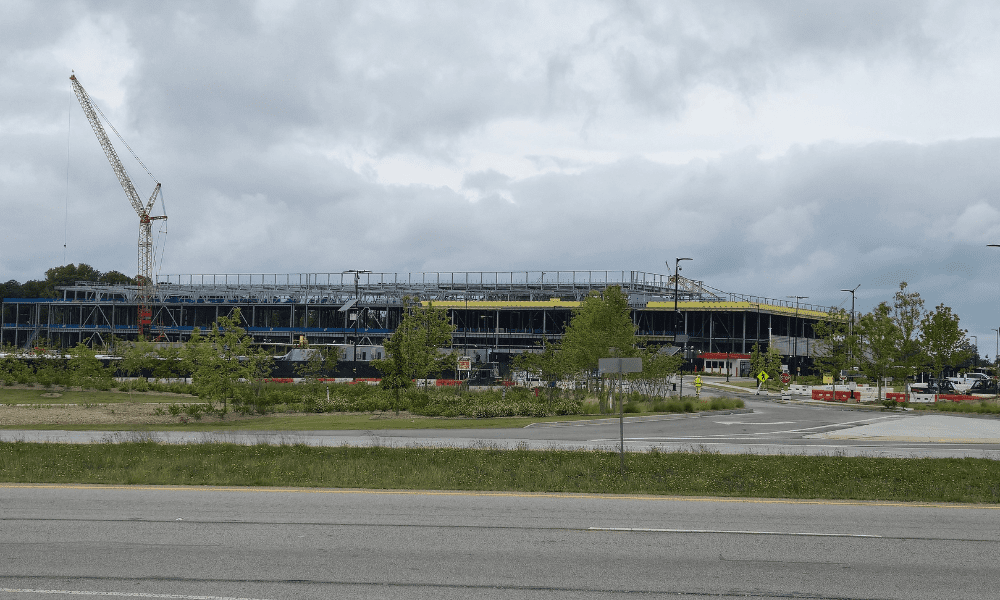
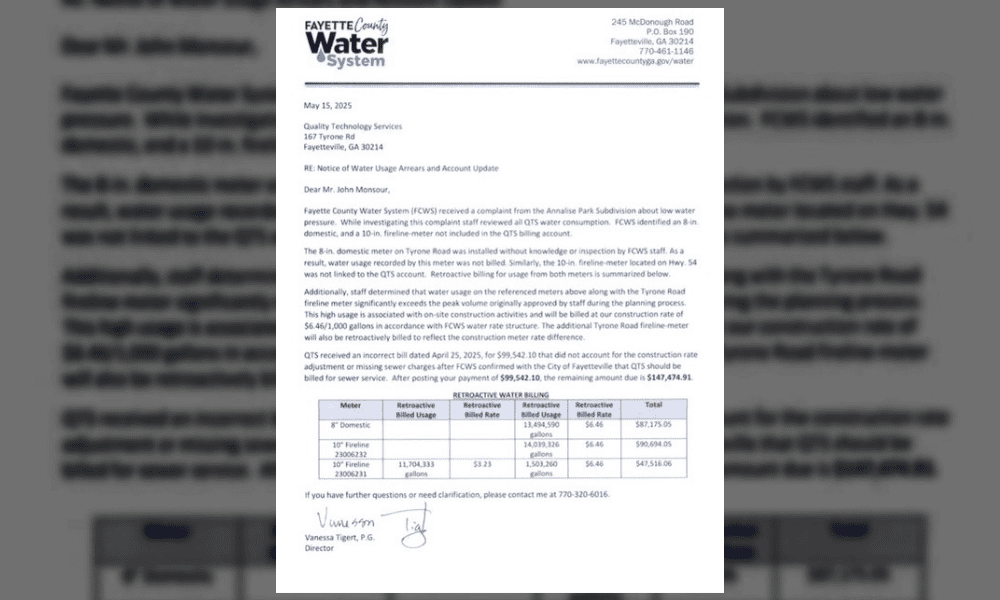
Fayette County officials say a confusingly worded water-system letter released through an open records request helped fuel widespread misconceptions about water usage at the massive QTS data center campus under construction in Fayetteville.
The 2025 letter referenced millions of gallons of unbilled water usage tied to the project, prompting questions online about whether QTS had improperly tapped into county infrastructure during ongoing drought conditions.
But in interviews with The Citizen, Fayette County Administrator Steve Rapson and Assistant County Administrator Jason Tinsley said the issue stemmed from a missed meter reading during Fayette County Water System’s transition to a new countywide smart-meter system — not unauthorized water usage.
“It’s not like they put a meter in, threw a camel net over it, and we didn’t know they put the meter in,” Rapson said. “It’s that we thought the meter was being read electronically, and then we found out it wasn’t, and we sent them a bill.”
A meter-reading issue during a countywide transition
The county letter, written in May 2025 by Fayette County Water System Director Vanessa Tigert, stated that one meter had been installed “without the knowledge or inspection” of the county water system and referenced more than 13 million gallons of water usage tied to one connection.
Rapson acknowledged the wording created an impression that QTS had acted improperly.
“If you read the letter, I can see how someone can interpret it that way,” Rapson said. “Because the letter kind of has that vibe.”
But Rapson said county staff had inspected the meter installation during construction and believed the meter was being electronically read during the county’s transition from an older Beacon system to a newer Advanced Metering Infrastructure system capable of remote readings.
Fayette County replaced roughly 33,000 water meters countywide during the transition.
According to county officials, QTS currently has 13 water connections around the property. Officials said county staff believed one meter was being electronically read during the countywide transition to the new AMI system but later discovered the usage had not been captured.
Rapson said the widely circulated figure of roughly 15 million gallons reflected about six months of combined usage billed at one time — not a single month of consumption.
“That bill was cumulatively for six months,” Rapson said. “But I understand why some people could look at that and jump to false conclusions.”
Tinsley said some residents mistakenly interpreted the retroactive bill as evidence QTS had consumed 15 million to 30 million gallons in a single month.
“The comment about the one month is inaccurate,” Tinsley said.
Once the county identified the billing issue, QTS paid the retroactive charges.
QTS Chief Operating Officer Ryan Hunter said the company has remained in close coordination with Fayette County Water System throughout construction and has operated within the water-use estimates submitted as part of the project’s Development of Regional Impact process.
“We’ve only done the things that we’re allowed and legally permitted to do,” Hunter said.
Construction scale unlike anything Fayette has seen
Part of the public reaction may stem from the sheer scale of the QTS project itself.
Hunter said approximately 8,000 workers are currently on site during peak construction periods. That’s like importing the population of Tyrone onto the QTS campus each day.
The campus, planned for up to 13 buildings, includes two active concrete plants, multiple large building foundations, and seven bridges under construction.
“When you hear 16 million gallons, it’s difficult to get your mind around,” Rapson said.
According to county officials and QTS representatives, current construction-phase water usage includes:
- concrete production,
- dust suppression,
- truck washing stations,
- irrigation,
- bathrooms and kitchens for thousands of workers,
- and the initial filling and testing of cooling systems.
County officials said truck washing and dust mitigation are standard practices intended to prevent clay and construction debris from spreading onto public roads or creating large dust clouds affecting nearby neighborhoods.
“They literally had truck washing stations where all they did was wash trucks down when they came in and wash trucks off when they went out,” Rapson said.
Tinsley said much of the current water demand is tied specifically to active construction and would likely occur with any industrial-scale project built on the site.
“If you were building a large project, it could be anything — you’d have the same amount of high usage while they’re under construction,” Tinsley said.
Commercial rates and water revenue
QTS pays a commercial construction water rate that county officials said is approximately double the residential rate paid by typical Fayette County customers.
County officials said the outstanding balance associated with the retroactive billing totaled roughly $147,000, though Rapson noted the single six-month meter read itself represented approximately $100,000 in charges.
County officials estimate QTS’s construction-related water usage currently generates just under $500,000 annually in water revenue for the county system, though officials said that usage — and the associated billing — is expected to decline significantly once construction is complete.
Rapson said QTS’s monthly water bills during peak construction currently average between $35,000 and $38,000 per month but are expected to drop substantially after construction ends.
Temporary construction demand vs. long-term operations
QTS representatives emphasized that current water usage reflects an active construction site, not long-term operational demand.
Hunter said QTS’s completed buildings use closed-loop cooling systems that continuously recirculate water rather than consuming it through evaporation.
“Once the water’s in there, it stays in there for the life of the asset,” Hunter said.
According to QTS, once operational, each completed building is expected to use water roughly equivalent to four American households per month, primarily for bathrooms and kitchens rather than cooling.
But county officials and QTS representatives acknowledged that construction-related water demand is expected to remain elevated for several more years while the campus buildout continues.
The project is currently planned for up to 13 buildings, and QTS representatives said major construction activity could continue for another three to five years.
County officials said QTS currently uses less than 1% of Fayette County Water System’s actual daily production capacity.
Fayette County Water System currently produces about 17.3 million gallons of water daily and is permitted for approximately 22.8 million gallons per day.
Rapson said the county’s only current water customer using more water than QTS is the City of Fayetteville itself, which purchases wholesale water for city residents and businesses.
“After these buildings are built, QTS won’t even be on my top 10,” Rapson said.
Questions about water pressure
The original county letter also referenced complaints from residents near the Annelise Park subdivision about low water pressure.
Rapson said Fayette County Water System later installed monitoring equipment in the area to track pressure levels following the complaints.
“Since we’ve been reading it, there’s been no issue,” Tinsley said.
County officials noted that some nearby homes rely on private wells rather than Fayette County Water System connections. Officials also emphasized that QTS does not draw water from wells or groundwater sources. Instead, the project receives treated water directly from Fayette County Water System infrastructure.
“But keep in mind, the individual that made that complaint made the complaint because they had issues with their well,” Rapson said. “We don’t pull anything out of the ground. We don’t have any wells in our system.”
County officials said they have not identified evidence showing QTS construction activity caused widespread pressure problems within the county water system.
Drought concerns remain part of the conversation
The debate comes as much of Georgia remains under varying drought conditions, leading some residents to question whether industrial-scale construction should continue using large volumes of water.
County officials stressed that current drought declarations are precautionary and that Fayette County has not implemented mandatory water restrictions.
“There’s different classifications of drought,” Rapson said. “We haven’t told anybody to stop doing anything.”
Still, QTS acknowledged community concerns about water stewardship and said the company is exploring alternatives for some non-essential uses.
“Given ongoing drought conditions, QTS is exploring alternative irrigation solutions, such as capturing stormwater or roof runoff, to help reduce water use across our campus,” QTS said in a written statement.
County officials said they now meet regularly with QTS representatives to monitor projected water demand and maintain communication as construction continues over the next several years.
“We reached out to QTS. QTS didn’t reach out to us,” Rapson said. “We understand there’s a lot of stuff in social media. What can we do to get the facts out and to normalize this so people understand what happened?”






Leave a Comment
You must be logged in to post a comment.