


 434
 0
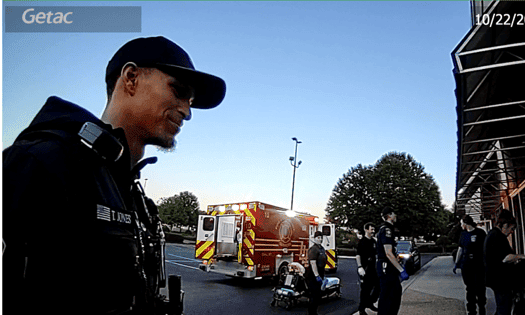
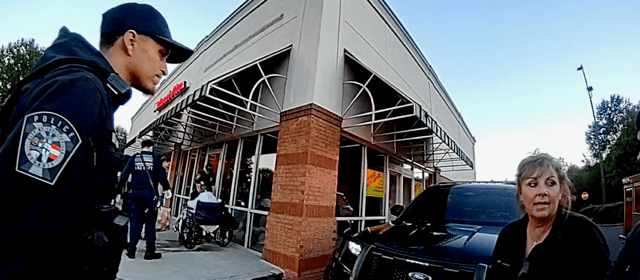
On Thursday, October 22, a 55-year-old homeless woman sat outside the Town Center shopping center in Fayetteville, dressed in a hospital gown, wrapped in a hospital blanket, her wheelchair parked in a spreading pool of her own blood. She had no place to sleep that night, no one to care for her, and serious medical conditions that she said had left her unable to care for herself.
By evening, strangers were handing over $100 bills, Fayetteville Police Cpl. Bush was trying to convince her to return to a hospital, and community activist Tami Hurst-Clarke was searching for somewhere that could help.
The woman, whom The Citizen is calling “Vickie” to protect her identity, had left Piedmont Fayette Hospital against medical advice earlier that day. She said she had been transported by Uber to Kroger, where she hoped to find something to eat.
Her experience, documented in Fayetteville Police body camera footage obtained by The Citizen, raises questions about what happens when someone is homeless, physically disabled, medically vulnerable, and unable to find appropriate shelter or ongoing care.
It also reveals the lengths to which a police officer, a community volunteer, and ordinary citizens were willing to go to help one woman.
A hospital gown and nowhere to go
When Bush encountered Vickie outside the shopping center that afternoon, she explained that she had been moving between hospitals, motels, temporary housing arrangements, and the streets.
She had tried homeless shelters, but said her physical limitations prevented her from remaining in them.
“I can’t get into a shelter. I can’t get into the DV shelters. I can get in, but I can’t stay because I can’t take care of myself 100 physically,” Vickie told Bush.
She described serious problems with her hips, four abdominal hernias, inability to walk, and medical conditions that had required multiple hospital visits. She said she had experienced continuous vaginal bleeding for more than seven years and had been told she needed a hysterectomy.
She also described previous surgeries that she said had nearly taken her life. Her mother, now in a nursing home with dementia, wanted to be near her if she underwent another major operation. Vickie said she was unwilling to have the surgery until she could arrange that and lose additional weight.
These medical conditions and treatment recommendations are based on Vickie’s account. The Citizen did not have access to her medical records.
Her history of homelessness was intertwined with accounts of domestic violence, financial instability, and unsuccessful attempts to find housing that could accommodate her disabilities.
She described leaving an abusive marriage and spending years trying to escape the relationship.
More recently, she said, a social worker at Piedmont Henry Hospital had helped arrange placement in a group home in Riverdale.
According to Vickie, the home was supposed to provide accessible accommodations and three meals a day for $924 per month. Instead, she said, the building was difficult to enter in a wheelchair, the bathroom was inaccessible to her, and the living arrangements were unsuitable.
She said she was forced to leave when she could not immediately pay the requested rent because her monthly benefits had not arrived.
From Riverdale, Vickie eventually reached Piedmont Fayette Hospital, where she sought treatment for gastrointestinal symptoms and other medical problems.
What happened there remains a central unanswered question.
Why did she leave the hospital?
Vickie told Bush and Hurst-Clarke that she had been humiliated by an emergency room physician at Piedmont Fayette.
She said the doctor challenged her statements about allergies to saline and certain medications and that she felt she was being treated disrespectfully in front of other people.
Vickie also raised concerns about whether race played a role in her treatment. Those allegations have not been independently substantiated.
She acknowledged signing paperwork to leave against medical advice, commonly called AMA.
Vickie told Bush and Hurst-Clarke that after leaving the emergency room, she sat outside near a security station. She said a security guard allowed her to remain there until the end of the guard’s shift.
At some point, an Uber was arranged to transport her away from the hospital. Vickie said she was hungry and asked to be taken somewhere she could get food. The driver took her to the Town Center Kroger, a grocery store Vickie said she had never visited before.
The available recordings do not establish who arranged or paid for the Uber. They also do not establish exactly how long Vickie remained outside the hospital or who was responsible for arranging her departure.
The bodycam recording does not establish whether hospital staff assessed her ability to make medical decisions, what treatment was offered, or whether a social worker was involved.
Patients generally have the right to refuse medical treatment when they have the capacity to make that decision. But the circumstances can become more complicated when a patient has serious physical limitations, unstable housing, or possible concerns about decision-making capacity.
In Vickie’s case, there was another serious concern: the amount of blood she was losing.
The bodycam footage shows blood on the pavement beneath and behind her wheelchair. Hurst-Clarke described blood running down Vickie’s legs into her shoes and soaking the absorbent pads beneath her.
Significant blood loss can affect a person’s physical condition and, in severe cases, impair alertness and the ability to think clearly. The recordings do not establish how much blood Vickie had lost or whether it affected her decision-making. But the visible bleeding raises another question about what medical assessments were performed before she left Piedmont Fayette.
Vickie told Bush that she was receiving treatment for mental health conditions, including bipolar disorder, PTSD, and anxiety. She said she took medication to manage those conditions.
But she also made clear that she did not believe her mental health conditions prevented her from making decisions or managing her own finances.
“I’m physically not capable of taking care of myself 100, but mentally, I probably can take care of my money better than they can run their own whole house,” she told Bush.
She described experiences in which she believed others had tried to take advantage of her disability and monthly benefits.
Her statements drew a distinction between the physical assistance she needed and her desire to maintain control over her own life.
Mental illness does not automatically mean someone lacks the ability to make medical or financial decisions.
The Citizen contacted Piedmont Fayette about the incident, but the hospital declined to comment.
Without Vickie’s medical records or an explanation from the hospital, it is not possible to determine whether her departure followed appropriate procedures or whether additional assistance could have been provided before she left.
What is documented is where she ended up: outside a Fayetteville shopping center, still bleeding, wearing hospital clothing, and facing a cold night without shelter.
A police officer who wouldn’t walk away
Bush’s body camera recorded conversations with Vickie that began in the afternoon and continued after Hurst-Clarke arrived.
He listened as she described her history, asked about her medical needs, and repeatedly encouraged her to seek treatment.
When Vickie explained that doctors had told her surgery was necessary, Bush urged her to consider the immediate danger of remaining outside.
“I think you should go back to the hospital,” Bush told her. “I don’t think it’s best for you to be sitting out here on the side of the road or outside business with all these health conditions.”
Vickie initially refused.
Bush offered to call an ambulance and explained that medical professionals could evaluate her. He also contacted Hurst-Clarke, whom he knew through her work assisting homeless people in the area.
According to Hurst-Clarke, Bush had checked Vickie’s information through police records and found no outstanding warrants. The encounter was not a criminal investigation. Bush was trying to find assistance for a woman with serious medical and housing needs.
With other police calls requiring his attention, Bush arranged for Vickie to remain outside a vacant storefront near Marco’s Pizza, where she would not be blocking an occupied business. He told her he would return.
“No one’s gonna bother you,” Bush told her, explaining that she was outside a vacant business and could remain there.
He kept his promise to return.
By the time Hurst-Clarke joined him, Bush was still encouraging Vickie to accept medical attention.
The officer explained that even when he could not solve someone’s problems, the circumstances stayed with him. He talked about going home after his shift and wondering whether people he had encountered had received the help they needed.
“I got to come back Monday wondering, man, where is she at? Did she get the help she needed, or is she still stranded out on the streets,” Bush told Vickie.
The bodycam footage captures his repeated efforts to persuade rather than force her to accept help.
A community steps forward
As Vickie sat outside Marco’s Pizza, residents came and went, picking up dinner and shopping at nearby businesses.
Some stopped to offer assistance.
Hurst-Clarke said people approached her and Bush with cash, including $100 bills, hoping the money could provide Vickie with a hotel room or somewhere safe to stay.
One man had gone to Walgreens to purchase something to help with Vickie’s upset stomach.
Hurst-Clarke described the generosity, particularly of older residents who offered money.
But she faced a difficult decision. Vickie wanted a hotel room, and the donations could potentially pay for one. Hurst-Clarke feared leaving her alone overnight while she was still bleeding and unable to care for herself physically.
“I can’t put her in a hotel room to die overnight,” Hurst-Clarke said in an interview with The Citizen. “I mean, I’ve got to see what’s medically wrong with her.”
She believed Vickie needed to return to a hospital.
Getting her to agree was the challenge.
Hurst-Clarke spent close to an hour talking with Vickie, who remained adamant that she did not want to return to Piedmont Fayette. She initially resisted going to any hospital.
But the conversation shifted when Hurst-Clarke began explaining how cold it would be outside overnight.
“It’s going to be in the 40s. That’s close to freezing. Do you understand that?” Hurst-Clarke said she told Vickie.
On the bodycam recording, Vickie acknowledged that she hadn’t realized how cold the night would become.
“I didn’t know how cold,” she said.
Hurst-Clarke reminded her that the businesses would eventually close, the lights would go out, and she would be alone.
“That’s too cold,” Vickie responded.
She asked whether there was a warming center where she could spend the night.
There wasn’t one available locally.
“We don’t have one, Miss [Vickie]. That’s our problem. We don’t have anywhere to take you,” Hurst-Clarke told her.
The possibility of spending the night outdoors in the cold appeared to shift the conversation. Vickie was still unwilling to return to Piedmont Fayette, but she began considering another hospital.
Eventually, Hurst-Clarke and Bush discussed Piedmont Newnan Hospital with her.
Vickie asked whether it was affiliated with Piedmont. They explained that she could request treatment at another hospital.
After repeated refusals, Vickie finally agreed to let emergency medical services come evaluate her.
The footage does not establish precisely what changed her mind, but her growing concern about the cold was evident.
No shelter, no caseworker, no easy answer
The exchange about a warming center captured a larger problem that The Citizen documented earlier this year in its Local & Homeless reporting series.
Fayette County has no dedicated homeless shelter, no local warming shelter, and no municipal housing authority.
Neighboring Coweta County has organizations providing case management, social services, and assistance to people experiencing homelessness, but resources there are also limited. Coweta’s only warming shelter was unable to secure adequate insurance to open for the current season.
Police officers, churches, nonprofit organizations, and volunteers often respond to individual emergencies as they arise.
But Vickie’s circumstances presented another level of difficulty.
She needed more than a meal, a motel room, or transportation to another community. According to her account, she needed accessible housing and assistance with physical care, while also managing chronic medical problems.
Traditional shelters had not worked for her. Temporary group housing had not worked. Hospital visits had not produced a lasting solution.
Hurst-Clarke had previously helped homeless families obtain temporary lodging and connected individuals with outside organizations. She knew the local options were limited.
Before arriving at Kroger, she contacted a mental health crisis service to see whether a mobile crisis team could assist Vickie. She said she could not get the service to send someone.
On the bodycam footage, Hurst-Clarke explained to emergency responders, “The hotline won’t come.”
The recording does not establish the crisis service’s eligibility criteria or independently verify why assistance was unavailable.
A police officer and a volunteer were left trying to find a solution for someone whose needs extended well beyond law enforcement.
One more trip to the hospital
When emergency medical personnel arrived, Bush and Hurst-Clarke explained Vickie’s medical problems and their concerns about her ability to remain outside safely.
They also discussed the importance of alerting the receiving hospital to her mental health history, physical limitations, and previous reluctance to accept treatment.
Emergency personnel prepared to transport her to Piedmont Newnan.
Before she left, there was one final question: What should they do with the money strangers had donated?
Hurst-Clarke worried that the cash could be lost or stolen. Bush believed it belonged with Vickie.
“I say we just take our chances and let her,” Bush said. “At least, at least if she needs to use, if she needs money, she has it.”
Hurst-Clarke placed the donations in a bag with Vickie’s belongings.
After the ambulance took Vickie away, emergency personnel cleaned the sidewalk where her wheelchair had been. Hurst-Clarke described workers using a large hose and disinfectant, including bleach, to wash away the blood that had accumulated on the pavement.
Hurst-Clarke called Piedmont Newnan on Friday, October 23, the day after Vickie was transported there, and confirmed that she had been admitted and was still at the hospital.
When Hurst-Clarke followed up again on Tuesday, October 27, and reached a hospital social worker, Vickie was gone.
Hurst-Clarke was unable to learn where she had gone, whether she had been discharged to another facility, or whether anyone was helping her find stable housing.
What happened to Vickie?
The central question surrounding Vickie’s departure from Piedmont Fayette remains unanswered: What responsibility does a hospital have when a patient with serious medical and physical limitations chooses to leave against medical advice but has nowhere safe to go?
The bodycam footage does not establish whether additional services were offered or what assessments were made before she left. It also does not reveal what arrangements, if any, were made for her after she arrived at Piedmont Newnan.
For the people who stopped to help outside Kroger that Thursday evening, there is no way to know whether their assistance became the beginning of something more permanent.
Vickie left Fayetteville in an ambulance, carrying the money strangers had given her.
Three weeks later, The Citizen still does not know where she is, whether she has found a safe place to live, or whether anyone is helping her now.



Leave a Comment
You must be logged in to post a comment.