


 275
275 0
0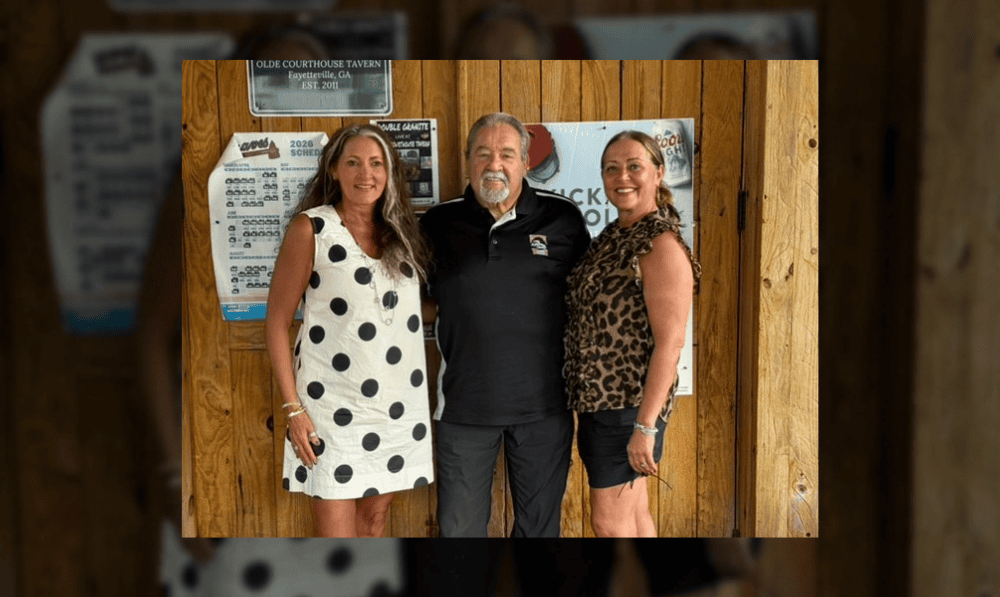
Olde Courthouse Tavern had only recently begun recovering from the financial hit of COVID when another challenge arrived at its back door.
Now, co-owner Andrea Mueller says the downtown Fayetteville business is trying to survive an alleyway improvement project that began nearly two years ago and still is not finished.
Mueller said the tavern’s revenue has fallen about 30% to 40% during construction. Her father, Larry Graves, who owns the building and founded the restaurant, has gone without rent or salary from the business and has used personal funds, including money from his teacher retirement, to help keep it afloat.
The tavern sits along Highway 85/Glynn Street across from the old Fayetteville Courthouse. Its front entrance faces the highway, but Mueller estimates about 75% of customers have traditionally entered through the back, where the alleyway and nearby parking are located.
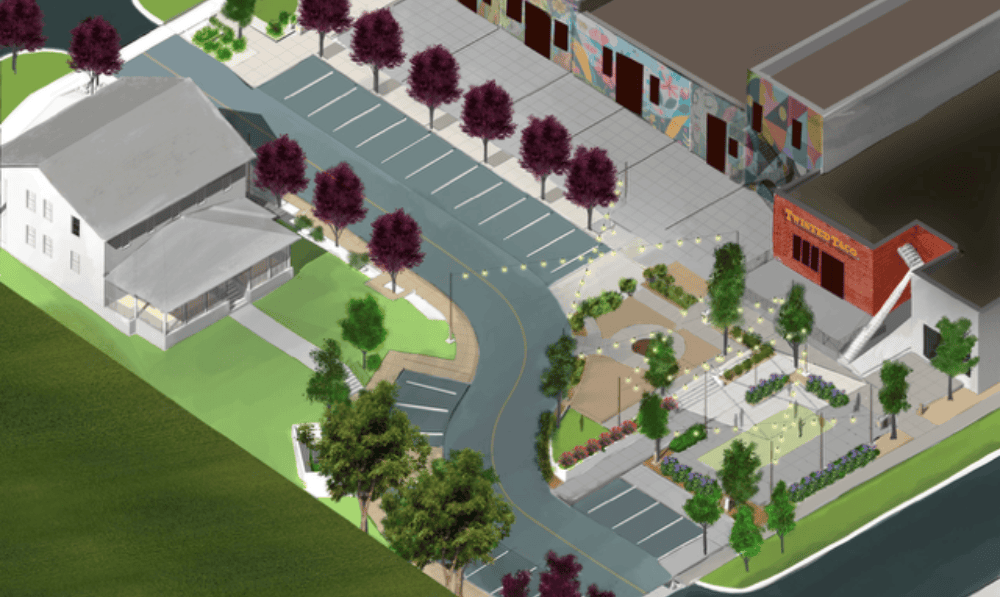
The city’s long-planned alleyway improvement project is intended to make that area behind the businesses safer, more attractive, and more useful. Phase One has already produced a two-way alley, parking, sidewalks, ADA-accessible spaces, string lights, and a new plaza.
But a project originally expected to take about 12 months is now nearly two years in, and it still is not done.
“You have to survive to someday,” Mueller said. “And if you don’t make it to someday, then you never get to see that. You never get to benefit from that.”
A needed project that took much longer than expected
Fayetteville Downtown Development Director Lori Funderwhite said the alleyway improvement project had been in the works for more than a decade before construction began in September 2024.
The old alley behind the businesses was narrow and shared by cars and pedestrians, with drivers using it in both directions. Vehicles had struck buildings, and there were no ADA-compliant parking spaces.
“There were accidents back there before this project started all the time,” Funderwhite said. “There were cars going both ways and people walking back there.”
Phase One ultimately opened July 2, 2026.
It includes the new two-way alleyway, parking, sidewalks, ADA-accessible spaces, and plaza. The new parking area contains about the same number of spaces as the previous lot, but the layout separates vehicle traffic from pedestrians.
The opening restored nearby parking and gave businesses and customers use of the new alleyway. But it did not complete the project.
Lawsuits added months to the project
During construction, lawsuits were filed by adjacent property owners René Victor Bidez, a local photographer, and Tim Clarke, another building owner.
Bidez declined to comment because of the active litigation. Clarke did not respond to The Citizen’s request for comment.
Funderwhite said she could not discuss the litigation because it remains pending, but said it forced the city to redesign the project while work was underway.
“We had to redesign the project to accommodate for that,” Funderwhite said.
The redesign added about nine months to the timeline and divided the work into two phases.
Phase Two will address the old alley immediately behind the businesses — the area between their rear doors and the new two-way alleyway and parking area.
The city plans to bury the overhead power lines and resurface the old asphalt. Conduit for the underground utilities was installed during Phase One. City renderings show the old alley resurfaced with a more finished treatment that could eventually provide a pedestrian-oriented area immediately behind the businesses, including the potential for outdoor seating.
For businesses such as Olde Courthouse Tavern, that means the work closest to their most-used entrances is still ahead.
The cost of waiting
To qualify for the Downtown Development Authority’s hardship grants, businesses had to document a revenue loss each month compared with the same month the previous year. Mueller said Olde Courthouse Tavern submitted its financial records as part of that process.
The business also lost an employee who had worked there more than a decade. Mueller said the longtime server and bartender could no longer depend on enough customers and tips to meet her own expenses.
“She was just honest,” Mueller said. “She’s like, you know, I just need to be able to count on a certain amount of money coming in each month.”
The accessibility issue hits especially close to home for Mueller’s family. The tavern’s rear entrance is also its accessible entrance, while the front entrance facing Highway 85/Glynn Street has steps.
Graves has mobility problems and cannot easily use those front steps himself.
“We know how important having the back access available to people like my dad, who are not quite as mobile as they wish they were, is,” Mueller said. “We just hate for people to go somewhere else because it’s easier.”
Mueller can see how the completed project could eventually help the restaurant. The plaza could bring more people downtown. New residential development nearby could create future customers. And a finished pedestrian area behind the businesses could create new opportunities for restaurants and shops.
Her concern is making it to that point.
Just recovering when construction began
Mueller said the tavern was finally seeing its regular customers return and its finances begin moving in the right direction after COVID by 2023.
“You’re finally starting to see that, okay, people are coming back out,” Mueller said. “You’re just coming out of the financial devastation and just like trying to make ends meet through COVID, and then this project just absolutely does knock us back to our knees.”
The family has continued offering live music and community events, sometimes using personal funds to pay musicians when business revenue falls short.
Mueller said the family supports efforts to improve downtown Fayetteville.
“We’re all about the improvements wanting to be brought to the downtown area,” she said. “It’s wonderful to have improvements, but not necessarily where it’s at the detriment of the businesses that you’re supposedly going to help the future of.”
Ballard saw many of the same problems
A few doors away, attorney David Ballard experienced the disruption differently, but many of the problems were familiar.
Ballard Law’s front entrance also faces Highway 85/Glynn Street, while its rear entrance opens toward the alleyway project.
Ballard said he supported improving the old alley.
“I was probably one of the more supportive of the city’s efforts in that regard,” Ballard said.
What surprised him was how long the disruption lasted.
“My recollection was that this was supposed to be a very quick process,” he said. “It was told that we would have sort of a temporary inconvenience.”
Ballard said some clients believed his office was closed. Older clients and people with mobility limitations had particular difficulty reaching the building once convenient rear access and nearby parking were disrupted.
He eventually curtailed much of his wills practice in part because many of those clients were elderly.
“I thought it was unconscionable to ask many old people to do that,” Ballard said.
Construction also brought intermittent power and internet interruptions, he said, both significant problems for a law office.
Still, Ballard said the work completed so far is an improvement.
“I certainly thought the status quo beforehand was just simply not — that wasn’t going to work,” he said. “That needed to be improved, and I do think it’s an improvement.”
DDA offered hardship grants
The Fayetteville Downtown Development Authority established a hardship grant program for businesses adjacent to the construction.
Eligible businesses could submit bank or point-of-sale records showing a revenue loss for a particular month compared with the same month the year before. They could receive up to $1,500 for that month, an amount increased to $2,500 during the final four months of Phase One.
“I have to commend the DDA for offering this business hardship grant to the adjacent businesses,” Funderwhite said. “Oftentimes when cities do projects like this, they don’t.”
The grant program ended when Phase One opened in July.
Mueller believes it should continue because Phase Two has not begun and will affect the portion of the project directly behind the tavern.
“The project’s not complete,” Mueller said. “Phase One is complete. Phase Two has not even started, and it is going to be the one that is directly at our back door entrance.”
She said the family still wants clearer information about when Phase Two will begin, how long it will last, and how customers, delivery trucks, and people who need the accessible rear entrance will reach the restaurant during construction.
What the finished project could become
With Phase One open, the city and its Main Street program are working to make the new plaza a community gathering space and are encouraging neighboring businesses to use it for events.
“We’re really hoping this will be something that benefits the businesses and is an amenity for the city,” Funderwhite said.
That is also what the business owners hope happens.
Neither Mueller nor Ballard argues that the old alley should have been left as it was. Both say improvement was needed, and both can see how a safer, more attractive area behind the businesses could strengthen downtown Fayetteville.
But construction that was expected to take about a year began in September 2024. Nearly two years later, Phase One is open, litigation remains active, and Phase Two has not yet begun.
For Olde Courthouse Tavern, and for other businesses along the block, the question is no longer just what downtown Fayetteville will look like when the work is finished.
It is whether they can stay open long enough to see it.





Leave a Comment
You must be logged in to post a comment.