


 6807
6807 6
6
The January city council retreat in Kennesaw was supposed to prove James Clifton right. He spent months telling Fayette County residents that city officials had used that meeting to quietly lay the groundwork for a data center. When the retreat recordings were finally released on March 25th, he posted a “PEACHTREE CITY DATA CENTER UPDATE” declaring that everything he said was confirmed.
However, the newly released recordings tell a very different story. So does the record of how Clifton got access to information about that retreat in the first place.
My March 9th column established who Clifton is and what he has done to this community. This column is about what the recordings actually show, what a sitting councilmember’s role in all of this tells us about who she is as an elected official, and what Fayette County voters should do about both of them.
Who Clifton Is and What He Has Done
Before working through the new evidence, it is worth briefly restating what my last column established because Clifton is counting on voters forgetting it.
After losing the Peachtree City Post 4 race last November, Clifton created a Facebook group called “Stop Peachtree City Data Center” and began posting claims that city officials were secretly laying the groundwork to annex land from Coweta County and rezone it for a data center behind the public’s back. He built his case on four things:
- A city council retreat he claimed was deliberately hidden from the public
- A meeting the Fayette County Development Authority (FCDA) requested with him that he framed as an attempt to silence him
- The February purchase of approximately 1,100 acres near Lake McIntosh by Brent Scarbrough and Company
- The city council’s unanimous vote to commission an annexation study
He packaged those four things into a timeline and presented it to residents as confirmed fact. When The Citizen asked him directly about his evidence, he admitted in writing that it was circumstantial. Three officials across three separate institutions then denied his claims in writing, but Clifton posted through all of it, telling his followers that every denial proved the cover-up rather than disproved it. He frightened people who trusted him into contacting their elected officials about a threat that did not exist, forced city staff to spend hours responding to panic he manufactured, and poisoned his community’s trust in its own government for his own political benefit.
What Has Happened Since
After my March 9th column, Clifton continued promoting his conspiracy, continued running for Fayette County Commissioner, and continued demanding the retreat recordings.
Clifton filed an open records request for the retreat audio. The city clerk turned over the recording secretary’s device, not realizing it did not capture the complete FCDA presentation. Clifton raised concerns publicly about the gap and a second broader records request went out. Two additional sources of audio then surfaced: a recording from a staff member’s personal device (which is the confirmed source of the previously missing FCDA portion) and recordings from Councilmember Brown’s personal device.
What came next is where things get strange.
The city’s March 25th open records response documented this in its own words: “Councilwoman Suzanne Brown advised that she had already directly provided her recordings to [Clifton],” and that the clerk’s office “was not aware that any additional recordings existed prior to earlier this week.”
Councilmember Brown had already given Clifton her recordings before the city knew they existed. She had said nothing about it to her colleagues, to the city clerk, or to the public while a valid open records request was pending and her fellow councilmembers were responding to a crisis.
A city staff member told The Citizen that Councilmember Brown retrieved her recording device from Clifton’s home to submit it in response to his own open records request. Both Mayor Kim Learnard and Councilmember Clint Holland said they had heard the same account. Mayor Learnard said she found it confusing that Clifton had spent weeks searching for tapes he may have had all along, obtained directly from Councilmember Brown.
Councilmember Brown has not helped clarify what happened. She did not respond to The Citizen‘s request for comment.
What The Retreat Recording Actually Shows
The newly released recording tells a story that is very different from the conspiracy Clifton has been promoting. Readers are welcome to listen to the full FCDA meeting recording by clicking here, and the FCDA presentation referenced throughout is available by clicking here.
For those who do not have an hour and forty minutes to spare, here is what the recording documents in the order it appears.
The presentation was delivered by FCDA President Niki Vanderslice. She opened by explaining that the FCDA had engaged an outside consulting firm to develop an economic development strategy for the county, drawing more than 700 survey participants. Vanderslice explained that the strategy was designed for the county as a whole and not tailored to any single municipality.
The presentation covered six targeted industry sectors: legacy business and industry, advanced manufacturing, corporate headquarters, digital and creative media, sports and health performance, and technology. The first five sectors covered existing employers, manufacturing, corporate operations, content creation, and the growing sports and health industry the county has been building around US Soccer.
The sixth sector is where things get interesting.
When Vanderslice reached technology, she stated directly that the discussion was not about data centers for Peachtree City. Instead, she discussed QTS in Fayetteville at length, describing what that investment has generated economically for that community.
During that same discussion, Vanderslice said: “There’s a lot of manufactured inaccurate information around data centers in general.” She addressed water usage at QTS directly, noting that its closed loop cooling system uses the equivalent of approximately 65 homes in ongoing water consumption, contrasting that with what 1,200 homes would have required on the same 600 acres. City Clerk Yasmin Julio noted that because Peachtree City’s occupational tax is based on the number of employees rather than revenue, data centers would generate relatively limited occupational tax revenue under the current system. Beyond that context, data centers in Peachtree City came up only once more, briefly, as a joke, and was followed by laughter from those in the room.
No data center was proposed, suggested, or seriously entertained for Peachtree City.
The discussion then turned to the Scarbrough property, approximately 1,100 acres southwest of Lake McIntosh in Coweta County. Vanderslice told the council that the property is under contract and that the developer could pursue rezoning in Coweta County for approximately 2,200 homes without any input from Peachtree City. She presented annexation as a tool that would give Peachtree City zoning control over what gets built there, allowing the city to manage the traffic and infrastructure consequences rather than absorbing them without any say.
At no point during this discussion was a data center proposed, suggested, or considered for the Scarbrough property. The conversation was entirely about how to manage the traffic and density consequences of residential development on the city’s border.
The TDK Boulevard extension came up in the context of a single aviation business prospect considering the Peachtree City airport for a flight training facility. The prospect had indicated it needed improved road access to the west side of the airport and had recently secured a contract to provide flight training for the Air Force. No formal proposal to extend TDK Boulevard was made and no vote was taken.
One more thing was mentioned towards the end of the recording that is worth noting.
During a discussion about how to document the conversation, Councilmember Brown raised concerns about what should be included in the official record. She said: “I think there’s an awful lot that we’re talking about that should not be in the minutes.” A staff member responded that minutes only need to reflect actionable items, and the group agreed to summarize the entire FCDA presentation with a single sentence.
Councilmember Brown also said that the city needed to keep its annexation discussions quiet, specifically because if property owners found out what the city was considering, land prices would skyrocket and the city would lose its ability to act.
What Clifton Is Claiming the Recordings Prove, and Why He Is Wrong
Clifton has now heard the recordings he spent months pursuing. Rather than share the full recording and explain what it actually contains like I just did, he is extracting audio from the FCDA discussion and posting videos like the one titled “The Peachtree City data center conversation that supposedly never happened.”
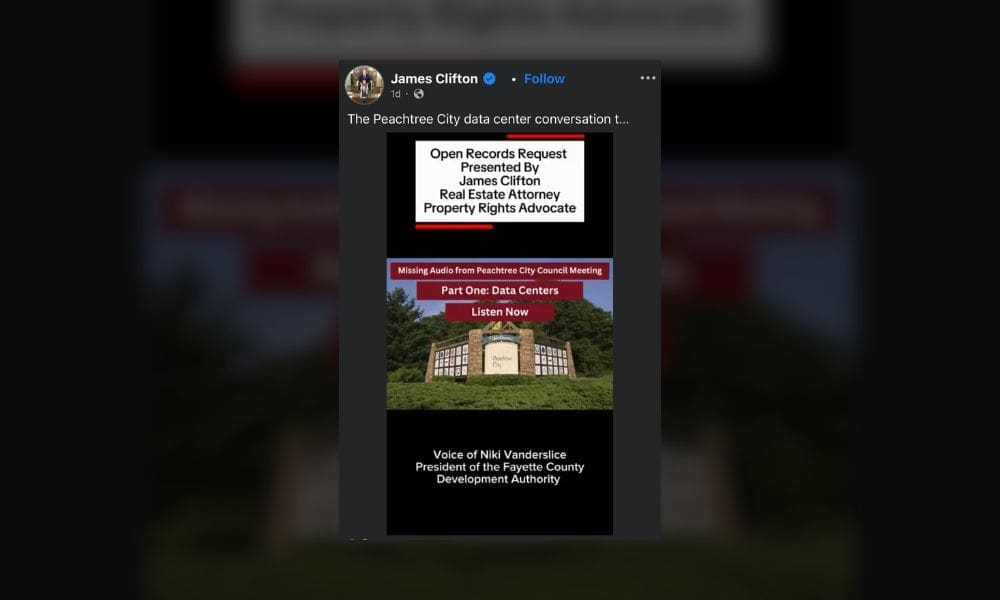
In this video he shared widely on Facebook (which you can view by clicking here), Clifton purposefully presented text and edited audio in a way that suggests Vanderslice and Learnard are talking about a data center in Peachtree City.
They are not.
Vanderslice in the audio is referencing a specific data center project in Fayetteville that was reviewed by the Fayetteville Planning and Zoning Commission on January 27th, two days before the retreat. That project, a data center on Highway 85 North, was denied despite meeting all applicable requirements, and Vanderslice was warning that the denial would likely result in a lawsuit. She raises it as a cautionary example of what happens when community misinformation drives official decision-making rather than facts. Mayor Learnard responds by saying that elected officials have a responsibility to know more than citizens who show up to protest, specifically so they can make informed decisions rather than reactive ones.
Despite these facts, Clifton took that exchange, stripped it of its context, applied a Peachtree City label, and told his followers it was the smoking gun and proof his conspiracy was true. All he then had to do was hope nobody checked his work.
Now he is caught in a massive lie.
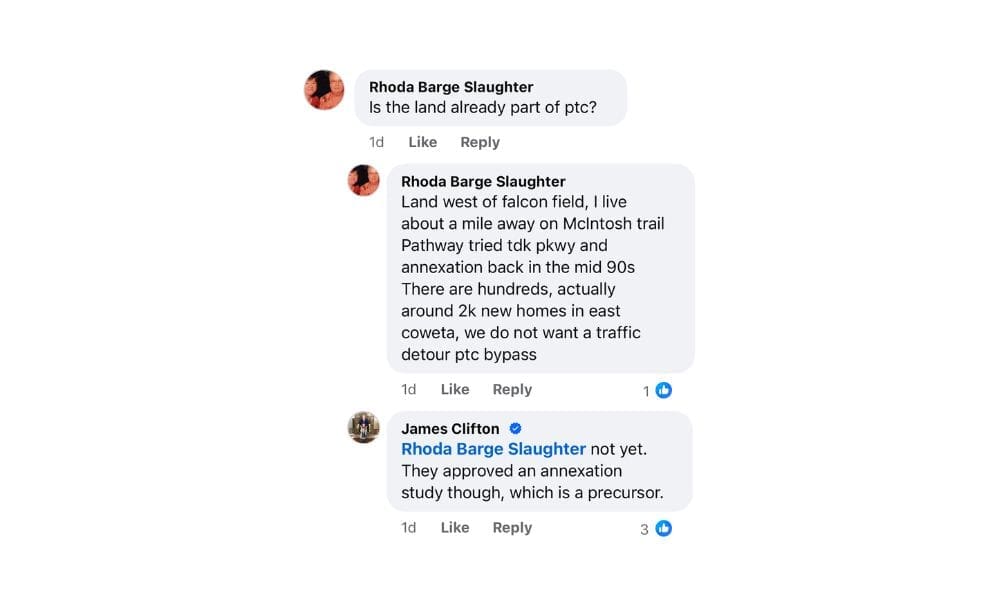
The comment thread on that video shows exactly how Clifton further promotes his deception. A follower, apparently convinced by the video that the data center discussion was about land near Peachtree City, asked whether the land was already part of the city. Clifton responded “not yet” and added that the city had approved an annexation study, which he called “a precursor.” He did nothing to correct her misunderstanding. He reinforced it.
The rest of the recording contradicts him just as completely. The remainder of the technology discussion contained no proposal for a data center coming to Peachtree City. The annexation discussion was about protecting the city from 2,200 homes being built on its border without any zoning input, not acquiring land for industrial development. The TDK discussion was about airport access for a single aviation prospect, not opening development corridors. He heard all of it and is still posting edited clips to his followers anyway.
To be fair, the city handed Clifton his opening. The retreat was poorly communicated, the initial recording was incomplete, and it took multiple open records requests to get the full audio into public hands.
Clifton had a legitimate grievance and a genuinely important story to tell. The recordings contain real discussions about real growth pressures on this city’s borders, discussions that residents had every right to know about. He had the access, the platform, and the evidence to report all of it accurately.
He chose to scare people instead. He took a legitimate transparency complaint, built a fabricated conspiracy on top of it, and has now declared that the recording proving him wrong actually proves him right, counting on his followers not to listen to the tape themselves.
Suzanne Brown Put Clifton Above This City
Now let us talk about Suzanne Brown.
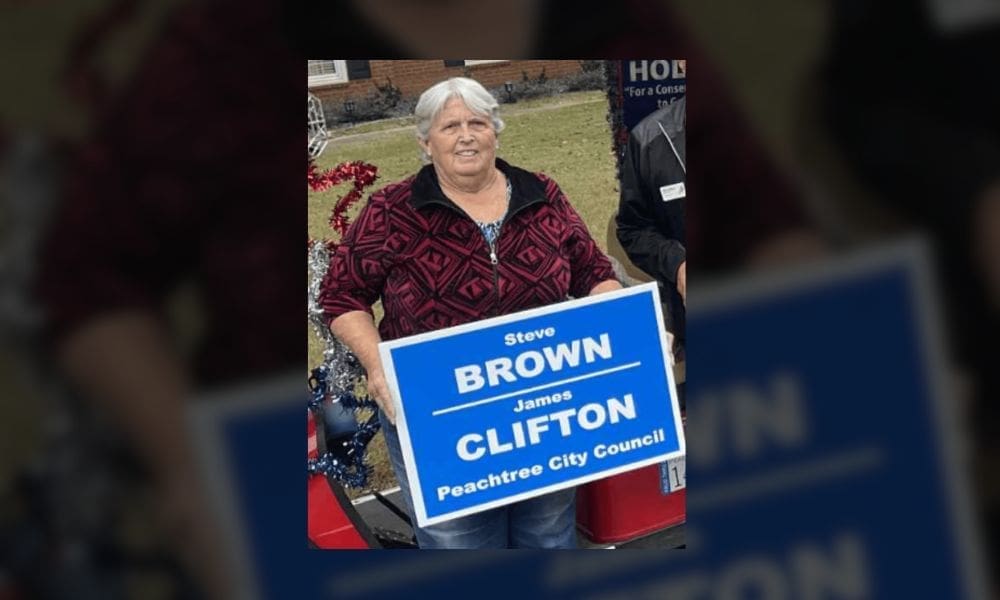
Councilmember Brown was elected to represent the people of Peachtree City. Her job is to serve her constituents, not to feed materials and recordings to a man running a disinformation campaign about the city government she was elected to serve. The record shows she did exactly that.
On February 7th, Councilmember Brown sent Clifton and (interestingly) former mayor Steve Brown the retreat agenda with nothing but “FYI” in the body of the email. She sent this while Clifton publicly claimed the retreat had been hidden from the public. She said nothing in her email to correct him.
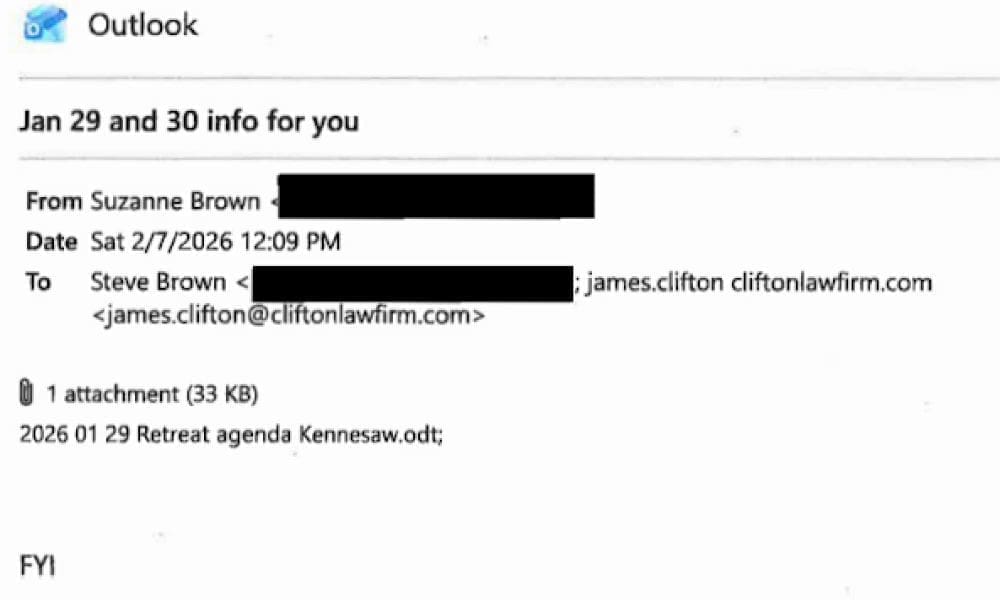
When the first open records request for retreat recordings was pending, Councilmember Brown was in possession of a personal recording she had made at an official public meeting and did not come forward with it. City records establish that she had already directly provided her recordings to Clifton before the city knew those recordings existed. What those recordings specifically contained may not be fully established, and what Councilmember Brown may have said to Clifton about them is not documented beyond what city records show.
On the recording itself, Councilmember Brown said she thought there was “an awful lot” being discussed that “should not be in the minutes” and pushed for the annexation discussions to be kept quiet so property owners would not find out what the city was considering. The motivation behind keeping things quiet was real estate negotiation strategy, not an attempt to hide a data center conspiracy.
But consider what the full picture shows. Councilmember Brown argued against documenting the discussion publicly, pushed for the details to stay out of the official record, and then walked out of that meeting with a personal recording she provided to a private citizen running a political campaign against the city’s leadership. She did not want the details of that meeting in the public record. She made sure Clifton had them anyway.
Ask yourself why.
Councilmember Brown knows what she did. She knows when she gave Clifton those recordings. She knows what was discussed in the FCDA meeting. What we do not know, because she has refused to say, is what she told him about any of it or what those recordings actually contained.
If that full account were innocent, she would have shared it by now. She has not shared it because doing so honestly would require her to explain why she provided recordings to a man who was using them to frighten her own constituents, why she sent him retreat materials he used to claim the retreat was hidden, and why she stayed silent while her colleagues cleaned up a mess she helped make.
Taken together, the record points in one direction: telling the full story would hurt James Clifton’s campaign, and she wants to protect him and his campaign. Peachtree City be damned.
What Should Happen Now
Suzanne Brown should resign. She will not because the record makes clear that her integrity and Peachtree City’s welfare do not come before her own pride. Instead, she will continue to sit on that dais alongside colleagues who have used the word “betrayal” to reference her conduct, say nothing, and hope voters forget before the next election.
As for James Clifton, he should withdraw from this race for three separate reasons.
The first is well documented. Clifton has repeatedly and deliberately misled this community because winning this election matters more to him than the damage he leaves behind.
The second reason is that he cannot do the job if elected. The Fayette County Board of Commissioners governs land use and zoning across the entire county, sets the budget, oversees public safety, and makes decisions about development that will shape how this county looks for decades. That work requires credibility with the FCDA, whose president said he had misrepresented her words so badly she could no longer respond to his questions. That work also requires collaboration with Peachtree City’s mayor and councilmembers, who are on the record saying he has wasted countless hours of their time and resources responding to panicked residents. Clifton has damaged every one of those relationships before casting a single vote.
The third reason is that a candidate who campaigns the way Clifton has will govern the same way as a county commissioner. He will manufacture fears from his seat the same way he has manufactured them now, and when the record catches up with him, he will blame whoever documented it. Fayette County cannot afford to find out what this behavior would look like from inside the commissioner’s office.
To The People Who Still Believe In James Clifton
There are people in this community who believe James Clifton is a man of good character and that he is being treated unfairly. I understand that. People do not follow someone for months and organize around his cause without genuinely believing in him. That belief did not come from nowhere. They were misled by someone who understood exactly how to use their trust, and before May 19th they should take a hard look at what the record actually shows about who he is.
But before that hard look, here is what is going to happen when this column publishes. If Clifton acts like he has in the past, he will not respond to what is written here with facts. He will tell his followers that The Citizen is out to get him, that this column is a political attack, and that the fact people keep coming after him proves he must be on to something. He will act like a perpetual victim because playing the victim costs nothing. Answering honestly for what he has done would cost him everything.
The people who believe in him deserve better. They deserve the truth about what is happening in our community without manufactured fear and theater. He had the ability to tell it, but he chose not to because the truth was not useful to his campaign.
That is who James Clifton is.
May 19th
In March I asked whether Fayette County wanted a commissioner who manufactured a crisis out of thin air. The recordings released on March 25th have now answered that question more completely than I could have then. Clifton has heard the entire FCDA presentation, knows what it contains, and posted a data center update telling his followers it proves everything he said. He is still lying, and he is doing it with the tape in hand.
That is not a character flaw that can be managed from a commissioner’s seat. It is a disqualifying professional trait. A leader who cannot operate from a shared reality is functionally useless in a democracy, and the retreat recording makes clear just how complex the real decisions facing this county actually are.
The good news is Fayette County has a better option in the May 19th Republican primary. Phil Crane is a Fayette County native and small business owner who claims to understand the real challenges families and employers in this county face. He also shares the underlying concerns that have motivated Clifton’s followers. He opposes a data center in Peachtree City, the TDK extension, and overdevelopment.
But the difference between Crane and Clifton is not just what they are concerned about. It is how they respond to those concerns. Crane brings them to the table rather than to Facebook. He can walk into a room with the FCDA, Peachtree City’s elected leaders, and Coweta County officials and be taken seriously. He can do the difficult, unglamorous work of local government without manufacturing a crisis to make himself relevant to it.
This election is a referendum on something larger than one commission seat. If Clifton’s campaign succeeds, it will confirm that in Fayette County a well-constructed fear is worth more than a documented fact, and every candidate who comes after him will have learned that lesson. The civic cost of that precedent is not paid on election day. It is paid for years afterward in the slow collapse of the public trust that makes local government function.
James Clifton has spent two campaigns in less than a year abusing this community’s trust. Fayette County deserves a commissioner who respects the people he is asking to represent.
The choice will be yours on May 19th.






Leave a Comment
You must be logged in to post a comment.