


 5654
5654 0
0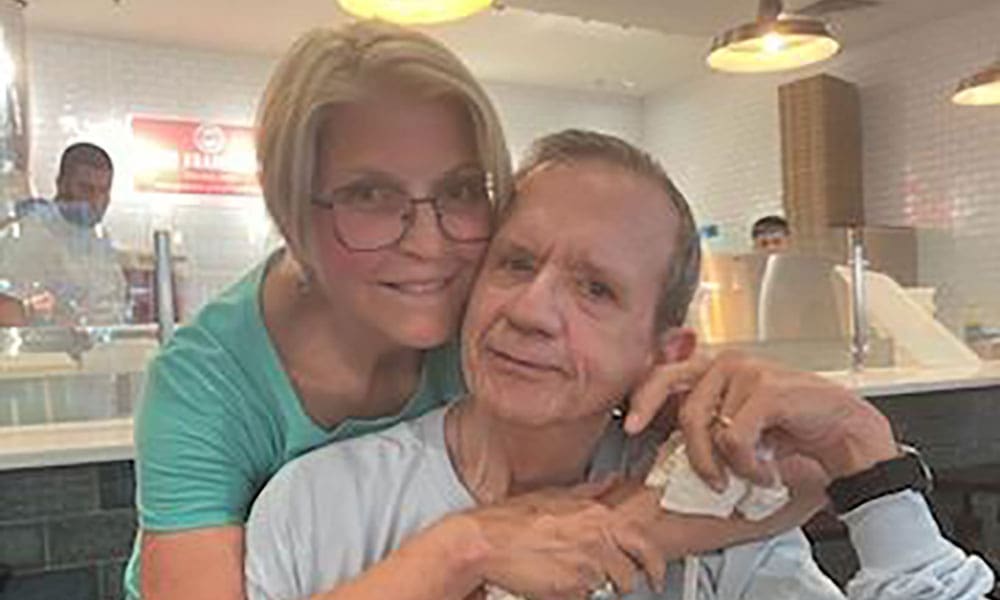
Earlier this month, The Citizen shared the story of Melodie and Wesley Woods, a Peachtree City couple confronting two devastating diagnoses at the same time. Wesley, 68, lives with progressive supranuclear palsy (PSP), a rare neurological disease that has taken his ability to speak and requires constant supervision, while Melodie was recently diagnosed with stage IV salivary gland cancer that will require extensive surgery and months of recovery.
Since that story ran, Melodie has now met with her full medical oncology team and received the complete results of her biopsies and scans — information that has clarified both the seriousness of her diagnosis and the difficult road ahead. The Citizen has continued reporting on the Woods’ situation and has contacted multiple local television stations in an effort to expand coverage of their urgent need.
Today, December 17, is Melodie’s 68th birthday — a day that under different circumstances might be marked with celebration. Instead, it comes as she prepares for life-altering surgery, manages her husband’s care, and faces decisions that will shape the months ahead.
“It’s not what I thought it was going to be,” Melodie said. “And it’s a lot to wrap your head around.”
A more invasive surgery than expected
After additional testing and consultation at Winship Cancer Institute of Emory University, Melodie learned that the tumor at the base of her tongue has crossed the midline — a critical detail that significantly changes the scope of surgery.
Her surgeon, Dr. Brian J. Boyce, MD, explained that removing the cancer will require operating both inside the mouth and externally, with an incision running from one ear, beneath the chin, to the other ear. The procedure is expected to last about 10 hours.
“They’re going to have to remove most of my tongue,” Melodie said. “They’ll rebuild it using tissue from my arm or my leg, depending on how much they need.”
When she wakes up, Melodie will have a tracheostomy to breathe and a feeding tube for nutrition. Doctors have told her that while some patients eventually have the trach removed, others never do. The feeding tube is expected to be permanent and will be placed before surgery to spare her an additional procedure during recovery.
In the days following surgery, doctors expect her tongue to be so swollen that she will be unable to swallow at all, requiring suction to manage saliva until the swelling begins to subside.
“I won’t be able to talk for a long time,” she said. “And even when I relearn how to speak, I won’t sound like myself again.”
Surgery is the only option
Doctors have now made it clear that salivary gland cancer does not respond to chemotherapy or radiation the way many cancers do.
“The only way to treat it is to cut it out,” Melodie said. “That’s it.”
The decision comes with stark odds. Without surgery, doctors estimate she would have about 18 months to live — only nine of those with meaningful quality of life. With surgery, her chances become a coin toss.
“They told me it’s about a 50% chance to make it five years,” she said. “And if you make it to five years, you have a chance at getting the rest of your life back.”
After hearing those numbers, Melodie chose to proceed.
“I’m terrified,” she said. “But I have to try.”
What causes salivary gland cancer?
Salivary gland cancer is rare, and doctors told Melodie that in many cases, there is no clear or identifiable cause. Known risk factors can include heavy tobacco use, excessive alcohol consumption, and certain occupational exposures— but Melodie does not fit those profiles.
She has never smoked, has never been a heavy drinker, and has no history of occupational exposure to asbestos, wood dust, or industrial chemicals commonly associated with head and neck cancers.
Doctors believe that in her case, a severely compromised immune system may have played a role. Melodie contracted mononucleosis (Epstein-Barr Virus, aka mono) as a child — a virus that remains dormant in the body for life — and spent years providing around-the-clock care for Wesley without respite.
Her medical team told her that prolonged immune suppression combined with a latent Epstein-Barr virus is a recognized risk factor for salivary gland cancer, though they emphasized that many patients develop the disease without any known cause at all.
Critical clarification brings cautious hope
One of the biggest concerns following the first story involved two spots seen on Melodie’s lungs, raising fears that the cancer had already spread.
Doctors have since compared multiple CT scans and PET imaging, including older scans from a previous surgery, and now believe the spots are scar tissue from an earlier infection — not metastatic cancer.
“That’s why they’re still offering surgery,” Melodie said. “If they thought it had spread, this wouldn’t even be on the table.”
Timing shaped by Wesley’s care
Melodie’s surgery is now expected to take place shortly after Jan. 5, a date chosen carefully to ensure Wesley’s needs are addressed first.
Wesley is scheduled to undergo a routine surgery that day — one that must be completed before Melodie feels she can move forward with her own surgery.
“He needs to come first,” Melodie said. “I need to know he’s okay.”
She also asked to delay her surgery until after the holidays to ensure her full medical team — including speech therapists and nutrition specialists — would be present throughout her recovery.
“This is not the time for rotating coverage,” she said. “I want the people who know my case.”
Wesley now knows — and remembers
Since the first story ran, Melodie has told Wesley about her diagnosis — earlier than she planned, but necessary as media crews prepared to visit their home.
“He cried,” she said. “He put his hands on my neck where the swelling is. He kept saying, ‘I love you.’”
Although PSP has taken Wesley’s voice, it has not taken his memory. He now communicates in faint whispers that only those closest to him can understand.
“That’s the cruel part,” Melodie said. “He remembers everything.”
Because Wesley’s disease progressed so quickly, the couple never had the opportunity to preserve his voice through voice banking — something Melodie is now racing to do for herself before surgery.
Melodie and Wesley’s support system is small and already stretched thin. One of their daughters, who lives locally, has stepped in to help manage care for Melodie’s nearly 90-year-old mother in Columbus, often traveling back and forth while juggling her own work and family responsibilities.
Their other daughter recently graduated from nursing school and is in the early months of on-the-job training, a period when schedules are fixed and time off is limited. She also has two young children, ages 11 and seven. Both daughters are helping where they can, but neither is in a position to leave work or provide the level of daily care Melodie and Wesley now require.
Support grows — but the need remains urgent
Community response to the Woods’ story has been strong. Donations to their GoFundMe have climbed to nearly $50,000. Monthly donors have begun committing to ongoing support, providing a measure of stability.
Still, Melodie said the amount raised so far is not enough to cover the long-term care both she and Wesley will require.
“A year of care for Wesley alone can cost more than $120,000,” she said. “And that’s before you factor in my surgery, recovery, and ongoing treatment.”
An organization supporting PSP patients has approved 100 hours of emergency in-home care, roughly equal to one week of coverage — helpful, but limited.
Melodie’s employer, Action Plumbing, has committed to continuing her pay not only while she trains a replacement, but even after she is no longer able to work as their bookkeeper.
“I still don’t know how to process that,” she said. “It’s an extraordinary kindness.”
A renewed call for help
Melodie is now juggling appointments, coordinating care for Wesley, and preparing for life-altering surgery — all while trying to conserve her strength.
“There’s so much to do, and not much energy to do it,” she said.
Despite the fear, she remains focused on why she is choosing the harder path.
Melodie said she is choosing surgery because it offers a chance — however uncertain — to remain with her husband and family longer.
While the initial wave of generosity has helped, the Woods still face months — and likely years — of intensive care needs. Continued financial support will determine whether Wesley can remain safely at home while Melodie undergoes surgery and recovery.
Those who wish to help can contribute to the Woods’ GoFundMe, where both one-time and monthly donations play a critical role in sustaining care.
On Melodie’s birthday, community members have an opportunity to mark the day in a meaningful way — by helping ease the road ahead and wishing her the health, strength, and time she hopes for most.



Leave a Comment
You must be logged in to post a comment.