


 3464
 0
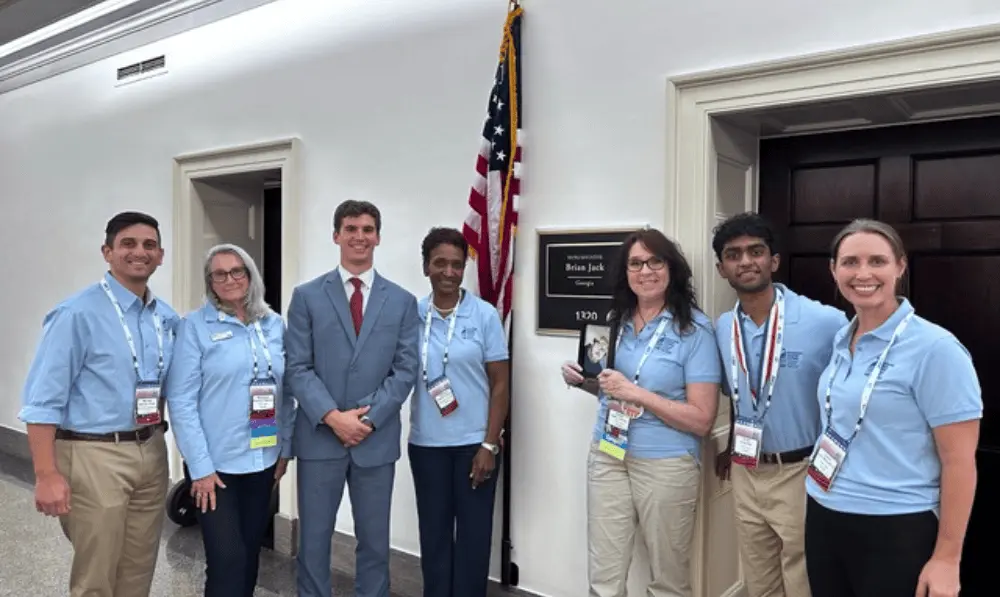
Roselynn Pearson knows what it means to fight for her life. Now, the 75-year-old Peachtree City resident has taken that fight all the way to Washington, D.C., advocating for cancer research funding, better access to treatment, and legislation that could make lifesaving clinical trials available to more Americans.
For Pearson, cancer advocacy is deeply personal. She has survived one advanced cancer diagnosis and is now living with another. But she is determined to use her experience to help other patients and their families.
Her journey began in 2011, when she was living in Florida and received a diagnosis of stage 3C endometrial cancer, an advanced form of uterine cancer.
She was scrambling to secure health insurance while trying to make decisions about treatment and her future.
After seeking a second opinion at Emory University in Atlanta, Pearson decided to remain in Georgia for treatment, where she could also be closer to family.
Finding hope during cancer treatment
Through a social worker, Pearson learned about the American Cancer Society’s Hope Lodge, which offers free accommodations to patients who must travel away from home for cancer treatment.
Pearson spent eight months living at the Atlanta-area Hope Lodge while undergoing surgeries, chemotherapy, and radiation.
During those months, she discovered something that would eventually shape the next chapter of her life.
“It is a place of grace,” Pearson said. “It’s where people come together and become a family very quickly because you’re all, in a way, walking the same path.”
Hope Lodge is one of the American Cancer Society’s programs designed to reduce the financial and emotional burdens associated with cancer treatment. Patients traveling from distant communities can face substantial expenses for hotels, transportation, and other necessities, particularly when treatment stretches over weeks or months.
Pearson remembers how important that support was during her own treatment, and it helped introduce her to the broader work of the American Cancer Society.
Her treatment was successful, and she moved to Peachtree City in 2013, choosing the community for its active lifestyle and proximity to family in the Atlanta area.
For more than a decade, there was no sign that her uterine cancer had returned.
Then, in 2024, Pearson received another diagnosis: chronic lymphocytic leukemia, a type of blood cancer.
Her doctors at Emory University’s Winship Cancer Institute are monitoring the disease, which she described as slow-moving. For now, they have recommended against beginning treatment unless it becomes necessary.
“Generally speaking, I’m doing very well, all things considered,” Pearson said.
Taking the fight to Washington
Rather than allowing cancer to define her retirement, Pearson has become a volunteer advocate with the American Cancer Society Cancer Action Network (ACS CAN), the organization’s nonprofit, nonpartisan advocacy arm.
Working in Georgia’s 3rd Congressional District, she joins advocates from across the country who meet with state and federal lawmakers to promote policies intended to reduce the burden of cancer.
This year, Pearson traveled to Washington, D.C., for ACS CAN’s annual Leadership Summit and Lobby Day, joining more than 750 cancer patients, survivors, and loved ones from all 50 states, Washington, D.C., Puerto Rico, and Guam.
Their priorities included increased federal funding for cancer research and prevention programs, as well as legislation to make clinical trials more accessible.
Among the funding requests was $51.3 billion for the National Institutes of Health in the fiscal year 2027 federal budget, including $7.99 billion for cancer research through the National Cancer Institute.
According to the American Cancer Society, advances in cancer prevention, detection, and treatment have helped produce a 34% decline in cancer mortality rates over the past 30 years. The organization credits sustained federal research investment with helping drive those improvements.
For Pearson, the funding requests represent more than numbers in a federal budget. They represent the possibility of additional breakthroughs for patients facing difficult diagnoses.
Her Georgia advocacy team met with legislative staff in the offices of U.S. Senators Raphael Warnock and Jon Ossoff and visited several congressional offices, including that of U.S. Rep. Brian Jack.
She was particularly encouraged by her team’s meeting with Grant Ruhlen, a member of Jack’s legislative staff, describing the reception as warm and Ruhlen as knowledgeable about the challenges cancer patients face.
Pearson hopes those conversations will translate into legislative support for research, prevention, and improved access to care.
Why clinical trials matter
Another major priority for Pearson and her fellow advocates was the bipartisan Clinical Trial Modernization Act, H.R. 3521 and S. 4440.
The legislation is intended to reduce barriers that prevent cancer patients from participating in clinical trials, including financial and logistical obstacles.
Clinical trials offer patients access to investigational treatments and help researchers determine whether new therapies are safe and effective. But participating in a trial may require traveling long distances, taking time away from work, or paying for accommodations and transportation.
Those barriers can be especially difficult for people living in rural communities, older adults, patients with limited incomes, and members of certain racial and ethnic groups that have historically been underrepresented in clinical research.
The proposed legislation would make it easier for trial sponsors to help patients with participation-related expenses, potentially opening research opportunities to people who otherwise could not afford to enroll.
Pearson knows firsthand how important assistance with lodging and other expenses can be during cancer treatment. Her eight months at Hope Lodge allowed her to receive care away from home without having to pay for a hotel throughout her treatment.
For her, removing financial obstacles is one way to help ensure that cancer patients have opportunities to receive the care they need.
The cancer burden in Georgia
The stakes are significant for Georgia residents.
According to the American Cancer Society’s 2026 cancer research fact sheet, an estimated 68,440 Georgians will receive a new cancer diagnosis this year, and approximately 19,400 will die from the disease.
The state’s five most commonly diagnosed cancers are projected to be prostate cancer, with 11,420 new cases; breast cancer, with 10,440; lung cancer, with 6,780; colorectal cancer, with 5,350; and melanoma, with 3,700.
Federal research funding also supports Georgia’s medical institutions, including Emory University, the University System of Georgia, Morehouse School of Medicine, and other research organizations.
The National Institutes of Health provided approximately $788.6 million in funding to Georgia institutions during fiscal year 2025, including approximately $71.9 million from the National Cancer Institute.
Pearson believes continued investment in research and prevention is essential to reducing the number of families affected by cancer.
“There has to be hope that in our lifetime there will be a cure for cancer, so that my grandchildren grow up in a world without cancer,” Pearson said.
She also emphasizes the importance of affordable, accessible healthcare for all Georgians.
A full life in Peachtree City
Although cancer advocacy is an important part of Pearson’s life, it is far from her only interest.
She enjoys Peachtree City’s golf cart lifestyle, playing cards, spending time with friends, attending community events, and visiting local farmers markets.
She is also a grandmother of two, and her hopes for their future help motivate her advocacy.
At 75, Pearson is grateful for the care she has received and the opportunity to remain active in the community she has called home for more than a decade.
“It’s all about quality of life,” Pearson said.
She credits her faith, hope, and access to good healthcare with helping her through the challenges she has faced.
Now retired, she has the time to volunteer and wants others to know they can become involved, too.
ACS CAN welcomes volunteers interested in advocating for cancer patients and their families, whether at the Georgia Legislature or in Washington. The organization works to influence public policy on research funding, cancer prevention, early detection, and access to treatment.
Those interested in learning more about cancer advocacy or becoming involved with the American Cancer Society Cancer Action Network can visit www.fightcancer.org.
Pearson hopes that sharing her experience will encourage others to recognize how much difference advocacy, research funding, and patient support programs can make.
Her own experience with Hope Lodge showed her what practical help can mean to someone facing cancer. Her advocacy on Capitol Hill is an opportunity to extend that help to people she may never meet.
“Because I’ve had the benefit of that, I think it’s important for me to use my voice to give back, to fight back, and to make sure that we have a world with more birthdays and less cancer,” Pearson said.


Leave a Comment
You must be logged in to post a comment.