


 2005
2005 0
0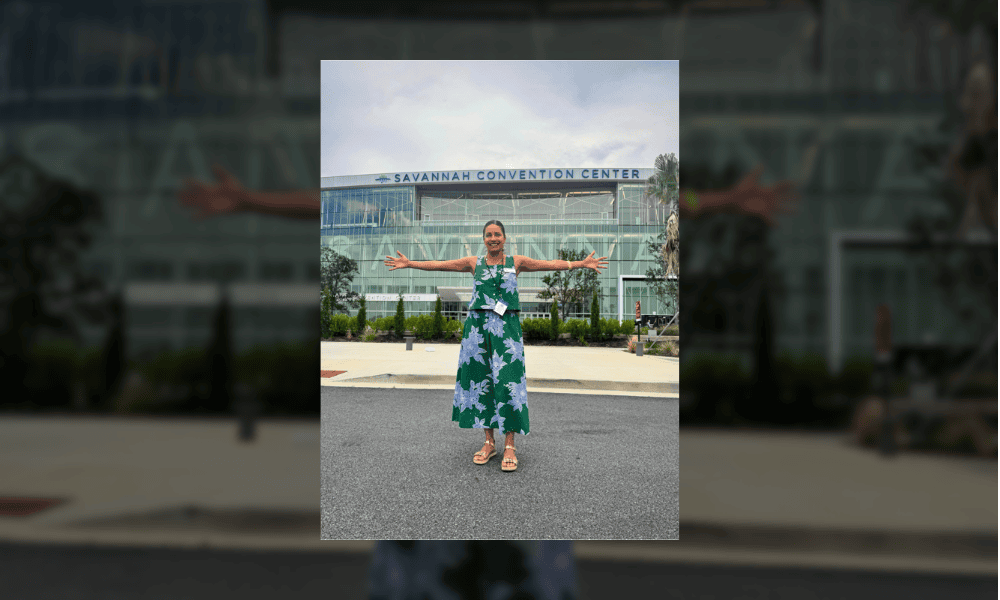
This past weekend, my husband and I spent several days in Savannah for a convention. Every time I visit, I fall a little more in love with the city. The stately squares. Oaks draped in Spanish moss that seem to hold centuries of stories in their branches. The collision of beauty and painful history. Even the food feels like Savannah itself, creative, layered, impossible to separate from the people who shaped it.
One brunch and dinner in particular still linger in my memory. We stumbled upon a restaurant that transformed familiar Southern ingredients into something entirely unexpected. Every plate was thoughtful. Every bite invited curiosity. One brunch turned into a return visit for dinner the very next evening.
But the moment I am carrying home with me has nothing to do with architecture or food.
It was an Uber driver named Sophie.
By pure coincidence, she picked us up twice.
French-born, now an American citizen, Sophie spoke with the unmistakable cadence of Europe still woven into her English. Once she learned that I, too, was an immigrant, the conversation changed. There is a quiet recognition that sometimes passes between immigrants, a shared understanding that requires very little explanation.
Then she said something that settled heavily between us.
These days, she told me she has become careful about who she picks up. Not because she fears being robbed or assaulted.
Because she never knows when someone will decide that her accent is an invitation to interrogate her.
“Are you one of them?”
“Are you legal?”
Not asked with curiosity.
Demanded.
As though citizenship were something she owed a stranger.
As though belonging required proof.
I realized, listening to Sophie, that I have quietly begun asking myself the same question before opening my mouth.
I have lived in the United States for decades. I became a citizen many years ago. I did not come to America because it was perfect. I came because it aspired to be something extraordinary.
My childhood taught me what it feels like to live where governments ask who belongs and who does not. America taught me something different, that citizenship could be rooted in shared ideals rather than shared ancestry.
Until recently, “Where are you from?” almost always felt like an invitation, a conversation about home, language, food, vampires (yes, I am from Transylvania), about family. People smiled when they asked. My accent was simply another thread in the tapestry of America.
Now, I sometimes hesitate before answering.
Not because my story has changed.
Because I no longer know what the question means.
It is a strange thing to realize that the caution you left behind in one country has quietly followed you into another.
I occupy a strange place in America’s racial landscape. I am what some might call a “white immigrant,” or perhaps more accurately, an acceptably beige one. I still remember someone once intending to compliment me by saying I reminded them of Melania. The remark made me uncomfortable then, and it does now.
My skin often allows me to move through spaces with a measure of safety that many immigrants of color do not enjoy. That privilege is real. But belonging built on appearance alone is fragile. The moment my accent, my views, my marriage, or my story enters the conversation, I am reminded that I, too, can become “other.”
America did not become extraordinary because of one people.
It became extraordinary because generation after generation of people arrived here carrying knowledge, labor, invention, languages, faiths, recipes, music, ideas, courage, and hope.
Some came freely.
Some came in chains.
Some came fleeing famine.
Some came fleeing dictatorships.
Some crossed oceans.
Some crossed mountains, jungles, and deserts.
Together, they built something none of them could have built alone.
So, if someone were to ask me today, “Are you one of them?”
My answer would be simple.
Without apology.
Yes.
I am one of them.
I am an immigrant.
I chose this country. I pledged myself to its Constitution. I built my life here. I pay taxes here. I serve my community here. I love this country enough to grieve for what it is becoming and enough to believe it can still become better.
Sophie is one of them.
The physician who delivered your child may be one of them.
The engineer who designed the bridge you crossed this morning may be one of them.
The scientist searching for a cure, the teacher helping your child learn to count, the woman caring for your aging mother, the farmer harvesting your food, they may be one of them, too.
Perhaps “Are you one of them?” is the wrong question.
Perhaps the question worth asking is why we have forgotten that they have always been us.


Leave a Comment
You must be logged in to post a comment.