


 2182
2182 1
1
It was once customary, and oft still is, throughout much of the South, to paint porch ceilings “haint blue,” as shown in the photograph below.
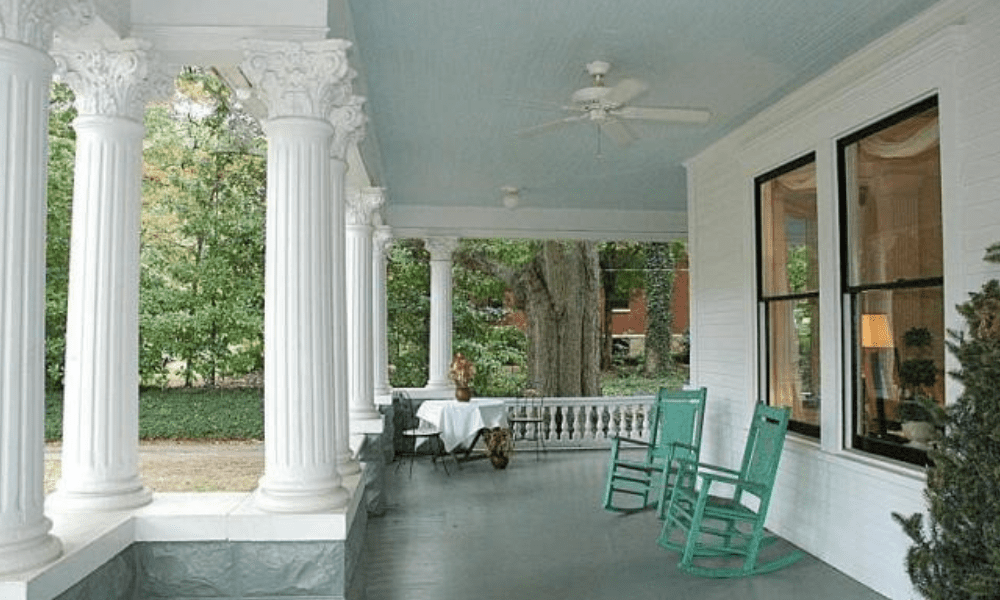
We’ve all seen it; we may even have it on or own homes, or perhaps our grandparents had “haint blue” porch ceilings. Why, other than the fact that the bluish-green tint is rather pretty and makes for a pleasant contrast with white walls, do we do this?
Supposedly (not “supposably,” which in spite of how often we hear it, is not a word), it’s a custom adopted from the Gullah/Geechee community of coastal Georgia and South Carolina. They believed that “haints” (other-worldly spirits that would haunt one) would torment one nearly to death if not kept at bay, and since legend says that haints could not cross water, the color “haint blue” was developed in order to fool the haints, thereby keeping them away from anything painted this color and presumably, from anyone living inside a structure bearing it. It puts your compiler in mind of a fun poem he learned as a child:
Little Orphant Annie (by James Whitcomb Riley)
Little Orphant Annie’s come to our house to stay,
An’ wash the cups an’ saucers up, an’ brush the crumbs away,
An’ shoo the chickens off the porch, an’ dust the hearth, an’ sweep,
An’ make the fire, an’ bake the bread, an’ earn her board-an’-keep;
An’ all us other childern, when the supper things is done,
We set around the kitchen fire an’ has the mostest fun
A-list’nin’ to the witch-tales ‘at Annie tells about,
An’ the Gobble-uns ‘at gits you
Ef you
Don’t
Watch
Out!
Onc’t they was a little boy wouldn’t say his prayers,—
So when he went to bed at night, away upstairs,
His Mammy heerd him holler, an’ his Daddy heerd him bawl,
An’ when they turn’t the kivvers down, he wasn’t there at all!
An’ they seeked him in the rafter-room, an’ cubby-hole, an’ press,
An’ seeked him up the chimbly-flue, an’ ever’wheres, I guess;
But all they ever found was just his pants an’ roundabout–
An’ the Gobble-uns’ll git you
Ef you
Don’t
Watch
Out!
An’ one time a little girl ‘ud allus laugh an’ grin,
An’ make fun of ever’one, an’ all her blood an’ kin;
An’ onc’t, when they was “company,” an’ ole folks was there,
She mocked ‘em an’ shocked ‘em, an’ said she didn’t care!
An’ thist as she kicked her heels, an’ turn’t to run an’ hide,
They was two great big Black Things a-standin’ by her side,
An’ they snatched her through the ceilin’ ‘fore she knowed what she’s about!
An’ the Gobble-uns’ll git you
Ef you
Don’t
Watch
Out!
An’ little Orphant Annie says when the blaze is blue,
An’ the lamp-wick sputters, an’ the wind goes woo-oo!
An’ you hear the crickets quit, an’ the moon is gray,
An’ the lightnin’-bugs in dew is all squenched away,–
You better mind yer parents, an’ yer teachers fond an’ dear,
An’ churish them ‘at loves you, an’ dry the orphant’s tear,
An’ he’p the pore an’ needy ones ‘at clusters all about,
Er the Gobble-uns’ll git you
Ef you
Don’t
Watch
Out!
Apparently, Little Orphant Annie didn’t know about haint blue and its gobble-un-repelling virtues. Or else haint blue won’t protect against truly rotten kids such as the ones in the poem.
Regardless, vintage haint blue beadboard porch ceilings absolutely exude Southern-ness. It has been your compiler’s lament for nearly thirty years that the porch ceilings at his house are white vinyl beadboard. One of his bucket list items is one day to pull that white vinyl down, front porch and back, to replace it with sure-enough three-quarter-inch tongue and groove beadboard, and to paint it all haint blue. Please just don’t tell his wife, and the dream might one day come to fruition.






Leave a Comment
You must be logged in to post a comment.