


 536
536 0
0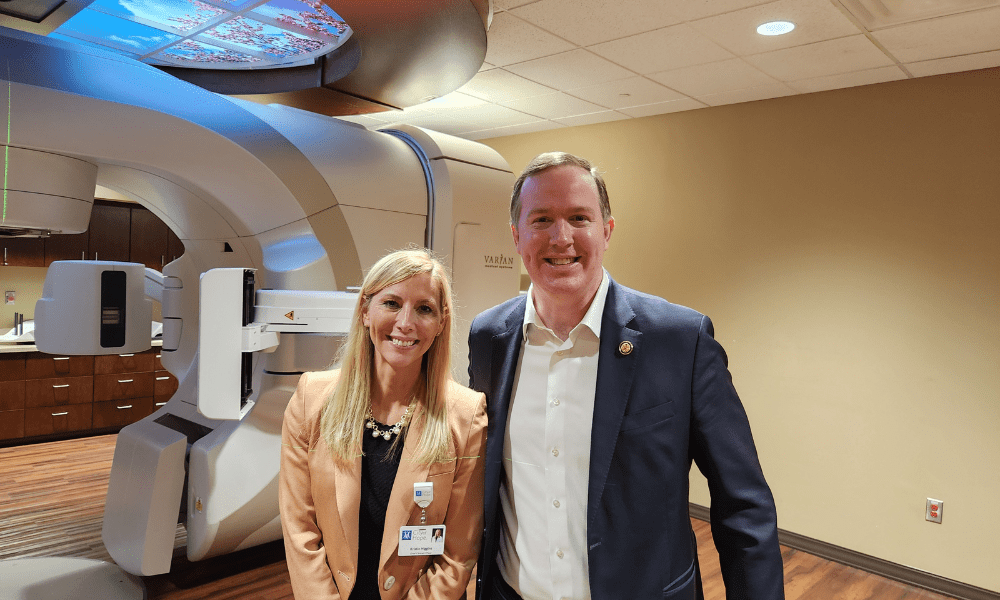
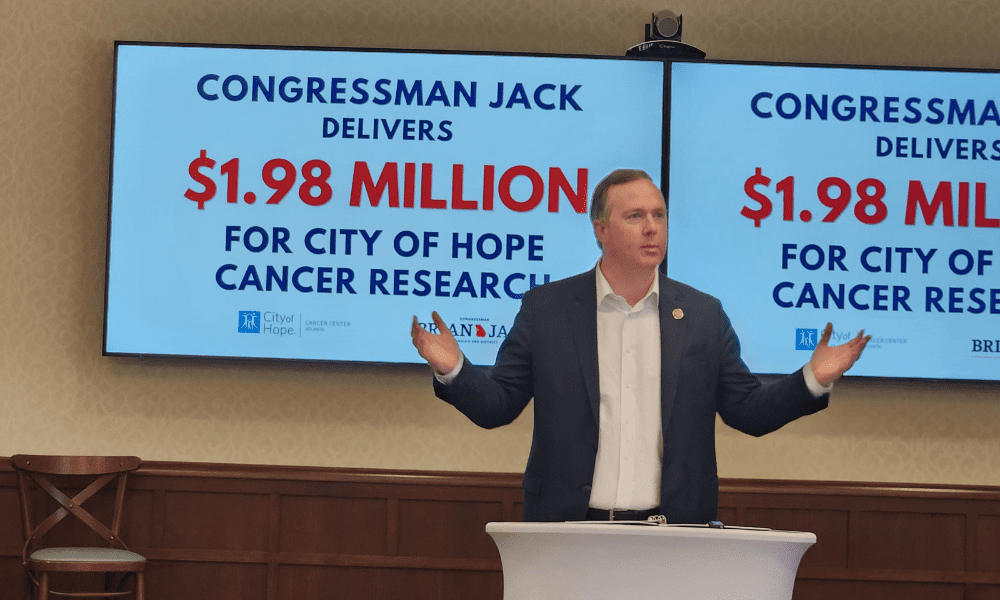
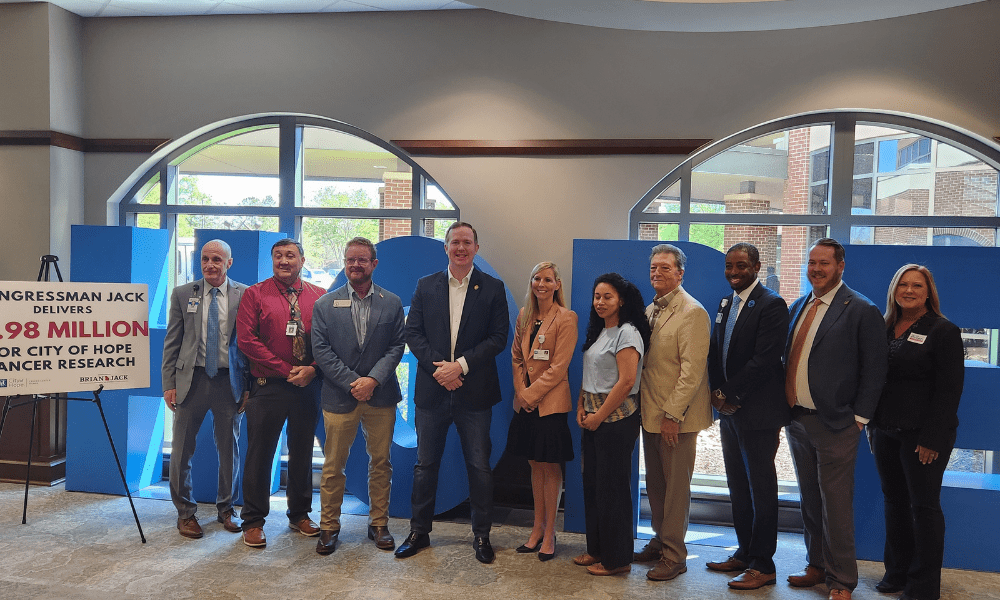
Congressman Brian Jack announced $1.98 million in federal funding for City of Hope Cancer Center in Newnan to expand an artificial intelligence platform designed to match cancer patients with clinical trials on Thursday.
The funding will support the rollout of “Hope LLM,” an AI system that helps physicians quickly identify which clinical trials a patient may qualify for—something doctors say has traditionally been slow and manual.
“This AI capability will help our clinicians more quickly identify appropriate clinical trials for individual patients,” said AJ Brooks, chief operating officer of City of Hope Atlanta. “Connecting more people to promising, timely, cutting-edge treatments that could otherwise be missed.”
How the technology works
During the presentation, physicians demonstrated how the platform analyzes large amounts of patient data and compares it against thousands of clinical trials.
“In the moment, you’re relying upon what the doctor knows in his or her head,” Jack said. “There are thousands, thousands of clinical trials and studies out there.”
The AI system compiles that information instantly, helping physicians identify potential treatment options that might otherwise go unnoticed.
“This technology… is going to enable doctors and physicians to identify the perfect trial, the perfect treatment plan,” Jack said.
Why clinical trials matter
Dr. Kristen Higgins, chief clinical officer at City of Hope Atlanta, said clinical trials are the reason cancer survival rates continue to improve.
“For the first time, 70% of patients diagnosed with cancer will live five years or more, and that is huge,” Higgins said. “Why is that? It’s because of clinical trials.”
But despite their importance, only a small percentage of adult cancer patients participate.
“Right now, only about 3% of patients are enrolled in clinical trials for oncology,” she said.
She said identifying eligible patients is one of the biggest barriers.
“It is very arduous… it takes a lot of leg work, and it is all manual,” Higgins said.
What the funding will do
The AI platform is already operating in a pilot program using data from City of Hope’s California system. The federal funding will allow it to expand locally.
“So now we’re going to build it out to the trials that are open here in Georgia,” Higgins said.
That shift will allow physicians in Newnan to match patients with clinical trials available in Georgia, rather than relying on out-of-state data.
The system can also summarize complex medical histories in seconds.
“It summarizes 100 pages of outside medical records… and puts it right in front of me,” Higgins said.
Inside the radiation oncology lab
Following the presentation, staff led a tour of the radiation oncology suite, where advanced machines deliver highly targeted cancer treatments throughout the day.
“We do have a patient roughly every 15 to 30 minutes all day, from about 7 a.m. to 4 p.m.,” a radiation team member explained.
The machines use onboard imaging to create daily scans, allowing doctors to adjust treatments with precision.
“It takes live images all the way around every day to create a CAT scan of each patient that enables us to really target what we’re treating down to the millimeter,” the technician said.
The center treats a wide range of cancers, including breast, lung, head and neck, and prostate.
Advances in treatment are also reducing how long patients need care.
“Whereas breast patients used to have 25–30 treatments… now they have like five or nine treatments,” the technician said.
AI beyond clinical trials
Doctors said artificial intelligence is already being used in radiation oncology to speed up treatment planning.
“You have to go through every slice of that CAT scan and draw the organs,” a staff member said. “Now AI can actually do that part for them.”
That process, which once took days, can now be completed much faster, with human review still required.
Future plans include adaptive radiation therapy, which would adjust treatment in real time based on changes in a patient’s body.
“It will allow you to give a higher dose of radiation, which can potentially impact survival,” Higgins said.
Looking ahead
Doctors estimate the AI platform could significantly expand access to care and increase the number of patients seen each day, as well.
“I would estimate that it would probably increase your total patient throughput by anywhere from 25% to 40%,” Higgins said.
For patients, providers say the goal is faster answers and better options, closer to home.
“With cancer, every day matters,” Higgins said.
Higgins also acknowledged that artificial intelligence can feel uncertain to patients, but said its application in medicine offers clear benefits.
“I want people and patients to know that I know AI is really scary, but it can be used to help people also,” Higgins said. “So this is one of those examples.”


Leave a Comment
You must be logged in to post a comment.