


 2709
2709 17
17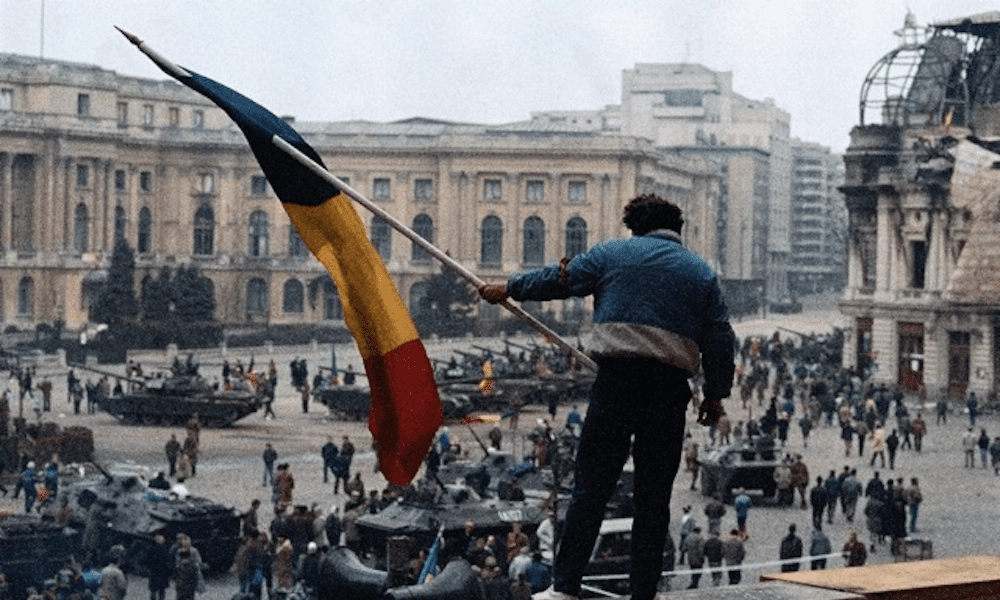
I grew up in a country where the law existed only on paper.
In Nicolae Ceaușescu’s Romania, rules were not protections; they were instruments of control. They applied downward, never upward. The state spied on its citizens, rationed food and heat, restricted movement, punished dissent, and wrapped cruelty in bureaucratic language. Fear was not a side effect. It was policy.
I was a child, but I remember one morning with painful clarity. It was winter. Still dark. The sun hadn’t fully risen, and the lobby of our dilapidated apartment building was dim, lit by a single, barely functioning bulb that flickered more than it shone. The elevator, as usual, was broken. I had run down eight flights of stairs, breathless, rushing to school in the cold.
And then I stopped short. The Poliția were standing there. Unexpectedly. Casually. In the lobby.
They asked me for my ID. I froze.
They had not done anything yet. They didn’t need to. My body already knew what they represented. They were not there to protect. They never were. They were agents of a regime that controlled where you went, what you said, what you read, how warm your home was allowed to be. They were the physical manifestation of a system that watched, recorded, and punished.
I knew enough, even then, to be afraid. I knew our family. I knew our views. I knew the spirit in our home, one that refused to accept the legitimacy of an oppressive regime built on lies and force. I knew enough to understand that law did not mean justice, and authority did not mean safety.
That moment, that sudden halt, that tightening in the chest, is not something you forget. It is also not something you mistake when you see it again.
Now, here in the United States, my adopted home, I felt that same chill watching what happened after Renée Nicole Good, a U.S. citizen, was shot and killed by an ICE agent in Minneapolis.
What followed matters as much as the shooting itself. The U.S. Department of Justice declined to pursue a civil-rights investigation into her killing, a role it has historically taken seriously in cases involving potential abuse of state power. Instead, the department moved to investigate Ms. Good’s partner. Career attorneys inside the Civil Rights Division resigned in protest, stating plainly that they could not participate in what they viewed as a politicized distortion of justice.
Let that sink in. Seasoned professionals, people whose job it is to uphold the law, walked away because they believed the law was being bent to protect power rather than restrain it. Local authorities were sidelined. Transparency evaporated. Accountability stalled.
This is a familiar pattern. This is what it looks like when the law stops functioning as a shield and starts functioning as a tool. When institutions meant to protect people, instead protect themselves. When authority demands obedience but refuses scrutiny.
This is not about immigration policy. It is about the Constitution. Law enforcement is bound by law. Agencies do not get to decide which rights apply and to whom. Due process is not optional. Oversight is not a nuisance. When the federal government declines to investigate the killing of a citizen by its own agents, while pressuring investigations elsewhere, the message is unmistakable: some actors are above the law.
That is the moment democracies begin to hollow out.
History teaches us something else, too. People do not rise up because they crave chaos.
They rise up because they crave dignity. Across the world, including in Iran, ordinary people continue to risk their lives not for domination, not for cruelty, but for the simplest human desires: agency over their bodies, fairness under the law, freedom to speak, to gather, to love, to live without fear. The lesson is not foreign. It is universal.
Human beings want decency. They want justice. They want rules applied impartially. They do not want cruelty disguised as order.
Those who thrive on fear, who normalize suffering, who treat human lives as expendable, are not strong. They are malignant. And history eventually names them as such.
This is a rally for humanity. For freedom. For the rule of law. For our souls, as a nation, and as a species.
History is watching, and so are the generations who will inherit what we leave behind. A society is measured not by its power, but by its refusal to accept cruelty as normal. I have lived under a system that demanded obedience without justice. I know the cost of waiting. This is the hour to stand for dignity, for the rule of law, for the irreducible worth of human life, and to refuse, clearly and collectively, to live on our knees.





Leave a Comment
You must be logged in to post a comment.