


 7973
7973 14
14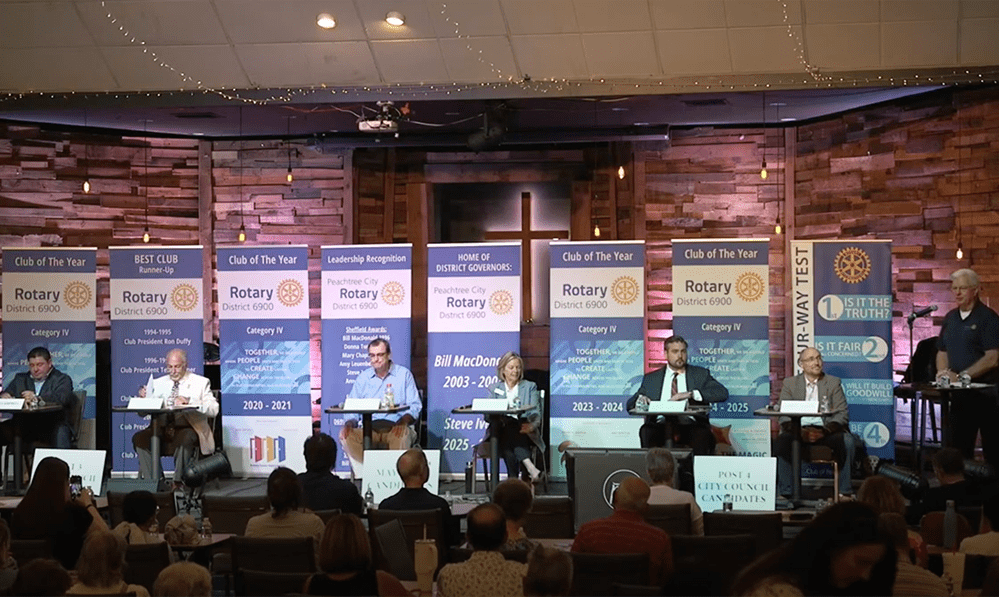
Report and Analysis
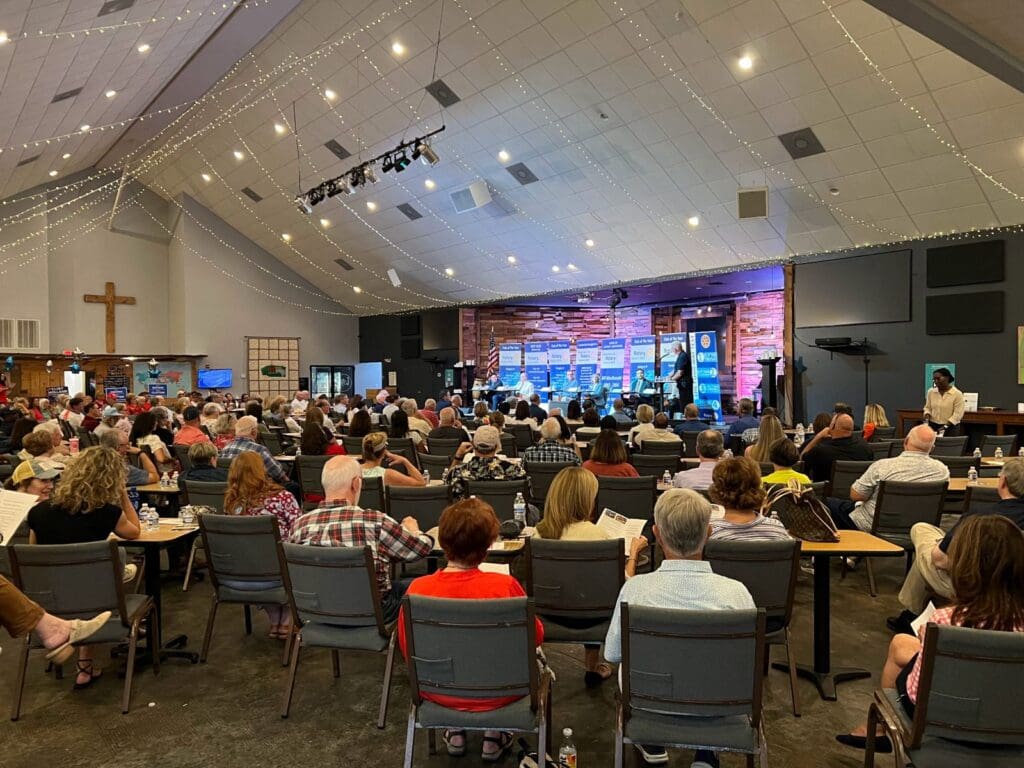
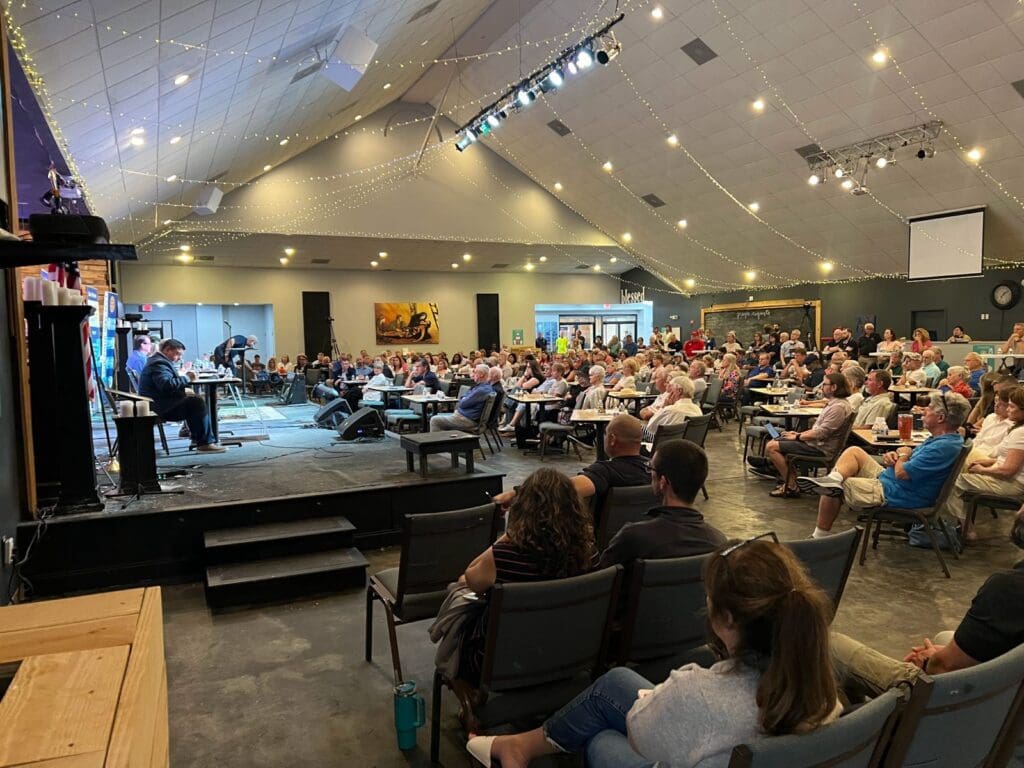
The sanctuary at Peachtree City Christian Church was packed on September 23 as neighbors filed in, Rotarians ushered folks to their seats, and six candidates took their places on stage. The occasion was the Rotary Club’s “Meet the Candidates” forum, the first time this election season that all of Peachtree City’s contenders for mayor and council shared the same spotlight.
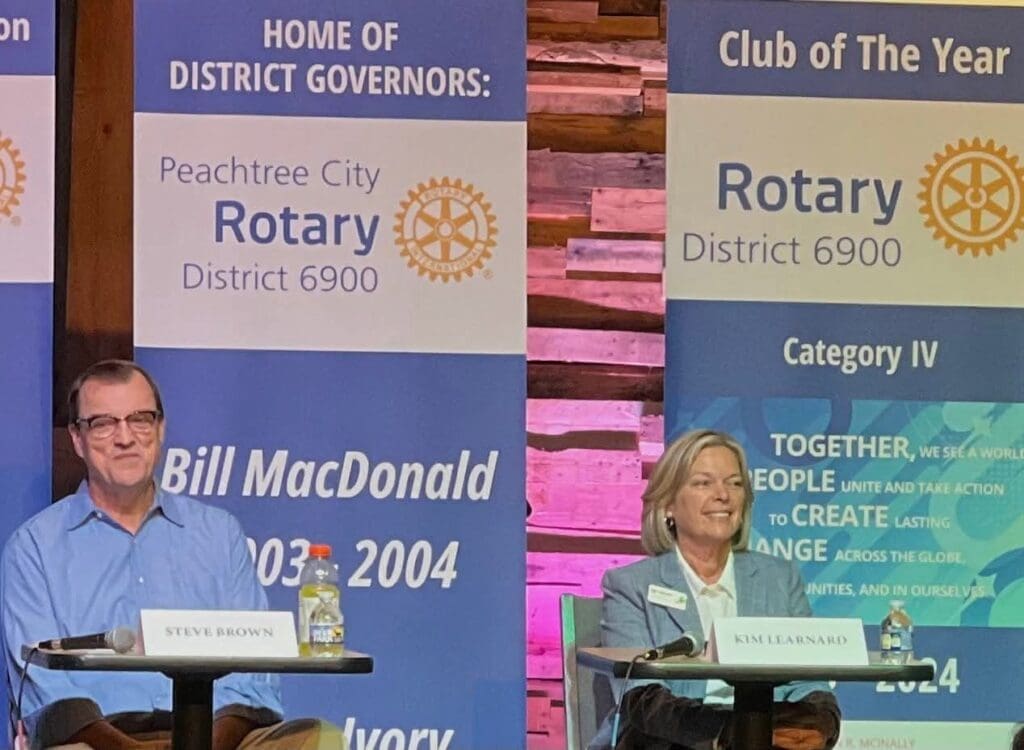
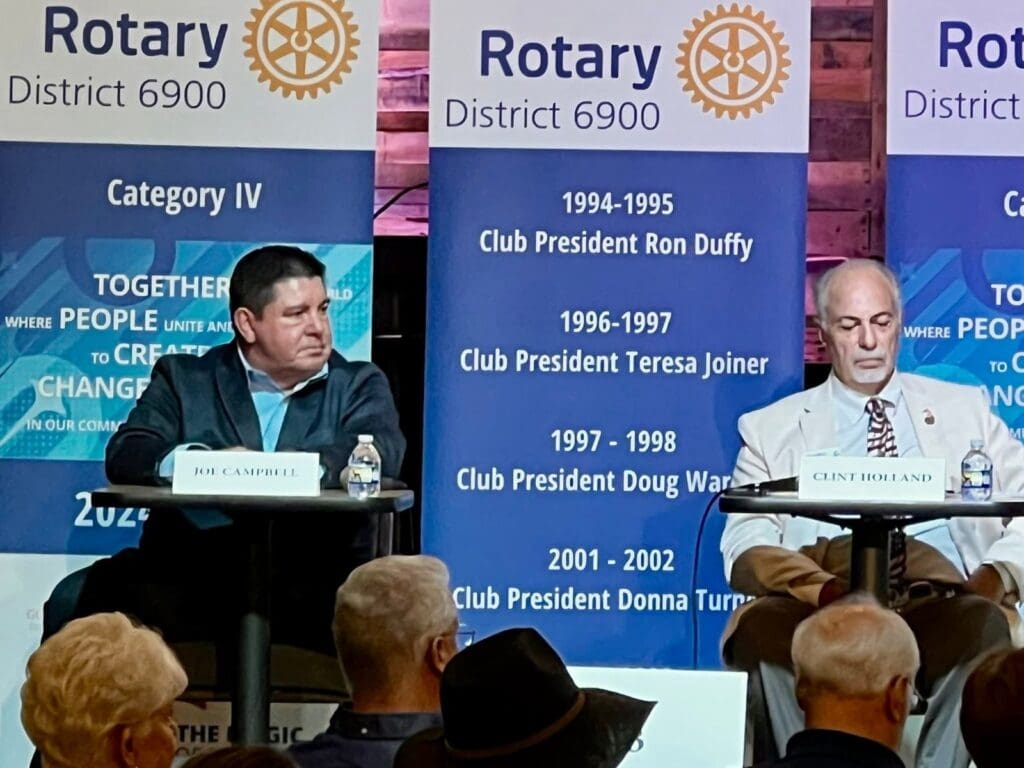
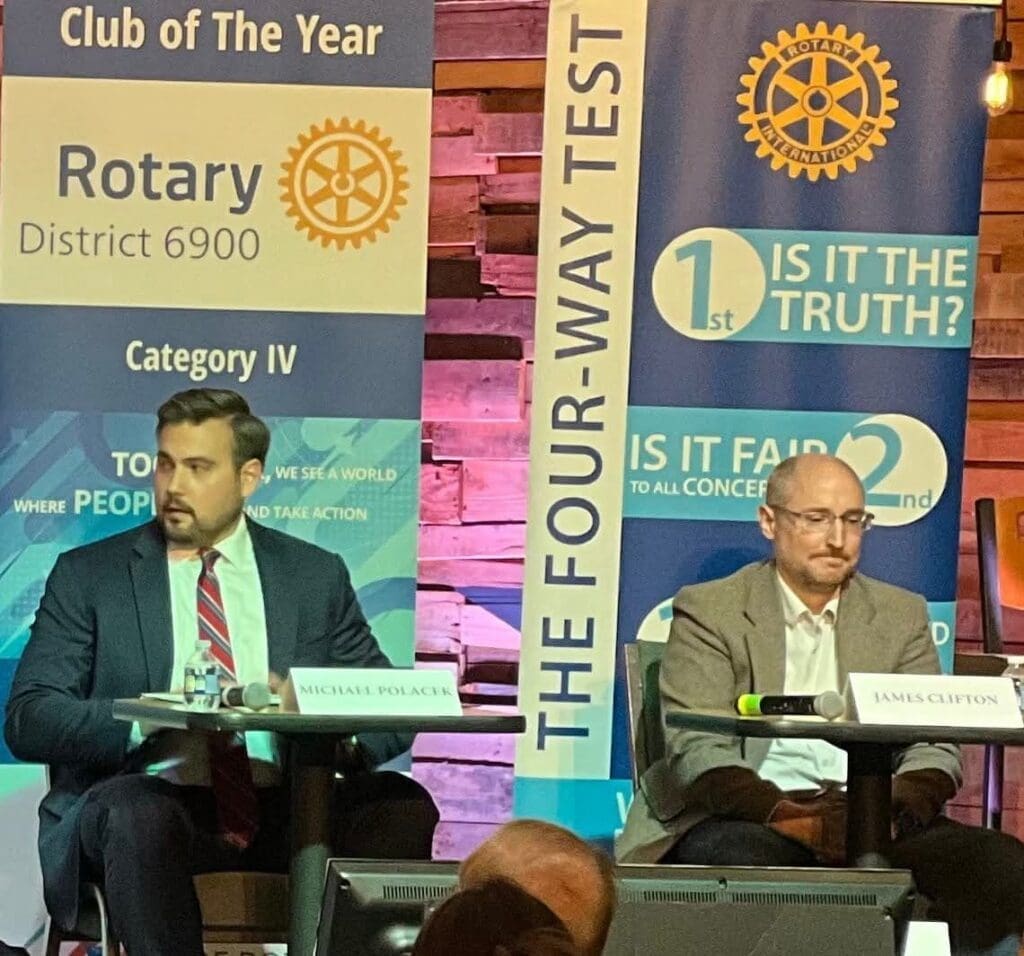
The stakes are high. Mayor Kim Learnard is seeking a second term against former mayor Steve Brown. In Post 3, incumbent Clint Holland faces challenger Joe Campbell. And in Post 4, Recreation Advisory Board member Michael Polacek is up against newcomer James Clifton.
A summary of questions and answers is below. But first, here is my take on how the candidates did.
Mayoral Candidate Kim Learnard (Incumbent)
Kim Learnard commanded the stage with the confidence of an incumbent. She was steady, prepared, and clear about what she has done in office and where she wants to go next. She leaned on specifics: fully staffing the police department after years of vacancies, cutting serious crime by a reported 25%, placing resource officers in every elementary school, and repurposing the old Big Shots range into an Emergency Operations Center with federal money. On redevelopment, she reminded everyone that she twice rejected apartments at the Kmart site, which is now seeing new life as Ace Pickleball and a soon-to-be-announced family-oriented business move in.
Kim’s tone was protective about Peachtree City, and that played well in the room. While some attendees clearly were not in her camp, many I spoke with told me she was the strongest performer of the night. She presented herself as a steward of the city’s green space and quality of life, not as someone out to make sweeping changes. For a city that prides itself on stability, that message landed. Her challenge is to keep delivering tangible results. At the forum, she looked the part of mayor.
Mayoral Candidate Steve Brown
Steve Brown and his overwhelming negativity had the opposite effect. While he had his fans in the room, he treated the forum as a platform for spouting old grievances rather than communicating a plan for the next four years. From the start, he came out combative, turning nearly every answer into an angry attack on Kim Learnard. He repeated familiar complaints about the budget, about rezoning decisions, and about ethics disputes, but rarely connected those complaints to a clear path forward. Instead of describing what Peachtree City should look like in ten years, he leaned on the claim that the 54/74 project is worthless and that leaders have failed to fix traffic. That kind of red meat may rile up frustration, but it does not inspire confidence.
Beyond the combative tone, several of Brown’s claims were either misleading or contradicted by the record. A few examples stand out:
- He claimed the city is “giving away” industrial and commercial land, even though those parcels remain zoned for their intended uses and the city now has a full-time Economic Development Manager working to recruit new tenants.
- He warned that apartments are being approved “all over town,” even as major redevelopments—most notably the former Kmart site—have rejected apartment proposals in favor of commercial uses.
- He labeled recent budgets “record tax increases,” despite the fact that Peachtree City rolled back its millage rate in 2025 and maintained a lower rate for 2026.
- He accused the mayor of treating cash reserves as a personal “slush fund,” a claim that is flatly false. Any use of reserves is governed by ordinance and requires approval from the full City Council.
And then there was the whopper. Brown repeated an old allegation that the mayor took a campaign-related kickback from a developer—an accusation reviewed by an independent hearing officer years ago and dismissed as unfounded.
Taken together, Brown’s rhetoric leaned more on grievance than on fact. His performance at the forum underscored the divide between his narrative and the city’s record, leaving voters with a picture of a candidate more focused on fueling outrage than on offering a realistic plan for Peachtree City’s future.
Post 3 Candidate Clint Holland (Incumbent)
Clint Holland, who never lacks personality, delivered a mostly strong performance. He was at his best when he stayed close to home, focusing on priorities people can relate to: keeping the tax rate reasonable, pushing for a pedestrian bridge to safely connect Booth Middle and McIntosh High, and advocating for a veterans memorial at the old community garden site. These are concrete, relatable goals that fit with the kind of local stewardship voters expect from a council member.
Where he stumbled was in bringing national politics into what was otherwise a very local forum. Several attendees told me it felt unnecessary and out of place. That matters because council work is about rezonings, annexations, contracts, and recreation bids, not national talking points.
His handling of the recent 2026 budget fight revealed the same challenge. His commitment to keeping taxes low is genuine, and many residents—including myself—support that goal. The concern is how he pursued it. After months of workshops and staff preparation, he raised objections only at the final vote, leaving colleagues and staff scrambling. At the forum, he did not acknowledge the disruption this caused. Instead, he defended it as the right move, even as others saw it as unnecessarily disruptive. The budget eventually passed with about $500,000 in cuts, mostly to new projects rather than core services. Several attendees also noted that even with a rollback, most residents would not see real savings on their tax bills. That undercuts the impact of his efforts and creates a sense of someone more interested in standing firm than working through differences.
Holland’s passion for the city is clear, and his priorities resonated with many in the room. The question for voters is whether he can turn that passion into steadier governance because, when he stays grounded in local needs, he connects. When he strays or digs in without regard for the fallout, he risks losing people.
Post 3 Candidate Joe Campbell
Joe Campbell showed the same pragmatism that has defined his campaign. He grounded his answers in everyday experience and moved quickly to practical solutions. He talked about making it easier for small businesses to open, about looking at traffic as a system instead of just one intersection, and about creating more for teenagers to do at night while not forgetting seniors who need access to services. He also spoke about maintaining a greenbelt perimeter for the city, an idea that one attendee later questioned.
Campbell was also willing to draw contrasts, particularly on fiscal management. He pointed out how Clint Holland handled the recent budget discussions, where last-minute objections created eleventh-hour issues and confusion. Campbell argued that this kind of brinkmanship is avoidable if council members engage earlier and more constructively in the process. It was a subtle but important moment, showing he is not afraid to challenge an incumbent while making the case that Peachtree City needs fewer disruptions and more preparation when it comes to its finances. He also noted that even if tax rates are rolled back, homeowners are unlikely to see meaningful relief because county assessments and schools are the real drivers of higher bills.
Attendees I spoke with liked his calm, cooperative tone. They saw him as someone willing to work with others rather than grandstand. Campbell is not flashy, but his answers reinforced that he favors steady improvements over sweeping promises. That style may not fire up a crowd, but it does speak to residents who want council members who come prepared, focus on the details, and keep the city’s work on track.
Post 4 Candidate James Clifton
James Clifton began the night on steady footing, but the longer it went on, the shakier he became. He leaned heavily on promises to cut the budget and reduce taxes, yet when pressed on how, he offered no specifics. He could not explain what he would reduce or restructure, or how the city would continue providing services with less money. Without details, his message came across as empty political talk.
He also tried to raise alarms with claims that did not hold up. For example, on redevelopment, he argued that the NCR and Hella buildings were empty, even though both are currently under contract for new tenants. He also claimed there were two million square feet of vacant retail space in Peachtree City, a figure a commercial developer I spoke with after the forum quickly dismissed as inaccurate. These kinds of statements reduced his credibility.
But that wasn’t the worst of it. As the evening went on, Clifton turned more negative, particularly in his attacks on Michael Polacek in his closing remarks. Several attendees told me the personal tone was off-putting. Others said he looked less like a candidate with his own ideas and more like Steve Brown’s “rubber stamp” on council who will just do as he is told, echoing an argument made by Polacek after being attacked.
Clifton is clearly a smart guy, but intelligence alone is not enough. He had to back up his political claims with specifics and demonstrate independence. At this forum, he did neither.
Post 4 Candidate Michael Polacek
Michael Polacek turned in a steady performance, even if his delivery was a little stiff. He leaned into his professional background managing multibillion-dollar budgets and worked to show how that experience translates into practical steps for Peachtree City. He emphasized protecting core services first—public safety, EMS, and basic maintenance—before moving on to “nice-to-have” projects. He argued for investing in recreation responsibly, for guarding commercial and industrial land against being flipped into residential, and for making it easier for small businesses to get off the ground. He also pointed to partnerships like Launch Fayette as examples of how to spur growth without changing the city’s character.
What set him apart was the way he tied these points into a broader philosophy. Polacek stressed that budgets are about priorities and tradeoffs, not campaign slogans. He talked about phasing projects so the city does not overextend itself, identifying waste before asking residents for more, and using collaboration with outside partners to stretch taxpayer dollars further. It was a technocratic style and definitely not flashy, but it conveyed competence and caution at the same time.
Attendees I spoke with responded positively, particularly to his approach on the budget. They liked that he offered something resembling a roadmap—how to prioritize, how to keep services funded, how to make room for improvements without letting costs spiral. The contrast with James Clifton was sharp. Clifton’s arguments often sounded political, while Polacek came across as thoughtful and measured, someone who has managed complexity before and understands how to set priorities and stick to them. For voters who want steadiness and discipline at the council table, his performance made that case.
What Should We Make Of This?
Forums are not elections, but they do reveal something important: how candidates carry themselves when they are side-by-side with their opponents and with no place to hide. On that stage, contrasts became clear.
Kim Learnard looked like the mayor, steady and prepared. Steve Brown came across as angry and stuck in the past.
Clint Holland was strong on local issues but undercut himself with last-minute tactics and detours into national politics. Joe Campbell offered a pragmatic, cooperative style rooted in process, which could resonate with residents who want steady leadership.
James Clifton leaned on shaky claims that were difficult to back up. Michael Polacek offered more specifics and a roadmap that felt practical.
Voters will have to decide not just which issues they agree with, but which qualities they want at the council table. Do they want steady stewardship, pragmatic problem solving, principled but disruptive stands, or grievance politics?
Election Day is November 4. We have 41 days to make our decision.
———–
Summary Of The Forum’s Questions & Answers
Opening Statements
Clint Holland said that although he is not from Georgia, Peachtree City has been his “forever home” for fourteen years. He described an extensive academic background—multiple engineering degrees (a bachelor’s and a doctorate) plus a master’s in economics and marketing—along with a career running both large and small companies. He noted that he currently serves as Mayor Pro Tem and as Vice Chair of the Peachtree City Water and Sewer Authority, and that he is also Vice Chair for the Eastern District under Congressman Brian Jack, a member of the Knights of Columbus and American Legion Post 50, and a weekly volunteer at Holy Trinity Catholic Church.
Joe Campbell explained that he and his wife moved to Peachtree City in 2018 with their two sons. His older son graduated from McIntosh and now attends Kennesaw State, while his younger son is a sixth grader at Booth Middle School, where Campbell has volunteered multiple times. He said his wife’s parents visited, fell in love with Peachtree City, and decided to build a house in Cresswind, making three generations of his family residents. He summarized his 28-year career at the Walt Disney Company: he began as a bellman, advanced to managing operations for multi-million-dollar hotels, worked in labor relations to “mitigate discrepancies between the union and the company,” and spent his final ten years on teams designing hotels worldwide, gaining exposure to international business and infrastructure development.
James Clifton identified himself as a “lifelong resident of Fayette County” who chose Peachtree City with his wife, Whitney, for its unmatched quality of life—jobs, schools, safety, amenities, and the “crown jewel” golf cart paths. He said “poor planning decisions” over the past decade have “started to erode that quality of life,” and he outlined five campaign commitments: restrict high-density housing, reduce the budget and cut taxes, alleviate traffic, create more open and transparent government, and stop annexing residential property while preventing the rezoning of commercial or industrial land to residential.
Michael Polacek shared his background in public budgeting and his progression to senior leadership under the Kemp administration. He told his family’s immigration story, explaining that his parents escaped communist Czechoslovakia in 1985 after being forced to wait five years because his mother became pregnant; his sister “literally ran with a backpack across the border to Western Europe.” He said the family arrived “with only $100 and a suitcase of clothes” and eventually settled in Peachtree City. He emphasized the values of “hard work, education, integrity” and added that he is married to a small business owner, has two young children, grew up attending local schools, worked his first job at Partners Pizza, and now rides the same cart paths with his children that he explored as a youth.
Kim Learnard said she was not nervous because she has “four years” of accomplishments and “can’t wait to tell you about my track record of success.” She announced endorsements from city founding father Joel Cowan and former mayors Chip Conner, Bob Lenox, and Harold Logsdon, and said her vision “aligns exactly with the original founders” on preserving green space and revitalizing village centers. She highlighted numerous accomplishments including expanded cart paths, industry expansions, village revitalization, community events such as Night Market, Sunset Sounds, and the Back to School Bash, and extended library hours, and she challenged her opponent to convince voters these achievements are “a bad thing.”
Steve Brown opened by attacking Learnard: “If you love government to shut citizens out, Kim is your choice.” He alleged restricted public input, prevented council members from placing items on agendas, and support for a budget-constrained 54/74 GDOT project that solves none of the problems. He said she rezoned “prime corporate land to cost prohibitive residential zoning,” used a “once in a lifetime federal grant meant for a new fire station” for maintenance, maintained “excess cash reserves” as a “mayoral slush fund” instead of providing tax relief, violated “Georgia open meetings and records acts,” oversaw “four city managers in four years,” and held the annual retreat “in Gwinnett County, just to keep you in the dark.”
“The city recently hired an economic development manager. What are your priorities related to economic development, and how will you engage with, support, and direct the Economic Development Manager?”
Michael Polacek called redevelopment “the conversation” that will define the city’s future and said council must make responsible decisions to preserve Peachtree City’s character. He supported businesses “getting the most out of their property” but stated, “I will not support rezoning industrial or commercial land” to residential. He emphasized faster, more efficient processes; partnerships with Launch Fayette, which “recently started this past month”; and “common sense variances” assessed case by case. He said “a blanket no to every single opportunity isn’t the vision,” promised to support landowners’ right to request variances, and said he would “shut down anything that isn’t good for the city.”
James Clifton said Peachtree City has “almost 2 million square feet of vacant commercial space” and warned that prolonged vacancy leads to “foreclosure,” which “brings down our property values” and “our tax base.” He said he had spoken with the Economic Development Manager about filling these spaces and argued that vacancy creates pressure for mixed-use with stacked housing. He declared himself “absolutely 100% against high density housing in any form,” saying it would worsen traffic and “accelerate crime” due to overcrowding.
Joe Campbell called the new manager “incredibly smart” and “full of ideas” and centered small businesses within the founders’ “village concept.” He said permitting is a major barrier and that, after speaking with business owners “especially in the last two weeks,” he heard the same message “over and over and over”: “it is tough to get things done in the permitting office.” He advocated streamlining permitting, supporting businesses after they open, and not just filling vacant buildings but “revitaliz[ing] them” so they attract customers. He cited his Convention and Visitors Bureau work, saying they managed to “increase the amount of hotel rooms being sold tenfold each year” over two years.
Clint Holland said he knew the new Economic Development Manager from working together when he was the mayor of Sharpsburg and both served on a Georgia Municipal Association committee. He quoted the manager as saying “industrial development” brings “the best amount of taxes with a minimum amount of services needed.” He argued that industrial firms pay taxes and employ people without the residential demand for fire, EMS, and police, and he linked this to his recent budget work: “I’ve been fighting, quite successfully as of last Thursday, to get a lower tax rate, not only for the residents, but also for the businesses.”
“I think we can all agree that public safety is the city’s number one funding priority. Aside from public safety, what would be your top two or three funding priorities during your term in office?”
Steve Brown said the budget is “off track” because “we’ve given away all the corporate headquarters and light industrial land,” including land “supposed to be light industrial corporate headquarters” that “would have offset all our residential taxes in future years.” He said houses must cost “$650,000 in order for it to break even,” claimed McDuff Parkway developments do not meet that threshold, and argued that “every one of you are paying for it.” He emphasized his credentials as the “only one that [is] certified in economic development,” the “only one that’s won economic development awards from the state,” and someone who “pulled in the largest employer in Fayette County.” He called for eliminating duplication, using technology better, and reducing “way too much money in contingency funds,” and he criticized using a federal pandemic grant meant for a fire station to pay maintenance: “If you can’t fund the maintenance, don’t build the new facilities.”
Kim Learnard said the city ranks in the “top 10 safest cities in Georgia” but was “grossly understaffed” when she took office. She described a pay and benefits study that led to increased police pay, full staffing, and a 25% drop in Part 1 crimes “from first quarter 2024 to the end of first quarter 2025.” She announced a partnership with the school system to place school resource officers in every elementary school—mentioning “Officer Smiley” likely going to Oak Grove—outlined the purchase and conversion of the Big Shots gun range into an Emergency Operations Center with potential for a “$1.172 million grant” if the federal budget passes by September 30, and noted that the FY26 budget includes “three new firefighters in anticipation of the new fire station” on the south side where the old animal shelter was located. She said “47% of our budget is public safety.”
Clint Holland clarified that the question asked for priorities beyond public safety. He called for maintenance funding for “old facilities all over the city,” arguing that deferred maintenance “waits till next year, and then it waits till next year, and it never gets done.” He supported a student-safety bridge over Highway 54 between McIntosh and Booth because students now cross “at grade” on a “high speed road,” and he said he has “been working on that in City Council” with completion “about a year away.” He also supported a veterans memorial “at the old community garden,” citing ongoing council discussions and potential reserve funding.
Joe Campbell emphasized a “multigenerational” approach to recreation, citing his teenage son’s view that there was little to do at night and his veteran father-in-law’s view that services like a VA office matter more than a memorial. He called for an “expanded citywide traffic survey” beyond a single area because “when you do that, the problems tend to spread out,” and he said some fixes can be implemented locally without state approval. He noted that “regular maintenance” is an “ongoing cost” that requires budget changes and more staff, and he asked “how do you pay for that?”
James Clifton said his “biggest priority with the budget is cutting it,” stressing that taxpayers “worked hard for every dollar” and that “every tax dollar that our city spends” should face tough scrutiny. He prioritized cart paths, replacing the Kedron Aquatic Center “bubble,” repairing the Kedron hockey center, and adding bathrooms at Battery Way Park and Line Creek Nature Area. He contrasted himself with an opponent who, he said, promised a taxpayer-funded yard-debris removal service that would cost “$1 million per year,” which he called fiscally irresponsible, and he criticized a Recreation Master Plan of “50 plus projects” with a “$104.1 million” price tag.
Michael Polacek emphasized budget experience managing “$3 billion of state agencies,” where leaders had to set priorities, work with the legislature and advocacy groups, and fund responsibly while the Governor “cut taxes, [gave] teacher raises and [moved] Georgia forward.” He said, “It’s fun to say I can cut taxes, but how am I going to fund all these fun projects?” He argued for balancing the budget, identifying waste, and cutting it. He praised recreation improvements since his childhood, mentioned a recent soccer game at Pack Fields, and said friends are impressed with the cart paths. He emphasized EMS, noting that in communities without EMS “it takes three minutes longer, on average…for an ambulance to get to their house,” and he advocated for “public private partnerships that generate revenue for the city” rather than cutting taxes alone.
“How you lead your economic priorities, your policies, the programs that you advocate will have an impact on our city long after your term is over. Share with us what is your vision for Peachtree City five, eight, ten years from now.”
Kim Learnard said “Peachtree City is built out,” so her focus is “preservation.” She described feeling “maternal about Peachtree City,” protecting what residents cherish, and she said she hired a “full time certified arborist” and earned “Tree City USA status for the first time in decades.” She said she created a new “transportation advisory group for citizen input on roads, paths and all things, safety.” She highlighted industry expansion that keeps the “industrial tax base growing,” partnerships that brought “Southern Crescent Technical College and Clayton State University to the former Booth Middle School location,” and specific redevelopment wins: rejecting apartments at the Kmart site twice, securing Ace Pickleball, and expecting another “family-oriented business” announcement soon. She also cited Trader Joe’s, J. Alexander’s moving into the Smokey Bones space, family-owned B. Turner’s taking the Stein Mart space, and a multimillion-dollar reinvestment at Willow Bend Shopping Center.
Steve Brown agreed on opposing multifamily housing but accused Learnard of approving “several condominium complexes” while “Blackstone, BlackRock, brownstone, BlackRock” and other funds are “buying all the condominiums and townhomes and turning them into rental properties. They’re the new apartments.” He alleged, “One of the condos that she approved was for a campaign contributor, and she didn’t disclose that it was a campaign contributor, and she didn’t recuse herself.” He made traffic the central issue—“we’ve got to fix the traffic problem”—and said a DOT engineer confirmed the 54/74 project is “budget constrained” and “does absolutely nothing for east west traffic, which is the core problem.” He presented himself as the solution, asserting that “there has not been an elected official in the history of Fayette County who’s pulled more state and federal highway money into this city,” citing 74 South, 54 West, and an $81 million I-285/74 interchange. He concluded, “We better have somebody that can pull in some money and fix the traffic, or we’re not going to have a future.”
“What factors would you consider, and what factors carry the most weight, when you are reviewing a request for a city annexation?”
Michael Polacek said the city needs “updated annexation data” because “the last report was updated 10–15 years ago.” He emphasized making decisions with “relevant facts, data, statistics,” said he is “strongly, very cautious” about annexation due to strain on services, and listed key considerations: what type of development is proposed, opportunities for industrial or commercial annexation, and caution with residential. His primary question would be whether a proposal brings revenue or imposes a burden on city services.
James Clifton stated, “I do not support annexation of any residential property whatsoever.” He said commercial or industrial annexation must be “tax revenue positive” and have a “business commitment from that particular corporation before we even begin the annexation…process.” He warned that residential annexation would “continue to strain our safety and essential services and our first responders,” which are the “number one cost in our budget,” and he listed the expensive requirements of additional fire stations, staffing, equipment, and maintenance.
Joe Campbell said he is skeptical of residential annexation because of school and infrastructure strain, and he said industrial annexation is “usually…lured with tax breaks and corporate welfare,” so expected revenue may not materialize. He suggested a different idea: if the city considers annexation at all, it should create a green-space border around Peachtree City to “preserve the bubble, so to speak.”
Clint Holland disagreed, saying that “buying land even on the outskirts” would cost “hundreds of thousands of dollars” per acre and that the city does not have the money to “re-encircle” itself. Citing his Fayette County Development Authority involvement, he said people and companies want Peachtree City, but “Peachtree City doesn’t have any land.” He advocated annexing “50 acres of a corporate center, or maybe 100 acres if it’s going to be a big manufacturing company,” particularly on the south side, and said short-term incentives may be needed because “once they’re in, they’re going to love it.”
“What would you specifically do to attract and retain large and small companies and their employees?”
Clint Holland said the city needs “more industrial base because they pay taxes and they don’t require the kinds of services you get with residential housing.” He called land the “number one” requirement, saying large employers need “50 acres, 100 acres,” not scattered five-acre lots. He favored “short term tax help” and potentially “some employee payment” tied to hiring local residents, and he said Peachtree City’s quality of life makes retention easy.
Joe Campbell said the city “sells itself,” noting that visitors immediately see its appeal and that it is “one of the safest cities in Georgia” with “nationally ranked schools.” He cautioned that “70% of the people who work in Peachtree City don’t live in Peachtree City,” so adding large industrial complexes will increase traffic. He said “there is no one fix to our traffic issue” and concluded that attracting industry will be easy if space is found, but leaders must remain mindful of traffic impacts.
James Clifton focused on vacancies: “We need to attract those businesses to Peachtree City to fill that 2 million square feet of vacant commercial space.” He cited NCR and Hella as examples of large facilities sitting empty and said companies look for a “business friendly city” with “favorable taxes,” careful spending, and “good schools.” He said that “10 years ago, we had three…or four elementary schools in the top 25,” but now “we only have one,” which he attributed to “overcrowding issues” from “over building residential property.” He said he does not want to annex property “until we get our existing commercial infrastructure built.”
Michael Polacek discussed making it “cheaper and more efficient for small businesses to start,” praised the Economic Development Manager and Launch Fayette partnerships, and referenced NCR’s departure, saying they could have left during COVID but “thankfully, folks were working from home.” He emphasized balancing preservation with attraction—redevelopment, recreation, and public safety—while “continu[ing] to attract the next generation of families,” and he said that “if Peachtree City has a chance to attract the next corporate office,” leaders should work together to make it happen.
Kim Learnard highlighted her ten years with the Georgia Department of Economic Development, her manufacturing experience, a master’s in adult education, and her service as “Vice President for Institutional Advancement at West Georgia Tech,” calling these “critical connections” for keeping industries thriving and balancing the tax base. She accused Brown of stopping the TDK extension without offering alternatives and said that “in the last 22 years” he has not produced “any other East West arteries as an alternate to Highway 54.” She also said that “the next time you’re sitting at those miserable traffic lights West 54,” it was Brown who “identified and recommended every one of those six traffic lights” in the 2001 “54 West Corridor Study.” She closed by emphasizing support for the Economic Development Manager and relationships with the Fayette County Development Authority.
Steve Brown defended his TDK decision, saying he opposed it because the planned development across the border would have produced traffic “equivalent to Tyrone, Fayetteville and Fairburn combined,” all flowing to TDK and 74 north. He said Learnard later “passed a resolution” against building TDK. He disputed her study attribution, saying the “54 West” work “was done under Bob Lenox,” prior to his administration. He explained that economic development “goes through the Fayette County Development Authority” with the state and utilities, and he cited Pinewood Studios as an exception where he was “the only government official involved…for two years,” enabled by a local billionaire providing the required 50 percent domestic investment. He described the result as “one of the largest employers” plus a “Film Academy,” and he said, “If you don’t understand how the process works, you’re never going to get it. And I know those people… and I have the deals to prove it.”
“The city’s budget has been in the news. Talk about the budget process.”
James Clifton said the council recently cut $550,000 and asked what could be achieved if that effort occurred year-round. He called government budgets full of “fluff and unnecessary expenditures,” criticized the lack of a meaningful millage rollback since 2021, and said the most recent 0.06-mill rollback was insufficient: “You deserve better than that.”
Michael Polacek criticized “11th-hour” decisions and said leaders floated cutting taxes from cash reserves late in the process. He said removing a $500,000 fire training station saved only “on average…80 cents per household per month.” He argued that budgeting should be a months-long cycle, praised zero-based budgeting—“begin at zero…assess the needs of today”—and said nineteen percent of spending is in contractual services that should be scrutinized first.
Steve Brown recalled Peachtree City’s CNN Money ranking as the eighth best place to live and said it once got “more bang for the buck” than other top cities. He criticized the mayor for saying “do whatever the city manager tells you to do” and said it should be “do whatever the City Council tells you to do.” He noted an endorsement from former mayor Eric Imker, whom he called “one of the premier budget minds,” and he cited instability from “four [city managers] in four years.” He praised Councilwoman Suzanne Brown for seeking budget data and said the city manager told her, “I don’t have time to answer that request,” which led her to vote against the budget.
Mayor Kim Learnard responded that John Rorie retired on schedule, an interim followed, and the current manager, Justin Strickland, is permanent and “doing a wonderful job.” She described former manager Bob Curnow as a strong hire who resigned after Brown wrote two “hit pieces” in February 2024 accusing him of breaking the law and behaving inattentively. She said the city manager, by ordinance, builds the budget based on council direction and listed public meetings on April 3, June 5, and July 10, where only two citizens spoke and both supported the budget. She said the budget failed on August 21 due to a 2–2 vote with one seat vacant. She highlighted a Moody’s AAA bond rating (March 2023), a budget with 47 percent for public safety and 70 percent for the four core departments (police, fire, public works, recreation), and a millage rate reduction from FY25 that was maintained in FY26. She contrasted this with Brown’s “0.968 mills” increase “in only four years,” which she called a 22.4 percent rise, and she said the city opted into House Bill 581 to cap assessments at CPI.
Joe Campbell said he reviewed the process with the finance director and found it “very collaborative,” beginning in April and resembling his experience building complex Disney budgets. He called last-minute changes irresponsible—“hijack[ing] a city budget at the last minute to save 80 cents a day”—and calculated that a full rollback on a $500,000 home would drop the city portion from $1,196 to $1,135, a savings of 17 cents a day. He noted that Peachtree City had passed every budget for 50 years until this year’s impasse.
Clint Holland defended forcing the issue after earlier rollback and reserve-reduction attempts failed. He said the September 18 resolution cut $550,000 and produced an “effective rollback,” likening the work to a federal efficiency review that found waste such as building a fire training tower instead of sharing the county’s tower eight miles away. He said the revised budget passed unanimously, that more cuts remain possible, and that “the Republicans on this dais need to be in power if we want to take a look at DOGE (his term for a ‘Department of Government Efficiency’) and do more efficiency.”


Leave a Comment
You must be logged in to post a comment.