


 113
 0
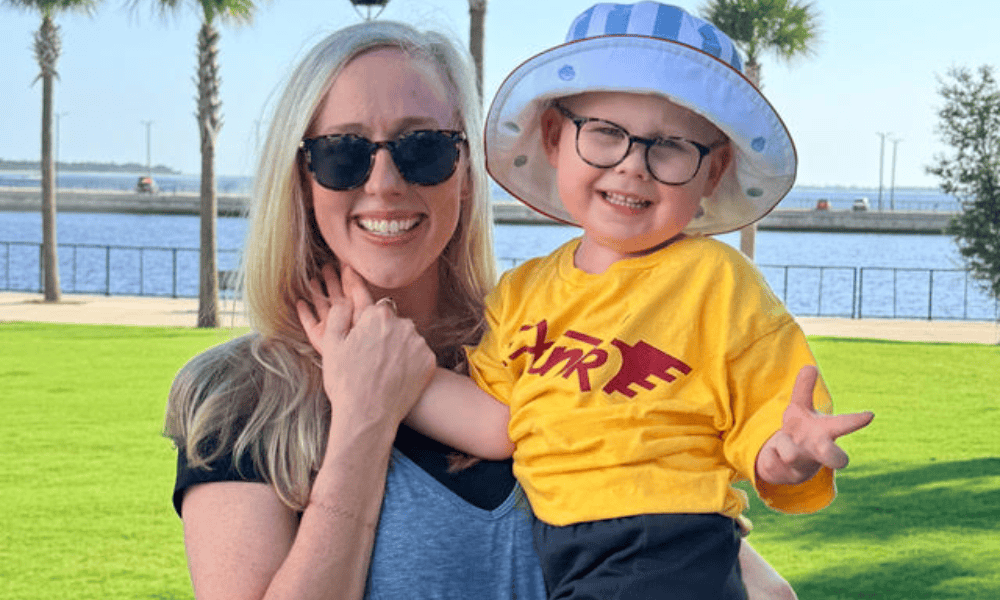
When Peachtree City mom Shelby Kennedy learned that her 4-year-old son, Felix, had an extremely rare genetic disease that could eventually rob him of his ability to walk and speak, she began searching for answers.
What she discovered was that fewer than 40 cases of his particular disease had been documented worldwide, there was no approved treatment or cure, and promising research was underway at a Massachusetts medical school with very little funding.
So Kennedy started a nonprofit called Mighty Mito, determined to raise the millions of dollars needed to move that research forward.
And while her son is the reason she began, she hopes the organization will eventually help families facing other ultra-rare mitochondrial diseases.
A diagnosis that changed everything
Felix was about 2 years old when a series of health problems began complicating his childhood. His older sister, Violet, had started kindergarten at Oak Grove Elementary, and the illnesses she brought home seemed to hit her little brother especially hard.
Repeated ear infections led to surgery to place tubes in his ears. Then Felix broke one leg and spent a month in a full-leg cast. Several months later, he broke his other leg in a fall.
Kennedy noticed that his walking was becoming increasingly unsteady. He was falling frequently, sometimes losing his balance from something as simple as a sneeze. He also began having difficulty swallowing and speaking clearly.
Initially, there were reasonable explanations for his symptoms. His balance problems might have been related to the ear infections, and his unusual gait could have resulted from spending time in casts.
But Kennedy continued looking for answers.
A physical therapist recognized that Felix’s symptoms could indicate something more serious and recommended a neurological evaluation.
Genetic testing eventually provided the answer in June: Felix had COX20-related mitochondrial complex IV deficiency.
Mitochondria are responsible for producing much of the energy that cells need to function. In people with mitochondrial disease, that process does not work properly.
Felix’s particular condition affects his neuromuscular system, creating problems with movement, balance, coordination, and potentially speech and swallowing.
It is also progressive, meaning that skills he has today could deteriorate as he grows older.
Kennedy has connected with families whose older children have the same diagnosis. Some of those children now use wheelchairs or communicate through electronic devices.
“My son Felix is just a normal four-year-old boy,” Kennedy said. “He’s wobbly, right? But he’s amazingly intelligent. He’s articulate. He has an insane vocabulary. His sentence structure is beyond his years, right? And so, the idea of him losing skills that he has and being trapped in his own body is terrifying.”
Working to preserve the skills he has
For now, Felix attends therapy four days a week, including physical, occupational, and speech therapy.
Kennedy said the work has helped him regain some skills and maintain others.
The family has also scheduled an intensive two-week physical therapy program in Texas for next summer.
But therapy is expensive, and the family faces the possibility of years of increasingly specialized care.
Kennedy is a stay-at-home mother, while her husband works remotely as a software engineer and provides the family’s health insurance.
“We don’t have the luxury of not doing these things,” Kennedy said. “I would rather go so deeply into debt than say sorry. I can’t take you to this therapy that could keep you walking.”
A promising discovery in Massachusetts
After Felix’s diagnosis, Kennedy began contacting researchers, scientists, and organizations working on mitochondrial diseases.
Her search eventually led her to UMass Chan Medical School, where researchers Dr. Gao and Dr. Gessler were already investigating COX20-related disease.
According to Kennedy, their research began after a physician in China, whose daughter has the same condition, approached Gao about developing a treatment. The physician helped provide a mouse model that allowed researchers to begin preclinical studies.
The researchers are now testing an experimental gene therapy in mice.
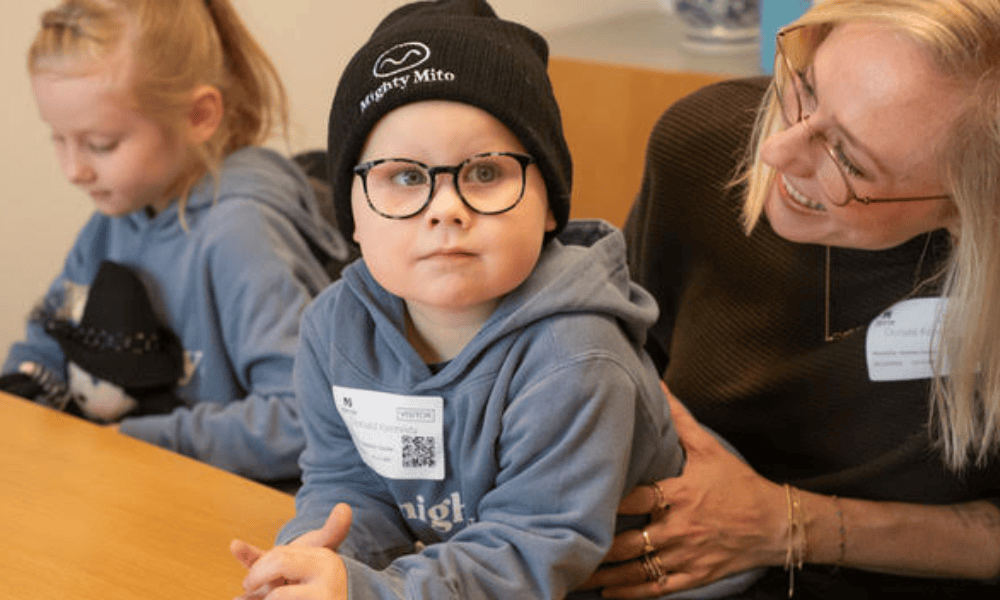
Kennedy said her family recently traveled to Massachusetts to meet the research team and learn about its progress.
During the visit, the scientists showed the family videos and data from experiments in which treated mice demonstrated improvements in movement.
The findings have not yet established that the treatment is safe or effective in humans. Researchers still need to determine appropriate dosing, delivery methods, and safety before human clinical trials could begin.
But for Kennedy, the existence of a research program focused on Felix’s specific disease offers a path forward.
The challenge is funding.
According to Kennedy, the UMass research team estimates it will take approximately $10 million to move the experimental gene therapy through the remaining development process, including additional preclinical studies, safety testing, manufacturing, and eventual human clinical trials.
The nonprofit’s first goal is to raise $250,000 to keep the current research moving. Kennedy said additional funding could allow the laboratory to hire more researchers and expand its testing.
Kennedy is also working toward a sponsored research agreement between Mighty Mito and UMass Chan Medical School to support the project.
Building Mighty Mito
Kennedy established Mighty Mito within months of receiving Felix’s diagnosis.
She has assembled a board, launched a website, begun fundraising, and applied for federal 501(c)(3) nonprofit recognition. That application was pending at the time of the interview.
In addition to the UMass project, the organization is pursuing a separate $75,000 research project to investigate whether existing medications or supplements might help people with COX20-related mitochondrial disease.
That research would screen potential drug candidates, looking for substances that might improve mitochondrial function and identifying others that could interfere with it.
Kennedy hopes the findings could eventually provide treatment options while the more complicated gene therapy research continues.
The nonprofit’s broader mission is to accelerate research and treatment development for ultra-rare mitochondrial diseases, beginning with COX20.
“Our mission is to accelerate treatment and research for ultra rare mitochondrial disease,” Kennedy said.
Her long-term vision extends beyond her own family.
“I’m not stopping when my son is taken care of, and when other kids like him are taken care of,” Kennedy said.
A Peachtree City family asking its community for help
Kennedy moved to Peachtree City when she was 2 years old and attended Peachtree City Elementary School and McIntosh High School. After living elsewhere for a time, she returned to raise her family near her parents.
She has a degree in early childhood education and previously worked in recruiting and property management.
Although she has no scientific training, she has spent the months since Felix’s diagnosis learning about genetic research, nonprofit operations, and the challenges of developing treatments for diseases affecting very small patient populations.
The family has already connected with other families around the world, including one in Argentina whose 13-year-old son received the same diagnosis after years of unexplained symptoms.
Kennedy said that family had not previously known anyone else dealing with the condition.
Mighty Mito has begun raising money through community fundraisers, individual donations, and merchandise sales. Its website offers sweatshirts, hats, and other items, with proceeds after production costs supporting the organization’s work.
The nonprofit is seeking larger individual and corporate donors to help it reach its research goals.
Kennedy believes the local community can play an important role in helping families affected by a disease that is so rare it receives little research funding.
“My son needs me. Other people need me. No one else is going to do it for us. How could I not?” Kennedy said.
How to help Mighty Mito
Residents interested in supporting Mighty Mito can visit mightymito.org to make a donation, purchase merchandise, or learn more about the organization’s mission.
The nonprofit’s immediate goal is to raise $250,000 for the UMass research program, the first step toward an estimated $10 million needed to advance the experimental gene therapy. The organization is also seeking funding for the separate $75,000 drug-screening project.
For Kennedy, the work began with the determination to protect her son’s future. She hopes it will eventually create treatment possibilities for families around the world who are facing the same diagnosis.


Leave a Comment
You must be logged in to post a comment.