


 12667
12667 0
0
When Heather and Chris Mizell bought their Newnan-area home in May 2022, they believed they had found a place where they could raise their three sons and build a more secure future.
Today, the home is condemned. The family is living in a rental, much of its property is gone, and the mortgage company is considering whether to accept the deed rather than proceed with foreclosure.
The collapse of the Mizells’ dream home began with sewage.
Heather Mizell said sewage backed into the house four times after a kink developed in a sewer line connected to Coweta County’s system. She said the county ultimately repaired the problem, stopping the backups, but only after repeated inspections and disagreements over where the problem originated.
By then, the damage had spread far beyond the sewer line.
Mizell said her insurance company paid portions of three claims but refused to cover a fourth. A contractor hired to restore the home received an estimated $200,000, she said, but left much of the work unfinished or improperly completed before disappearing from the project.
The Mizells have not filed a lawsuit against the contractor, the insurance company, or Coweta County.
They are instead preparing to surrender the home that Mizell described as the product of nearly 20 years of work and sacrifice.
“We’ve lost every single thing that we’ve ever worked for,” Mizell said. “Everything we had, we worked hard for for years, and we’ve lost everything.”
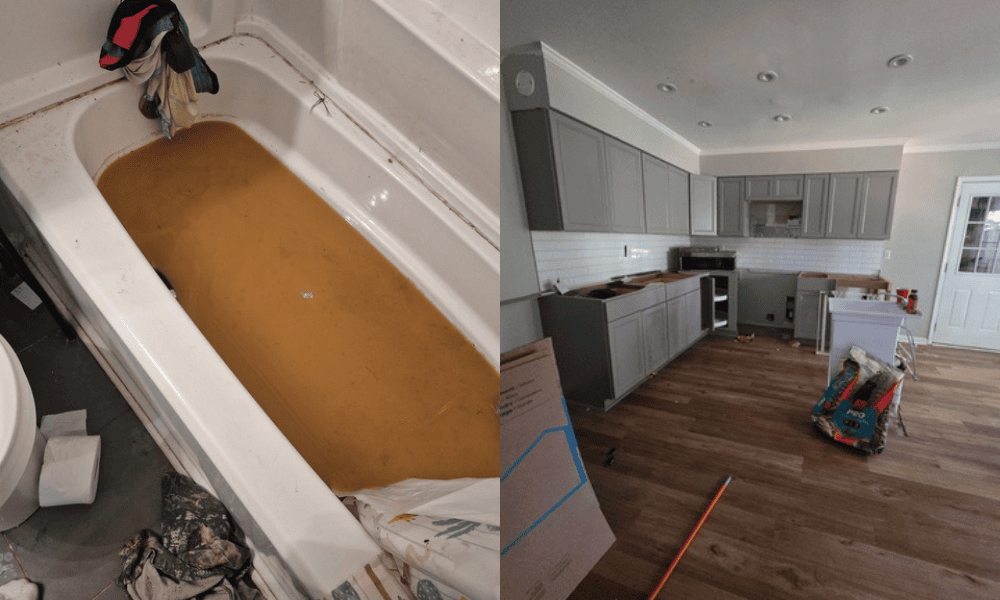
Sewage across the first floor
The first backup occurred in January 2025, Mizell said.
The family was asleep upstairs when sewage began coming from beneath a downstairs toilet. By the next morning, she said, raw sewage had covered much of the first floor and reached several feet up portions of the walls.
“The entire first floor, about at least two or three feet up the wall, was flooded in sewage, raw sewage,” Mizell said.
Mizell said the family contacted Homesite, its homeowners insurance provider, and a remediation company began removing water and damaged materials. According to Mizell, that work stopped after the remediation company said it had not been paid.
The family was left trying to navigate its first major insurance claim while still dealing with the contaminated home.
Mizell said the adjuster told her she could find a contractor to complete the reconstruction. She eventually hired Nicole McDonald of Prestige Contracting after McDonald provided licensing information and was reviewed by both the insurance company and mortgage company.
McDonald promised that a crew would complete the project quickly, Mizell said.
Instead, the rebuilding stretched from weeks into months.
Mizell said workers installed materials incorrectly, left portions unfinished, and had to redo earlier work. During that period, additional leaks occurred in two upstairs bathrooms.
The insurance company treated those incidents as separate claims, Mizell said, because they were considered breaks in the chain of events.
At that point, Mizell began asking why sewage continued to enter the home.
A kink in the line
Mizell said several plumbers inspected the system with cameras and concluded that the backups originated from a kink near the county sewer connection.
She said Coweta County Water Authority employees initially told her the problem was not on the county’s side. After another plumber reached the same conclusion, she contacted the county again.
Mizell said a water authority official then came to the property while her plumber was present and acknowledged the kink.
Before the line was repaired, sewage entered the house a fourth time, she said, this time rising through an open kitchen drain during reconstruction.
“It was like the fountain of youth of poop in the kitchen,” Mizell said. “We were living in the house at this time, so it was a nightmare.”
Mizell said the backups stopped after the county repaired the line.
The house, however, had already sustained repeated contamination, and much of the reconstruction would have to be torn out again.
Heather Mizell is disabled and unable to work. Her husband, Chris Mizell, is a medically discharged Marine Corps veteran who is also disabled. One of their three sons has disabilities.
Mizell said family members developed upper respiratory infections while living around the sewage. She also said her service dog developed an upper respiratory infection and died.
“We didn’t have a hotel,” she said. “We didn’t have anywhere for us to go. We didn’t have anybody coming in and doing mitigation. We didn’t have anything, so we’re just sitting here living among sewage.”
Insurance money and unfinished work
Mizell said the insurance company ultimately issued $115,000 in checks for portions of the repair work and instructed her to sign the checks over to McDonald.
By that time, she said, McDonald had already received other payments connected with the project.
Mizell estimates that McDonald received approximately $200,000 in total.
The work completed included portions of the flooring, drywall, and cabinets, Mizell said. Much of it was later damaged by the fourth sewage backup or would need to be removed.
According to Mizell, McDonald eventually sent her a message saying the money had been spent and that she would need to take other jobs to earn enough to finish the Mizells’ home.
“She said, ‘I’m sorry, I’ve spent all the money. I don’t have any more money. I’ve got to take on some more jobs, so I can get money to finish your job,’” Mizell said.
McDonald then stopped coming to the home and stopped responding, Mizell said.
Mizell later learned that Newnan Police had obtained arrest warrants against McDonald in a separate contracting case. The listed charges included first-degree forgery, conversion of payments for real property improvements, and felony theft by deception.
McDonald has not been convicted of those charges, and an arrest warrant is not proof of guilt.
Mizell said she does not expect to recover money from McDonald. Her priority is now criminal accountability.
“I would just like to see her in jail,” Mizell said.
Mizell also said Homesite refused to pay the fourth claim because McDonald had not submitted required scopes of work for earlier claims.
According to Mizell, the insurer later told her that she had selected the contractor and was responsible for the outcome.
“They said, ‘Well, you hired her. That’s who you chose to go with, so you’re stuck with it,’” Mizell said.
Homesite later dropped the family’s coverage, she said.
The family moved into a rental and began paying rent while still responsible for the mortgage on the damaged home.
A condemned home and a foreclosure threat
Coweta County Code Enforcement eventually posted notices declaring the property unsafe to occupy, Mizell said.
She said exposed electrical components, sewage contamination, and incomplete reconstruction made the home unlivable.
The family’s three sons, now ages 6, 15, and 17, had to change schools after the move.
“My kids are so resilient,” Mizell said. “They just go with the flow. They’re like, ‘All right, Mom, let’s go on to the next adventure.’”
After the family could no longer afford both rent and mortgage payments, the mortgage company temporarily paused the loan, Mizell said. It later began foreclosure proceedings.
The Mizells asked the lender to consider a deed in lieu of foreclosure, which would allow them to turn over the property voluntarily.
The foreclosure was placed on hold while the lender assessed the home, Mizell said.
The family has contacted attorneys but has not found one willing to pursue the case.
“We don’t want to run from the house, but what else are we going to do?” Mizell said. “We don’t have $200,000.”
Sheriff’s Office considered dispute civil
Mizell went to the Coweta County Sheriff’s Office seeking criminal charges against McDonald.
She said she brought information showing the amount paid, the incomplete work, and the message in which McDonald said the money was gone.
Mizell recalled being told that because the payments originated from insurance proceeds, the insurance company would have to pursue the matter.
The Sheriff’s Office gave a somewhat different account.
Coweta County Sheriff’s Office Public Information Officer and Deputy Sheriff Jacob Herbert said an investigator spoke with Mizell and contacted the Coweta Judicial Circuit District Attorney’s Office for guidance.
Herbert said the investigator was advised that when a contractor begins work, a dispute over whether the work was worth the amount paid is generally handled as a civil matter.
“We can’t determine what the value is of the work that was done,” Herbert said. “It has to be left up to a judge.”
Herbert said Mizell was told that a criminal report could be completed, but that the district attorney’s office was unlikely to prosecute under those circumstances.
According to Herbert, Mizell said she would pursue the matter in civil court and left without filing a report.
Mizell disputes the suggestion that she voluntarily declined a meaningful criminal avenue. She said she understood that law enforcement would not pursue the case.
Herbert acknowledged that, based on the information described to him, the amount of work appeared substantially less than the amount paid.
“It is unfortunate,” he said. “From what you’re telling me, it sounds like the money that was paid is nowhere near the amount of work that was done.”
Still, Herbert said a judge would need to determine the value of the work before law enforcement could distinguish a contractual dispute from a theft.
He also said the Sheriff’s Office did not have the complete details of McDonald’s separate Newnan case.
Criminal intent would need to be proved
Coweta Judicial Circuit District Attorney Herb Cranford confirmed that Newnan Police had obtained arrest warrants for McDonald.
Cranford said his office had not yet received the Newnan Police investigative file and had not made a decision about prosecution.
He also clarified that neither he nor his chief assistant had reviewed evidence from Mizell’s case when they spoke with the Coweta County Sheriff’s Office investigator.
“I don’t recall being told in that conversation the name of anyone involved and we did not review any evidence,” Cranford wrote in an email to The Citizen.
Cranford said Georgia law generally treats poor or incomplete construction performance as a civil matter after work has begun.
“Once a construction job is started, subsequent performance or failure to complete performance is generally a civil matter,” Cranford wrote.
For the conduct to become criminal, he said, prosecutors would have to prove beyond a reasonable doubt that the contractor possessed criminal intent.
“The primary issue is the necessity that the State (ie the DAs Office) prove beyond a reasonable doubt the Defendant’s criminal intent, as opposed to the evidence showing that they’re a bad business person or unwise with their money,” Cranford wrote.
Cranford said his office would evaluate the Newnan case after receiving the full investigative file. He declined to predict what decision prosecutors would make.
“As long as either of these matters are open, I can’t comment about them beyond what I’ve said above,” he wrote.
A home they may never enter again
For now, the sewer line has been repaired, but the Mizells’ home remains condemned.
Mizell said the structure could theoretically be rebuilt, but the family no longer has the insurance money needed to do it.
Their personal property, credit, home equity, and sense of stability have all been damaged, she said.
The family is continuing to rent a home in Coweta County while waiting for the mortgage company’s decision.
Mizell said she no longer expects to recover what the family put into the house. She wants the public to understand how a sewer problem, an insurance dispute, and an unfinished construction project combined to destroy a home that had represented her family’s life savings.
“This is just a speed bump,” Mizell said. “I mean, it’s more of a canyon, but we’re gonna make it through, and everybody’s alive.”


Leave a Comment
You must be logged in to post a comment.