


 3293
3293 0
0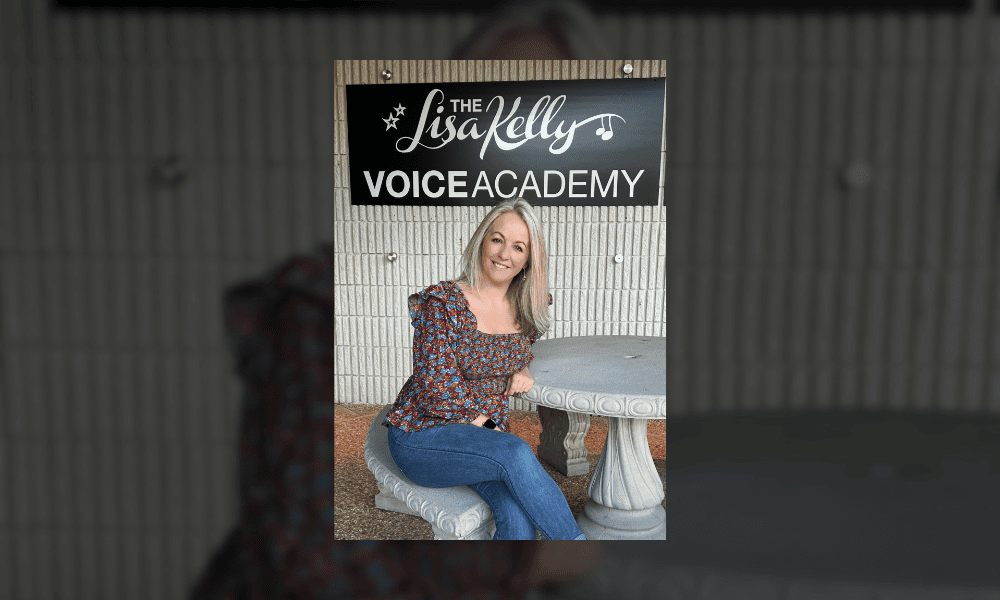
I came home from my voice lesson with Lisa Kelly and told my husband it was the most fun I had experienced in a long time.
That is not faint praise. I have taken a lot of voice lessons.
I studied voice for four years in high school, headed to college on a voice scholarship, and continued studying for four more years. I sang musical theater, performed with church praise teams, and once helped lead worship alongside my husband.
But almost all my formal training was classical. I was taught to open my throat, create space, sustain every vowel, and sing with the placement and precision required for opera.
No one had ever taught me how to sing pop.
In approximately 40 minutes at The Lisa Kelly Voice Academy in Peachtree City, Kelly began undoing eight years of training — without taking away any of it.
She made my voice stronger. She helped me stop oversinging. She taught me how to move a sound forward, reduce the space in my throat, and give up the idea that every word deserved to be sung properly.
Pop singing, I learned, involves a certain amount of cheating.
That may be the most liberating voice lesson I have ever received.
From Celtic Woman to Peachtree City
Grammy-nominated Kelly is best known internationally as one of the founding members of Celtic Woman. Before that, she was the lead singer in Riverdance. Altogether, she spent about 11 years performing with the two touring productions, after earlier work in musical theater and concerts in Ireland.
She grew up with classical and operatic training herself. One less conventional teacher later introduced her to greater vocal freedom.
“She was like, ‘You don’t have to sound like that. You can do this, and you can do that,’” Kelly said. “That was the first time I’d had a teacher that actually said those things.”
The formal training gave Kelly discipline and technique. The other teacher gave her permission to experiment with riffs, runs, and a sound that felt more personal — skills that proved useful when she joined Celtic Woman.
After Kelly and her husband, Scott Porter, left the touring world, they needed to choose a place to live. Kelly is Irish. Porter is Australian. Ireland was too cold for him, and Australia was not where she wanted to settle.
Kelly searched online for some of the best places to live, and Peachtree City repeatedly appeared.
The family moved here in 2013, with Kelly arriving sight unseen.
Opening a voice academy was not initially part of the plan. Kelly had taught before her touring career, however, and teaching ran in her family. Her parents and sisters were teachers, and she had always felt drawn toward it.
After the birth of her youngest son, Kelly began looking for a path back to work. She found a large space near The Fresh Market and realized that private lessons alone would not fill it. She began developing group programs, camps, and other opportunities for singers.
“I knew within a couple of weeks of what I was doing that this is the road that was meant for me,” Kelly said. “Hand on my heart, I enjoy this more than I’ve enjoyed anything else I’ve ever done. I love it so much.”
The academy has since moved to a studio near Home Plate on Ga. Highway 74, where Kelly shares space with the Kavanagh Porter Irish Dance Academy.
Eight years of training meets Adele
Before my lesson, Kelly asked me to choose a song that was outside my usual style — something I wanted to conquer.
I told her I liked Adele and wanted to improve my vocal agility. Kelly assigned me “All I Ask,” giving me about a week to practice before our session.
Like any good voice teacher, she started with warmups.
Hers were not easy.
We worked through scales and vowel combinations, bringing the sound toward the front of my mouth. Kelly asked for a wide, almost exaggerated smile and told me to imagine holding the sound in place as though I were chewing the inside of my cheeks.
Then she taught me to engage my pelvic floor.
Opera training had taught me to think about breath support and the diaphragm. Kelly showed me how tightening lower muscles could provide greater control and strength without simply becoming louder.
“It’s the accelerator for the car,” she said.
The difference was immediate. I was not pushing more sound out of my throat. I was giving the sound a stronger foundation.
After one exercise, Kelly pointed out that I had finished on a high D with far greater support than I had used on a lower note moments earlier.
“It’s just support,” she said.
Then came Adele.
I sang through “All I Ask” once while Kelly listened. When I finished, she diagnosed the problem quickly.
I sang too much.
Because I had been trained classically, I gave every word and vowel its full measure. Pop and contemporary musical theater use more words, more conversational phrasing, and a different kind of emotional delivery. Singers do not sustain and shape every syllable as they might in classical music.
“You talk-sing for the most part,” Kelly explained.
She asked me to approach the opening lines as though I were speaking seriously to my children. She told me to make some words smaller so the important words would stand out. She taught me to keep the sound toward the front of my mouth and to focus on consonants instead of widening every vowel.
“The consonants are key,” Kelly said. “It’s the exact opposite of singing your classical stuff.”
My mouth needed to be smaller. My throat needed less space. Some words could nearly disappear into the phrase.
In other words, I needed to forget nearly everything I had once been praised for doing.
And it worked.
After one verse, the song already sounded more natural. I caught myself falling back into classical placement, corrected it, and continued.
“That was really good,” Kelly said. “You caught yourself, because you started off classical.”
By the end of the lesson, I had not transformed into Adele. But I understood what I had been doing wrong for decades. More importantly, I knew how to begin correcting it.
Kelly asked me to keep practicing and send her a recording so she could tell me what still needed work.
“This is going to be your new karaoke song,” she said.
She is probably right.
Lessons for almost anyone
Kelly teaches students at nearly every stage of life. Some begin as young as 5. Others start after retirement, having never taken a lesson before. She teaches in-person students in Peachtree City and approximately 20 online students around the world.
Some students hope to work professionally. Others simply enjoy singing.
One adult student began lessons after a stroke left him unable to play golf. His wife enrolled him in singing, and he now comes each week with a friend.
“He just has the time of his life for 40 minutes a week,” Kelly said.
Kelly believes almost everyone can learn to sing. She has encountered only a few students during her teaching career whom she believed were physically unable to do so.
For most people, singing is a matter of learning to hear, listen, repeat, and develop the confidence to match pitch.
“Does that mean everybody’s a good singer? No,” Kelly said. “But everybody can sing.”
Her students tend to stay. Some remain at the academy for five or six years, leaving only when they graduate and move away. Kelly also holds two intensive children’s camps each summer, which regularly fill without significant advertising.
The work is disciplined, but Kelly is approachable, funny, direct, and relentlessly encouraging.
That combination was evident when 11-year-old student Olivia Hart arrived near the end of my lesson.
Olivia has studied with Kelly for about a year.
“The teacher, Miss Kelly, is really fun,” Olivia said.
When asked what had changed since beginning lessons, Olivia did not hesitate.
“I’m much stronger, and my vibrato is getting better,” she said.
A local legacy
Kelly’s impact can also be seen in former students such as Sophia Wootten, the Peachtree City native recently crowned Miss Georgia. We told her inspiring story last week.
Wootten, who was born with a complex cleft lip and palate, became friends with Kelly’s son when they attended elementary school together. She joined one of Kelly’s summer camps and remained connected to the academy for approximately 10 years.
Kelly said singing required Wootten to use her mouth in a deliberate way, carefully articulating words and sounds. Wootten has credited voice lessons with helping her speech as well as her confidence.
Kelly remembers her as a naturally expressive performer whose resilience was apparent even as a child.
“She was just a child that you knew was going to take on the world, and take it on with kindness and resilience,” Kelly said.
Kelly has also taught students who later pursued music degrees and professional careers. But she does not define success only by who makes a living onstage.
Many of her students may never perform professionally. They return because singing gives them confidence, connection, and joy.
Kelly believes that if someone can stand in front of other people and sing, that person can probably do almost anything. Singing is personal and vulnerable. Everyone with ears believes they are entitled to an opinion about it.
That vulnerability is part of why many people who would happily take a cooking, painting, or dance class hesitate to book a voice lesson.
But Kelly’s studio is not only for polished singers or children bound for Broadway. It is for the retiree trying something new, the child developing confidence, the adult recovering after a stroke, and the shower singer who would simply like to sound better.
An accessible investment in joy
Kelly charges $75 for a 40-minute private lesson. Group classes are generally $30 per person, with some smaller groups priced at $40.
She said she has never raised the price of her private lessons, even as her own business expenses increased. Support from Celtic Woman fans has also helped fund scholarships for children who otherwise might not be able to participate.
For the level of instruction Kelly offers, $75 feels almost absurdly accessible.
This is a teacher who spent more than a decade performing professionally in two internationally recognized productions. She knows what a voice and body must do night after night onstage. Just as importantly, she knows how to explain those techniques to another person in a way that immediately makes sense.
She did not make me louder. She made me stronger.
She did not erase my classical training. She showed me when to use it and when to get out of its way.
I will still be able to sing opera. But when I would rather sing Adele, this is what I needed.
I fully intend to take more lessons. My cruise ship karaoke performances will be better for it, but that is not the only reason.
I left Kelly’s studio energized, encouraged, and delighted. Singing makes me happy. Learning to do it better made me happier.
For every shower singer, cruise ship karaoke regular, church vocalist, musical theater hopeful, or person singing along with Spotify in the car, that happiness may be available in Peachtree City for $75.
It might be the best bargain in town.
Lessons can be booked with Lisa Kelly through The Lisa Kelly Voice Academy’s social media pages.


Leave a Comment
You must be logged in to post a comment.