


 8208
8208 11
11
Last Tuesday, more Fayette County voters pulled Democratic primary ballots than Republican ones.
That sentence would have been unthinkable in the past. In 1982, Fayette was one of only five counties in the entire state of Georgia to vote Republican for governor. In 2012, Mitt Romney took 65% of the Fayette vote against Barack Obama.
Yet last Tuesday, with all 35 precincts reporting through the Georgia Secretary of State’s election results portal, the crowded Republican U.S. Senate primary drew 15,975 votes in Fayette. The uncontested Democratic primary, with only Senator Jon Ossoff on the ballot, drew 16,742.
Usually, contested primaries draw higher turnout. The fact that Democrats outvoted Republicans while having nothing at the top of the ticket to fight over shows immense enthusiasm in our area. And these numbers are not an anomaly. For governor, the Republican primary had 16,373 Fayette voters. The Democratic primary had 17,176.
This is what a county in transition looks like.
The Fourteen-Year Arc
The 2026 primary is not an isolated data point. It is the latest entry on a fourteen-year line that has bent steadily in one direction.
The Republican margin in Fayette has compressed by 28 percentage points in twelve years. Every cycle bends leftward, and the bending has not stopped.
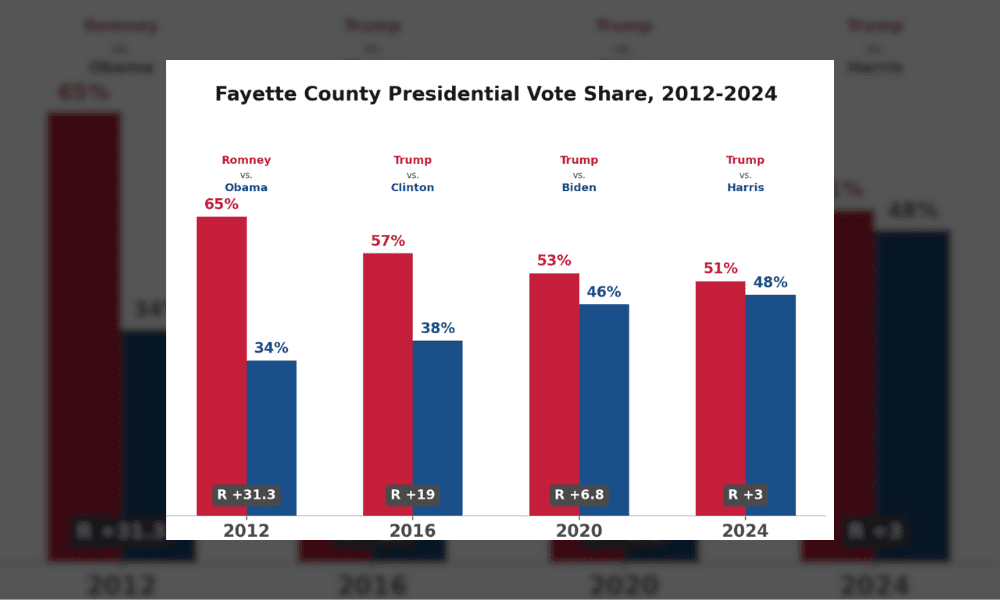
The 2024 result is the most striking. Donald Trump improved his margin nationally and won Georgia by approximately 2 points. He performed worse in Fayette County than he had in 2020. According to USA Today’s review of all 159 Georgia counties, only 24 counties in the entire state shifted Democratic in 2024 while the nation shifted Republican. Fayette was one of them.
The historical context matters. Kamala Harris’s 3.1-point loss in Fayette was the closest a Democratic presidential candidate has come to winning the county since Jimmy Carter, a Georgia native, carried it in 1976.
The trend was already visible to political observers outside Fayette.
The week before the 2024 election, the Atlanta Journal-Constitution’s chief political reporter Greg Bluestein identified Fayette as an up-and-coming bellwether and quoted Republican consultant Brian Robinson describing the county’s increasingly diverse population and college-educated White voters as a challenge for the GOP. Also on election night 2024, NBC News political correspondent Steve Kornacki named Fayette County as the bellwether for the future of the Atlanta suburban vote.
Two Cities, Two Different Futures
The structural explanation for what is happening in Fayette is not a mystery. It is visible in U.S. Census data compiled by the Atlanta Regional Commission.
In 2010, Fayette County was 69.6% non-Hispanic White. By 2023, that figure had dropped to 56.9%. The non-Hispanic Black share of the county’s population grew from 18.9% to 25.2% over the same period.
But the more revealing data lives at the city level.
Peachtree City, the largest city in Fayette by population at approximately 40,000 residents, is 68.8% White, 10.2% Black, and 8.5% Asian. The median household income is $113,987.
Fayetteville, the county seat at approximately 20,000 residents, is 38.2% White, 39.1% Black, and 5.5% Asian. The Black share of Fayetteville’s population now exceeds the White share. The median household income is approximately $82,000.
Within the same county, two neighboring cities now have demographic profiles that look like two different states.
This split shapes everything else. Peachtree City’s voter base skews older and wealthier, and it has remained reliably Republican in local races. Fayetteville’s voter base skews younger and more diverse, including a growing professional class of metro Atlanta transplants whose national counterparts have moved sharply away from the Republican Party over the past decade.
Educational attainment is the second structural factor. According to Data USA, citing Census Bureau data, the share of Fayette residents holding bachelor’s degrees or higher rose from 19.8% in 2014 to 24.25% in 2022. In Peachtree City alone, 57.55% of adults hold a bachelor’s degree or higher. National polling has consistently shown college-educated suburban voters moving away from the Republican Party during the Trump era. After the 2024 election, Augusta University social sciences chair William Hatcher told Newsweek that Fayette and other metro Atlanta counties shifted left as college-educated voters broke for Harris.
The data is telling the same story from every angle. Fayette County is younger than it was, less White than it was, better educated than it was, and increasingly populated by people whose political habits do not match those of the county that voted for Romney by 31 points.
What Already Happened Next Door
The trajectory unfolding in Fayette is not isolated. Three other Atlanta suburban counties have already completed it.
In 2012, Romney won Cobb County by 12.6 percentage points. He won Gwinnett County by 9 points and also carried Henry County. All three were considered safely Republican parts of the metro Atlanta map.
In 2024, all three voted Democratic for president. According to USA Today’s compilation of the 2024 Georgia county results, Henry County shifted the furthest with Harris winning it by 29.7 points, the largest Democratic margin in that county since Jimmy Carter in 1976. Newsweek’s analysis of the metro Atlanta vote shows Cobb voting Democratic by approximately 14 points and Gwinnett voting Democratic by approximately 16 points.
Cobb. Gwinnett. Henry. Three counties that were reliably Republican when Romney faced Obama and that now vote Democratic in presidential elections by double-digit margins. And all three experienced demographic diversification, college-educated population growth, and migration that Fayette is experiencing now.
Where This Goes
If the fourteen-year trajectory holds, Fayette County may vote for a Democratic presidential candidate before the end of this decade.
The Republican presidential margin has shrunk by approximately 28 percentage points in twelve years, an average of roughly 2.3 points per cycle. Apply that rate forward, and the 2028 election would put Fayette within a hair of flipping. The 2032 election would definitely do it.
Down-ballot, the implications are already arriving. In the Fayette portion of Georgia’s 6th Congressional District, Democratic Representative Lucy McBath defeated Republican challenger Jeff Criswell by 70.4% to 29.6% in 2024. In the Fayette portion of Georgia’s 3rd Congressional District, where Republican Brian Jack won districtwide by 32 points, the Fayette margin compressed to 14 points.
The 2026 general election in November will provide the next major data point. The winner of the Republican U.S. Senate runoff between Mike Collins and Derek Dooley will face Senator Jon Ossoff. The winner of the Republican gubernatorial runoff between Burt Jones and Rick Jackson will face former Atlanta Mayor Keisha Lance Bottoms. Local races for school board, county commission, and the state legislature will fill in the picture at the precinct level.
What Both Parties Could Do
If the Fayette County Republican Party is not nervous, it is not paying attention. The party’s base of older White voters in Peachtree City is not getting any younger. The county’s population growth is concentrated in demographics that have voted Democratic in every recent presidential election. The party’s nominees for local office still win Fayette but by margins that have shrunk in nearly every contested cycle since 2016. A strategy that depends on turning out Peachtree City at maximum capacity while ceding Fayetteville and Tyrone is, mathematically, a strategy on a clock.
For the Fayette County Democratic Party, the numbers suggest that the long-running narrative of Fayette as a hopelessly Republican county no longer matches reality. The party fielded candidates in nearly every contested Fayette race in 2024 and lost most of them, but several came within striking distance. Sustained investment in voter contact in Fayetteville and Tyrone, candidate recruitment, and county-level infrastructure could plausibly produce the first county-wide Democratic win in a partisan office in a generation.
Neither party controls the demographic forces reshaping this county. But both will be measured by whether they read the data and act, or read the data and look away.
The clock is ticking.



Leave a Comment
You must be logged in to post a comment.