


 341
341 0
0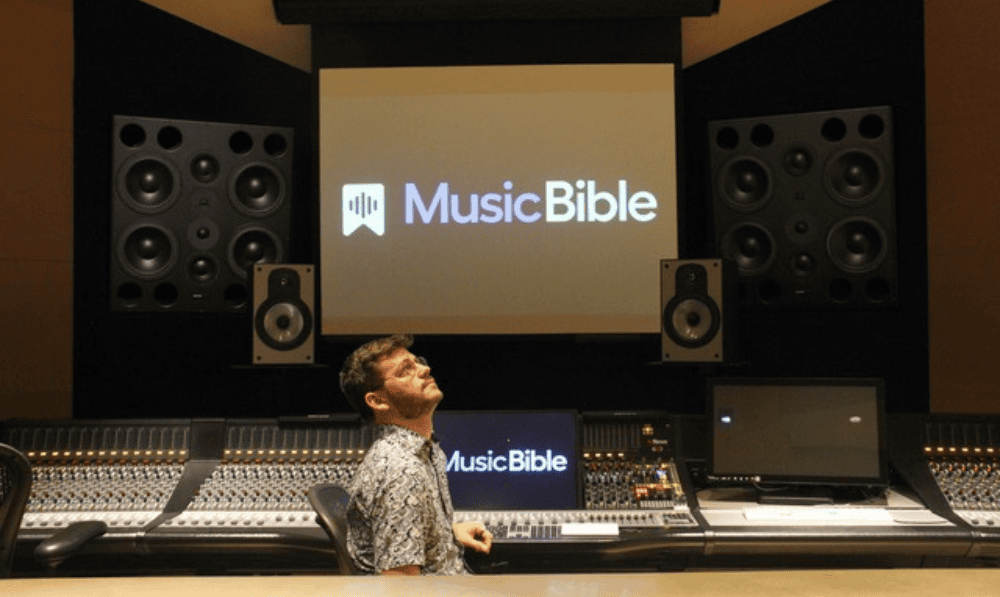
What does Psalm 23 — “The Lord is my shepherd” — sound like?
Country, apparently. Also jazz. Hip-hop. Rock. Pop. Choir.
Those are just some of the answers offered by Music Bible, an ambitious new project that has taken the words of Scripture and turned them into more than 30,000 songs — without rewriting the biblical text to make it rhyme, fit a chorus, or land neatly on a beat.
I know because before interviewing Music Bible founder and CEO Micah Fiechter, I went online and listened to all 11 English musical versions available for Psalm 23.
And here is where this story gets considerably more interesting.
Fiechter is 28. He started the project less than two years ago after his pastor father asked him to turn a passage from 1 John into a song for a sermon. Today, Fiechter leads a paid team of 72 people working across 11 countries, using artificial intelligence and human review to attempt something that would have been almost unimaginable just a few years ago: make the Bible listenable as music, from Genesis through Revelation, in the musical language a listener already loves.
“I wanted to create a resource that is the Word of God and is not an interpretation,” Fiechter said. “I wanted it to meet people where they are.”
The Music Bible app officially launched September 22 on iOS and Android. Listening to its Scripture songs is free.
It started with one sermon
Fiechter grew up as a pastor’s kid after his parents moved the family to Florida to plant a church when he was 7. He later earned a bachelor’s degree in biblical studies from Moody Bible Institute in Chicago.
Then, in December 2024, his father was preparing to preach from 1 John 4:6–10 and asked his son to help turn the passage into a song. The idea was to put the biblical text on a screen while the congregation heard those same words sung.
Fiechter made the song.
Then he sat in church and watched what happened.
“I just remember looking around to my right and my left and seeing the congregation experiencing the Word of God being sung over them while reading the text on the screen, knowing nothing had changed,” he said.
The experience left him with a much bigger question: What would happen if people could hear the entire Bible that way?
“I just feel like that was a moment for me where the Lord put on my heart, Micah, what would it be? What would it look like? What would the impact be if the church and if the world had the Word of God in its entirety sung for the very first time?” he said.
By September 30, 2025, Fiechter said his team had completed its first musical version of the New American Standard Bible.
But one musical Bible wasn’t the goal.
He wanted hip-hop.
And country.
And jazz, rock, pop, and choir.
“I want to take every musical sound that someone is used to driving to work, listening to music, and I want to give them the Word of God through the lens or through the delivery vehicle of that musical style,” Fiechter said.
The project now offers the full Bible across 11 English genres and three Spanish genres. Fiechter said work is planned in nine additional languages, with Arabic, Mandarin, Urdu, and Hindi among those coming next.
Making music fit Scripture
For generations, Christian musicians have incorporated Bible verses into songs. But lyrics are often adapted to work musically — words repeated, rearranged, shortened, or combined with original lyrics.
Fiechter sees Music Bible as the reverse of that process.
“In the last 30 years of Christian music, artists, rightfully so, have taken Scripture and had made the Scripture change to fit into music, and I think that’s the biggest key difference,” he said. “Now we’re flipping it on its head, and we’re inviting artists. We’re saying we need you to make music fit Scripture, not the other way around.”
Music Bible uses the New American Standard Bible under license. The project divides Scripture into song-sized passages, generally aiming for roughly three minutes.
A passage such as Genesis 1:1–13 can become one song.
Then artificial intelligence enters the process.
Music Bible’s production staff uses multiple AI platforms, including Suno, to create songs in particular musical styles. A production team and review team pass songs back and forth in what Fiechter describes as an assembly line.
The scale is enormous. Listening to just one genre from Genesis through Revelation would take about 160 hours, Fiechter estimates.
And AI is precisely why the project can operate at that scale.
It is also why Music Bible employs so many humans.
Where the humans come in
For a project built around the premise that the biblical text will not be altered, an AI hallucination — when an AI system generates information that isn’t actually in its source material — isn’t just a quirky technological mistake. It could change Scripture.
Fiechter said every song is reviewed by people checking it against the biblical text.
“We have a team of 72 people on staff around the world in 11 countries that are reviewing all of this content and time stamping any issues, any textual infidelity, and sending that to the production team,” he said.
AI, he said, made Music Bible possible. But he doesn’t believe it eliminates the need for people.
“There’s something about the soul of an artist or the soul of a human reviewer that I don’t think AI will ever be able to replace,” Fiechter said. “Even with using AI, we still need such a big team to go through every single song and comb through it to make sure we’re staying faithful to the Word of God because we don’t want to alter that.”
That human component becomes even more important as Music Bible moves into other languages.
Fiechter said he doesn’t want to simply tell an AI model to produce a song in another language and assume it understands the linguistic and musical nuances of the people who speak it.
“We want the teams on the ground in the countries of the languages that we’re working on,” he said.
The AI-generated catalog may eventually be only part of Music Bible.
The platform is also accepting Scripture songs created by human musicians.
“It’s creating a new lane in a way for artists because it’s word for word, verse by verse, and artists are now phonetically trying to figure out how do we sing Scripture,” Fiechter said.
Veteran Nashville music executive Michael Blanton has joined Music Bible full time as executive producer. Blanton has worked with artists including Amy Grant, Michael W. Smith, and Rich Mullins, and Fiechter said Blanton is helping oversee the quality of the music as the project expands.
A Bible that doesn’t stay on the shelf
The Music Bible app is free to download, and Fiechter said access to the Scripture songs themselves will remain free.
“We will never charge for the Bible in song,” he said. “I will never gatekeep the Bible behind a paywall.”
The company does have advertising and premium features, including the ability to save songs within the app for offline listening. Fiechter said advertisements are designed not to interrupt Scripture songs while they are playing.
For him, though, the measure of the project isn’t simply downloads.
He shared the story of a woman who contacted Music Bible to tell the team what the app had done in her home.
“The Music Bible has genuinely changed the way that I am able to bring God’s Word into our home,” Fiechter quoted her as writing. “We hear it, we sing it, remember it, and talk about it.”
But the part that mattered most to her, he said, was watching her husband grow closer to God.
“It’s the testimony of people that are experiencing the Word of God in a fresh way, in a new way for the very first time,” Fiechter said. “It’s those testimonies that make up why I’m doing what I’m doing, and that’s success.”
He said pastors have begun using Music Bible songs alongside sermons, while some small groups are using the songs to help members memorize Scripture.
That gets to the heart of Fiechter’s idea.
Music is unusually good at lodging words in the human memory. People who struggle to remember a paragraph they read yesterday can sometimes sing every word of a song they haven’t heard in 20 years.
Fiechter wants to harness that relationship between music and memory for Scripture.
“How do we creatively get people into the Word of God?” he said. “There’s so many Bibles on shelves today. How do we deliver the unedited Word of God in a way for people that it can land on their soul in a fresh way?”
How he built it
The scale of Music Bible is even more striking considering how recently it began.
Fiechter didn’t come to the project after a long career as a record executive or technology entrepreneur.
He was working full time in sales.
He said he decided to use his own money to fund the original Music Bible, building the first team and production system as economically as he could.
“I was going to self fund the entire first, the original Music Bible, which is in the app,” he said. “And I did that, and I was able to, in a very scrappy way, build a team and a process that laid the template for everything now that we have.”
After that first musical Bible was completed in September 2025, Fiechter said a longtime mentor learned about the project and became convinced of its potential. The mentor, then president of the National Christian Foundation in Chicago, left that position to join Music Bible and help lead its financial efforts.
Since then, Fiechter said, investors interested in the project’s Christian mission have helped fund its expansion.
Fiechter moved from Chicago to Nashville in January as Music Bible continued to grow.
“Sometimes when I sit back and I look at the team that I’m dealing with and the scope of what we’re doing, and I’m 28, it’s amazing to see what God can do,” he said.
An old text and a very new technology
Fiechter sees a historical symmetry in the timing.
Five hundred years ago, William Tyndale used what was then still relatively new printing technology to distribute his English translation of the New Testament. Copies of Tyndale’s printed English New Testament appeared in 1526, despite fierce opposition, and his work became profoundly influential in later English Bible translations.
Now, exactly 500 years later, Fiechter is looking at another emerging technology and asking what it might do for Bible distribution.
He describes music as another medium for experiencing Scripture alongside written text, spoken audio, and sign language.
AI makes it possible to produce that music at a scale that would previously have required an extraordinary amount of time, money, and human labor.
That doesn’t settle the much larger questions surrounding artificial intelligence, artists, creativity, copyright, or ethics. Fiechter readily acknowledges that those conversations matter.
But he wants people to hear the result before deciding what they think about this particular use of the technology.
“I want people to be curious,” Fiechter said. “I want people to be curious about their favorite verse of the Bible. What would that sound like in your favorite style of music, or what would the passage preached on Sunday sound like in a particular style of music?”
Then there is the simplest test of all.
Pick a verse you know.
Pick the kind of music you love.
And listen.
Music Bible is available on iOS and Android and at themusicbible.org.



Leave a Comment
You must be logged in to post a comment.