


 1694
1694 0
0
Dear Mark,
I’m a parent of a high school student in Fayette County, and I just saw the new U.S. News rankings for our local high schools. As we start thinking about the college admissions process, these numbers have me genuinely worried about what they mean for my child’s future.
Looking at the rankings, there’s a stark difference between our schools. McIntosh and Starr’s Mill are sitting at #1 and #2 in the county with college readiness scores of 57, math proficiency at 62%, and reading proficiency in the high 60s-70s. But then there’s a dramatic drop-off. Whitewater falls to a 40.4 college readiness score with 49% math proficiency. Sandy Creek drops even further to 28.9 college readiness with only 40% math proficiency. And Fayette County High School comes in last with a 26.8 college readiness score and just 27% math proficiency.
This is worrisome. What story do these numbers actually tell about each school? If my child attends a school where only 27% of students are considered “proficient” in math versus 62%, does that mean they’re less likely to get into college? Are colleges going to look at my child’s application and see “Fayette County High School” and automatically assume they’re not as prepared as a kid from McIntosh?
And what does “college readiness” really mean anyway? Is a score of 26.8 saying that only about a quarter of students are ready for college-level work? Because if so, that’s terrifying. But then I look at the graduation rates – they’re all pretty decent, ranging from 87-96% – so clearly kids ARE getting through high school and presumably going somewhere.
I’m also confused because I don’t actually know what test these percentages are based on. Are these the Georgia Milestones tests? SAT scores? Something else? And here’s my real concern: do students even take these tests seriously? I remember when I was in school, we had state-mandated tests that didn’t count for our grades or college applications, so frankly, a lot of us just rushed through them. If that’s what’s happening here, then maybe these rankings don’t really reflect what students CAN do, just what they DID do on one particular test they didn’t care about.
But if colleges DO look at these school-level statistics, or if these numbers actually reflect real differences in academic preparation, then I need to understand: Is my child at a disadvantage attending a lower-ranked school in our county? Will a student with a 3.5 GPA and good SAT scores from Fayette County High School be viewed differently than the same student from McIntosh?
I guess what I’m really asking is: Should these rankings change where we choose to live or which school my child attends? And more importantly, how do these school-level proficiency numbers actually translate into individual college admissibility?
Any insight would be tremendously helpful.
Sincerely, Confused and Concerned in Fayette County
Dear Confused and Concerned,
These rankings can send any parent into a spiral. I get it. You’re looking at those numbers and thinking, “Wait, did I just accidentally doom my kid’s college prospects by living in the wrong zip code?” Take a breath. Here’s the thing: these numbers tell a story, but not the whole story. And more importantly, they’re probably not telling the story you think they are.
What Are We Actually Looking At Here?
Those proficiency percentages are from Georgia Milestones End-of-Course assessments—state-mandated tests that high school students take in American Literature, Algebra I, Biology, and U.S. History. When you see “62% math proficiency,” that means 62% of students scored at the “Proficient” or “Distinguished” level on their Algebra I assessment.
The “college readiness” score? That’s U.S. News’s own formula, and here’s what really drives it: AP and IB exam participation and performance. Specifically, it measures the percentage of 12th graders who took at least one AP or IB exam and the percentage who passed with a qualifying score (3+ on AP, 4+ on IB). And here’s the kicker—U.S. News weighs passing scores three times more heavily than just taking the exam. So, a school where many students take AP tests but don’t pass them won’t score as high as a school where fewer students take them but most pass.
The formula also factors in how well students perform on those state assessments compared with what U.S. News predicts based on the school’s demographics, graduation rates, and curriculum breadth. But make no mistake, that big “college readiness” number is primarily driven by AP and IB testing, not by whether students can actually handle college-level work.
What Colleges Actually Care About
Now, the million-dollar question: Do colleges look at your school’s proficiency rates?
Short answer: Not really.
The deal is that colleges evaluate your child, not their school’s aggregate statistics. They’re looking at:
- Your child’s individual GPA
- Their course rigor (did they challenge themselves with honors, AP, or IB classes?)
- Their SAT/ACT scores
- Their essays, recommendations, and extracurriculars
- Their class rank (if the school provides it)
That said, and this is important, colleges DO understand school context. They receive a “school profile” from your child’s high school that shows information such as which AP courses are offered, average SAT scores, and where graduates typically attend college. So if Fayette County High offers 15 AP courses and your child takes 8 of them, colleges see a student who maximized their opportunities. That’s what matters.
The Real Story These Numbers Tell
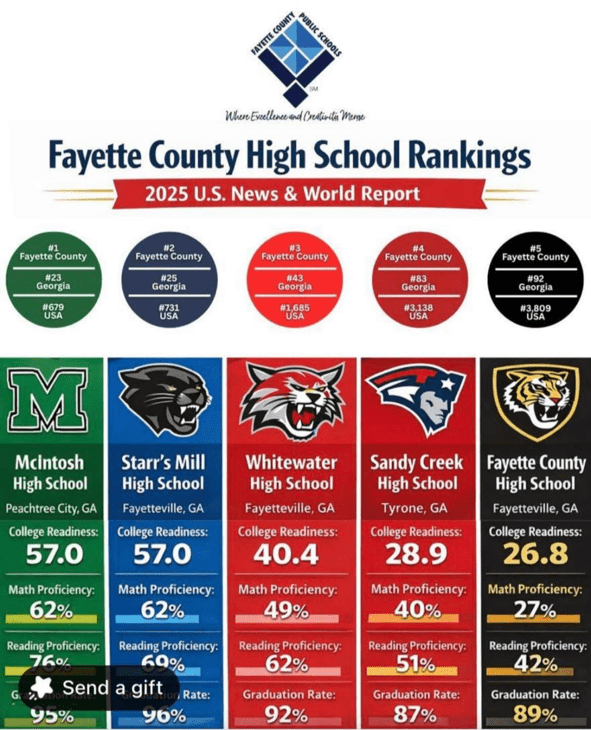
Let’s break down what you’re actually seeing:
Those top two schools (McIntosh and Starr’s Mill) likely have more affluent student populations, greater parent involvement, and a culture in which college is the assumed next step. That creates a feedback loop—engaged students, strong test scores, more AP offerings, better rankings.
The schools lower on the list might have greater economic diversity, more students working part-time, more first-generation college students, or simply different priorities. But here’s what the graduation rates tell us: 87-89% of students at the “lower-ranked” schools finish high school. They’re getting diplomas. Many are absolutely going to college.
A 26.8 “college readiness” score doesn’t mean only 26.8% of students are college-ready; it means U.S. News’s particular formula (which heavily weights AP participation and state test performance) assigned that score to the school. Plenty of students from that school will thrive in college.
Your Actionable Game Plan
Here’s what you actually need to focus on:
1. Focus on Individual Performance, Not School Averages Your child’s transcript is their story. A student with a 3.7 GPA, rigorous courses, and strong SATs from any Fayette County school will be competitive for college. Colleges know kids don’t choose their high schools; they judge students on what they did with what was available.
2. Maximize Course Rigor What AP, IB, or dual enrollment courses does your child’s school offer? A student who takes the hardest courses available at their school shows ambition. If one school offers 25 AP courses and another offers 10, colleges adjust their expectations accordingly.
3. Look Beyond the Building If your current school has limited advanced offerings, explore:
- Online AP courses through Georgia Virtual School
- Dual enrollment at local colleges
- Summer programs or independent studies
Just be sure to discuss these options with your school counselor before registering for any additional academic programming.
4. Don’t Move Based on Rankings Alone Should you uproot your family to get into the McIntosh district? Only if there are other compelling reasons. A happy, engaged student at a “lower-ranked” school will outperform a miserable, isolated student at a “top-ranked” one. School fit matters more than school rank.
The Bottom Line
Think of it this way: these rankings are like looking at a restaurant’s Yelp score. Sure, a 5-star rating suggests good food, but it doesn’t mean the 3.5-star place down the street won’t serve the best meal you’ve ever had. And more importantly, you’re not eating the average meal; you’re ordering your specific dish.
Your child’s college admissions outcome depends on their individual choices, effort, and opportunities, not their school’s aggregate test scores. A motivated student with strong grades, challenging courses, and a genuine passion will find their place in higher education, regardless of whether they attend the #1 or #5 school in Fayette County.
The question isn’t “Which school has the best numbers?” It’s “Where will my child be challenged, supported, and able to shine?” Answer that, and the college admissions will take care of themselves.
You’ve got this.
-Mark
Question Mark on College is now on YouTube! You’ve read them, now come watch as Mark dives deeper into the college admission topics that matter most to your family—with expert guests, real talk, and actionable advice. Subscribe today at Question Mark on College and be part of the conversation from day one.



Leave a Comment
You must be logged in to post a comment.